VALORANT Weapons Tier List
Compare all Valorant weapons by attack and defense win rates, combat range, headshot rate, and their best maps
October 1, 202611:11 AM5 min

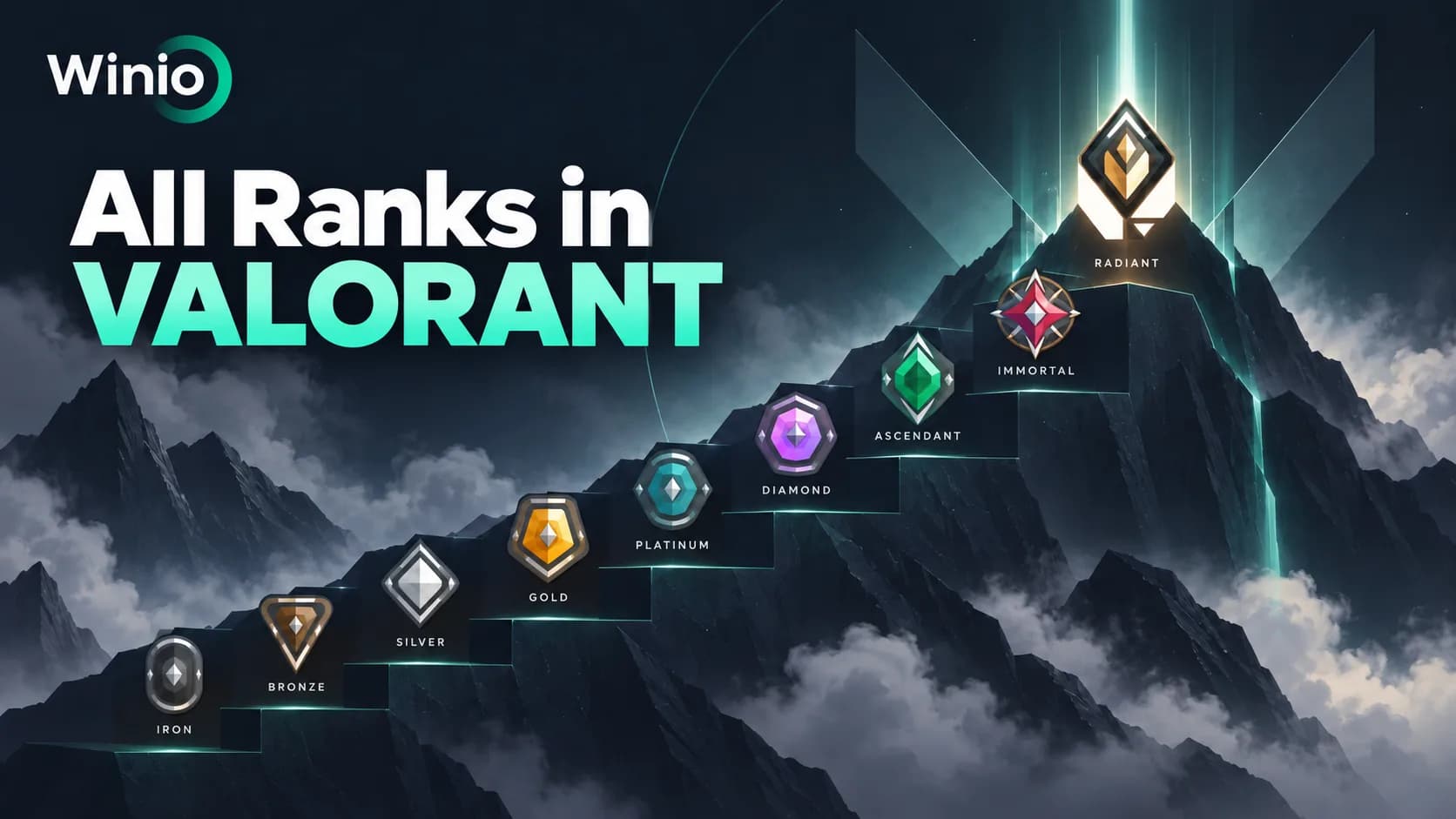
VALORANT has nine Competitive rank tiers and 25 visible rank divisions. The ladder starts at Iron 1 and ends at Radiant, with three divisions in every rank except Radiant.
The full rank order is:
The rank names are only the first part of the system. Competitive progression also uses Rank Rating, hidden MMR, placement matches, Rank Shields and separate high-rank rules for Immortal and Radiant.
| Rank tier | Divisions |
|---|---|
| Iron | Iron 1, Iron 2, Iron 3 |
| Bronze | Bronze 1, Bronze 2, Bronze 3 |
| Silver | Silver 1, Silver 2, Silver 3 |
| Gold | Gold 1, Gold 2, Gold 3 |
| Platinum | Platinum 1, Platinum 2, Platinum 3 |
| Diamond | Diamond 1, Diamond 2, Diamond 3 |
| Ascendant | Ascendant 1, Ascendant 2, Ascendant 3 |
| Immortal | Immortal 1, Immortal 2, Immortal 3 |
| Radiant | Radiant |
That gives VALORANT nine rank tiers and 25 visible divisions in total. Iron 1 is the lowest Competitive rank, while Radiant is the highest.
VALORANT now uses Season for its yearly Competitive structure. Each Season contains six Acts, with major placement checkpoints at the start of the Season and again at Mid-Season.
The standard requirement for unlocking Competitive is Account Level 20. Once eligible, players need placement matches before receiving a visible rank, and the number depends on the point of the Season.
| Competitive checkpoint | Placement matches |
|---|---|
| Season start - Act 1 | 5 |
| Act 2 | 1 for returning placed players |
| Act 3 | 1 for returning placed players |
| Mid-Season - Act 4 | 5 |
| Act 5 | 1 for returning placed players |
| Act 6 | 1 for returning placed players |
The maximum rank you can receive directly from placements is Ascendant 3. After placement, players from Iron through Ascendant begin with 50 RR in the assigned rank.
Valorant Champions 2026
Tomorrow 12:00
 Global EsportsEDward Gaming
Prediction: Global Esports
Valorant Champions 2026
Tomorrow 15:00
 T1JD Gaming
Some accounts can also be affected by account-history or regional verification requirements, so Level 20 should be treated as the standard unlock rule rather than the only possible account requirement in every case.
RR, or Rank Rating, is the visible number used to track progress through the Competitive ladder. From Iron through Ascendant, the basic progression structure is straightforward:
Rank Shields add protection at specific rank boundaries. When you enter Tier 1 of a rank through promotion or demotion, you receive two Rank Shields that can protect you from dropping through that major rank boundary.
For example, shields apply around transitions between rank tiers. They do not protect normal division drops inside the same tier, such as Silver 2 to Silver 1.
Match outcome has the strongest influence on RR changes, but round differential, individual performance and the relationship between your visible rank and hidden MMR can also affect progression. There is no single universal RR amount that every player gains for a win or loses for a defeat.
VALORANT now displays several numbers related to Competitive play, but they serve different purposes.
| System | Visible? | Main purpose |
|---|---|---|
| Rank Rating - RR | Yes | Progress through visible Competitive ranks |
| Matchmaking Rating - MMR | No | Matchmaking and rank convergence |
| Performance Score | Yes | Match performance, MVP and scoreboard position |
RR is the visible progression number attached to your Competitive rank. From Iron through Ascendant, reaching 100 RR moves you into the next rank.
MMR is hidden. It represents the matchmaking system's assessment of your skill and helps determine both the opponents you face and how the system tries to align your visible rank with that underlying rating.
The relationship works broadly like this:
This is why two players at the same visible rank do not necessarily receive identical RR changes.
Performance Score was introduced in Patch 13.06. It ranges from 0 to 500 and is used for MVP and scoreboard position in Competitive, Unrated, Swiftplay and Premier.
Performance Score is not RR and it is not MMR. It did not replace either system. Its purpose is to represent match performance, while RR remains the visible Competitive progression value and MMR remains the hidden matchmaking rating.
The system changes once you move beyond Ascendant. Reaching 100 RR in Ascendant 3 promotes you to Immortal 1. From there, progression uses regional RR thresholds rather than the standard 100 RR promotion structure used through Ascendant.
| Region | Immortal 2 | Immortal 3 | Radiant threshold |
|---|---|---|---|
| LATAM / KR | 90 RR | 150 RR | 200 RR |
| BR | 100 RR | 230 RR | 340 RR |
| NA | 90 RR | 200 RR | 450 RR |
| APC | 80 RR | 200 RR | 400 RR |
| EU | 100 RR | 200 RR | 500 RR |
Reaching the listed Radiant RR number alone is not enough. To reach Radiant, you need both:
This means a player can meet the RR requirement and still remain outside Radiant if all available leaderboard positions are occupied by players with more RR.
Radiant is also not permanent. A player can lose it by falling below the regional RR requirement or by dropping behind the lowest player currently occupying a Radiant position. To maintain leaderboard activity, players need to complete at least one Competitive match every seven days.
At Immortal and Radiant, winning and team results dominate RR progression more heavily, while individual-performance influence is reduced.
Competitive party restrictions depend on both party size and the ranks involved. For standard two-player and three-player parties, the allowed gap works like this:
| Lowest-ranked player | Highest allowed rank |
|---|---|
| Iron or Bronze | Silver |
| Silver | Gold |
| Gold | Platinum |
| Platinum or above | Maximum one tier higher |
High-rank parties have additional restrictions. Players at Immortal 1 or above can queue solo, as a duo or as a five-stack. Four-player Competitive parties are not allowed.
Five-stacks are the major exception to normal rank-disparity rules. A five-player party can include ranks that would not normally be allowed to queue together, but wider gaps and high-rank players can sharply reduce RR gains.
The amount of RR reduction depends on the ranks inside the five-stack.
| Five-stack situation | RR reduction |
|---|---|
| Ascendant 3 or below, all players within normal disparity limits | No disparity penalty |
| Ascendant 3 or below, at least one player outside normal limits | 25% |
| At least one Immortal 1-3 player | 25% |
| At least one Radiant player | 75% |
| Radiant plus at least one player below Radiant | 90% |
The practical trade-off is simple: five-stacks allow much more freedom in who can play together, but teams with large rank gaps or high-rank players may earn substantially less RR.
Act Rank and Rank Legacy both record Competitive achievements, but they describe different things.
| System | What it represents |
|---|---|
| Act Rank | Performance within an individual Act |
| Rank Legacy | Longer-term record of ranks reached during your Competitive career |
Act Rank reflects your performance within a specific Act and is based on your highest ranked win during that Act. Your Act Rank badge is separate from your current visible rank.
Rank Legacy was introduced in Patch 13.06. It tracks how many times you have reached each rank across your Competitive career.
A rank can increase its Rank Legacy counter once during each three-Act window:
Demoting into a rank does not increase its Rank Legacy counter. Act Rank therefore describes what you achieved within one Act, while Rank Legacy provides a broader record across multiple Competitive periods.
The VALORANT Competitive ladder runs from Iron 1 to Radiant, covering nine tiers and 25 visible divisions. RR controls visible rank progression, while MMR operates behind the scenes for matchmaking and rank convergence. Performance Score is a separate match-performance system.
At the top of the ladder, Immortal and Radiant use regional RR thresholds and leaderboard rules, while party restrictions also become stricter outside five-stacks.
Winio - explore VALORANT predictions and match analysis with added context around teams, form and completed results.

Global Esports
EDward Gaming
Prediction: Global Esports wins
T1
JD Gaming

G2 Esports

Team Liquid
Global Esports
EDward Gaming
Prediction: Global Esports wins
T1
JD Gaming
G2 Esports
Team Liquid
Global Esports
EDward Gaming
Prediction: Global Esports wins
T1
JD Gaming
G2 Esports
Team Liquid