


League Classic vs Modern League
League Classic changes champions, combat, runes, items and the jungle. Here are the biggest differences from modern LoL.
October 6, 202609:24 AM5 min

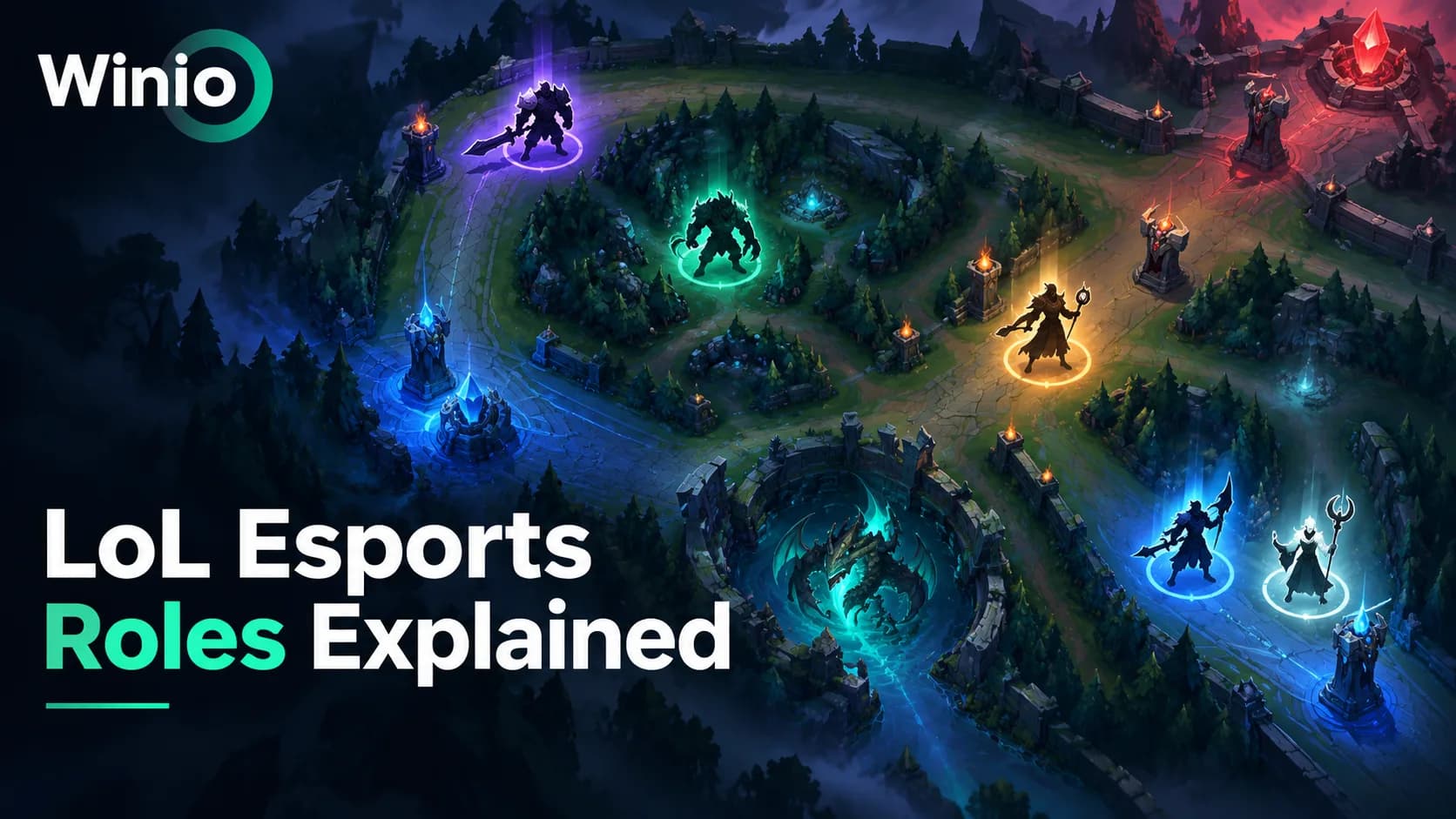
A professional League of Legends team has five players, but describing them as top, jungle, mid, ADC and support only tells you where they start the game. It does not explain what they actually do.
At the highest level, each position manages a different type of resource. Top laners often absorb isolated pressure and side lanes. Junglers control pathing and objective access. Mid laners connect different parts of the map. ADCs convert gold into sustained damage. Supports create vision and help decide where their team can safely move.
Riot's own description of modern role identity reflects this division: top is associated with level advantages, bot with item income, support with vision control, mid with broader map impact and jungle with objective control. Understanding those responsibilities makes professional games much easier to read.
Top lane is usually the most isolated position during the early game. The player spends long stretches managing a one-versus-one matchup, but the professional role becomes much more complicated once teams begin moving around the map. Riot's basic role description characterizes top laners as durable solo fighters responsible for holding their lane and dealing with powerful enemy champions. In pro play, that can translate into several very different jobs.
A top laner may be the team's primary side-lane threat. In that case, the team wants them farming away from the main group, forcing an opponent to respond. Another top laner may play a tank whose main responsibility is starting fights. A third may spend most of the game absorbing pressure on low resources so the team's carries can take more gold elsewhere. That is why looking only at a top laner's kills or damage can be misleading.
EMEA Masters
Today 19:00
 TLN PiratesMovistar KOI Fénix
Prediction: Movistar KOI Fénix
EMEA Masters
Today 19:00
 Kaufland Hangry KnightsGalions
Prediction: Galions
Ask four questions:
The answer changes how the whole team plays the map. A strong split pusher can force the opponent to send multiple players away from an objective. A tank may give up that side-lane pressure but make the team's five-versus-five setup much easier. Top lane is often about creating a problem the opponent must solve.
The jungler has no fixed lane. That gives the position freedom, but it also creates responsibility. Riot describes junglers as players who move between lanes and choose paths that let them appear at important moments. The jungle also contains major neutral objectives such as dragons and Baron Nashor. Professional jungling revolves around information and timing.
A jungler needs to decide:
Every decision has an opportunity cost. Spending time ganking top means the jungler is not farming another camp, protecting bot or establishing vision around an upcoming dragon.
It is common to blame the jungler when a team loses a dragon or Baron. Professional League is more complicated. A jungler may have Smite, but taking an objective safely usually requires help from the lanes. Mid and bot priority can determine who reaches the river first. Support vision can determine whether entering the area is safe at all. Riot's current role philosophy explicitly connects jungle influence with objective control. So when watching a professional jungler, do not only follow the champion. Watch the lanes around them.
Mid lane sits at the center of Summoner's Rift, which gives the position unusual access to both sides of the map. Riot describes mid champions as versatile damage threats capable of succeeding alone or in teamfights, while its current role philosophy emphasizes mid lane's broader map impact. That map access is one reason professional mid laners are so important. When a mid laner clears a wave before the opponent, they may gain time to move.
That move can become:
The mid laner does not even need to complete the roam for it to matter. Simply disappearing from vision can force the opponent to play more cautiously.
Some mid laners receive huge amounts of gold and become primary damage dealers. Others are selected because they can move first, provide crowd control or enable the team's side lanes. A professional mid laner's value therefore depends heavily on the composition. If the team already has enough damage, the mid player may prioritize setup. If other positions are playing low-resource champions, the mid laner may become one of the primary carries. This flexibility is what makes mid so central to professional drafts.
The official position is bot lane, but the farming bot player in professional League is commonly called the ADC or bot laner. Riot describes bot lane champions as damage dealers who are vulnerable early but become increasingly powerful as they gain gold and experience. That description captures the fundamental bargain of the position. The team gives the ADC resources because it expects those resources to become dependable damage later. In professional games, that usually means protecting access to waves and creating safe positions from which the ADC can attack during fights.
A late-game marksman can deal enormous sustained damage, but only while staying alive and within attacking range. That makes positioning critical. An ADC may need to hit the closest target rather than the most valuable target. Trying to walk past a frontline champion to reach an enemy carry can instantly lose the fight. This is why professional ADC play often looks less flashy than solo queue highlights. Consistency matters. The best attack is frequently the safest attack that can be repeated.
Because bot carries are heavily dependent on items, teams frequently have to decide who receives a wave or jungle camp. Giving gold to the ADC means another player is not receiving it. Resource allocation is therefore part of team strategy rather than a collection of individual farming decisions. Riot's current role philosophy explicitly associates bot lane with stronger access to items and gold-based power.
Support is the least gold-dependent position, but that does not make it the least important. Riot identifies vision control as one of the defining strengths of the role. At professional level, support players often help determine where the team can operate. They establish vision before objectives, remove enemy wards, move with the jungler, protect carries and create opportunities for engages. A good support can influence a fight before any ability is cast.
If the enemy cannot safely enter the river because they do not know what is waiting in fog of war, the support has already changed the situation.
The early game starts as a two-player bot lane, but professional supports regularly leave their ADC when the map state allows it. A support may move toward mid, accompany the jungler or arrive early around an objective. That creates a tradeoff. Leaving lane increases map influence but can expose the ADC. Remaining bot protects the carry but gives up pressure elsewhere. The strength of a support player is often visible in deciding exactly when the ADC no longer needs them nearby.
The easiest mistake when analyzing professional League is evaluating every position independently. A jungler cannot safely invade because the matchup looks good on paper if both nearby lanes are trapped under their turrets. A support cannot establish deep vision if no teammate can move first. An ADC cannot deal damage if the team gives them no safe space. A split-pushing top laner cannot apply meaningful pressure if the other four players immediately die around Baron. Professional League works through these dependencies.
A useful way to think about the positions is:
| Position | Core responsibility | Typical resource |
|---|---|---|
| Top | Side pressure, frontline or isolated matchup | Levels and side-lane farm |
| Jungle | Map movement and objective control | Camps, pathing and information |
| Mid | Connecting lanes and creating map pressure | Priority and central access |
| ADC | Sustained teamfight damage | Gold and items |
| Support | Vision, setup and protection | Information and map access |
These are not rigid rules. Compositions can move responsibilities between positions. A support can become the main engage. A top laner can become the primary carry. A mid laner can play almost entirely for utility. That flexibility is one of the reasons drafts matter so much.
Instead of following the scoreboard, pick one question for each position.
These questions reveal far more about the game than kills alone. A player can be 0-0-0 and still be creating a major advantage through wave control, movement or pressure.
A lineup of five champions is not automatically a functioning composition. The important question is how responsibilities fit together. Someone needs to start fights or create pressure. Someone needs to deal sustained damage. Someone needs to manage vision. Someone needs to control side waves. Someone needs to help secure objectives. Sometimes one champion performs several of those jobs. Sometimes an entire draft fails because one of them is missing.
That is why understanding player roles improves more than your knowledge of individual positions. It gives you a framework for reading the whole team.
When evaluating professional League matches, Winio can also be used to explore match predictions and analysis of completed games while you apply the same positional framework to each matchup.

TLN Pirates
Movistar KOI Fénix
Prediction: Movistar KOI Fénix wins
Kaufland Hangry Knights
Galions
Prediction: Galions wins

FURIA

LØS
Prediction: LØS wins

Anubis Gaming

Karmine Corp Blue

G2 NORD

Solary
Prediction: Solary wins
TLN Pirates
Movistar KOI Fénix
Prediction: Movistar KOI Fénix wins
Kaufland Hangry Knights
Galions
Prediction: Galions wins
FURIA
LØS
Prediction: LØS wins
Anubis Gaming
Karmine Corp Blue
G2 NORD
Solary
Prediction: Solary wins
TLN Pirates
Movistar KOI Fénix
Prediction: Movistar KOI Fénix wins
Kaufland Hangry Knights
Galions
Prediction: Galions wins
FURIA
LØS
Prediction: LØS wins
Anubis Gaming
Karmine Corp Blue
G2 NORD
Solary
Prediction: Solary wins