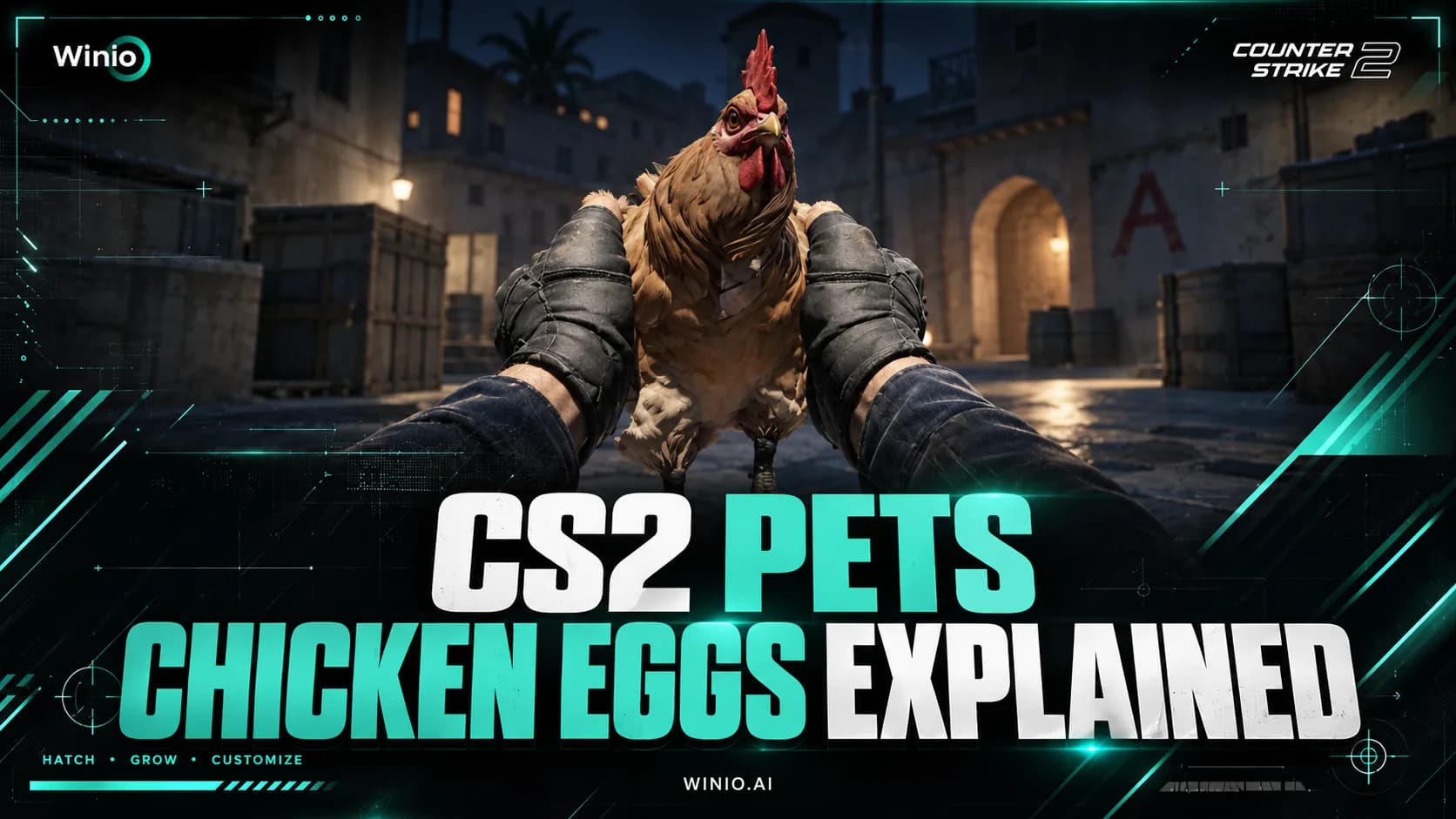
CS2 Pets Guide: How to Get and Hatch a Chicken Egg
Learn how to get a Chicken Egg in CS2, how pets hatch and grow, all discovered chicken breeds, Pet Book features and current drop details.
October 1, 202607:54 AM10 min


Esports analytics has undergone a fundamental transformation with the release of Counter-Strike 2. The transition to the Source 2 engine, the introduction of the sub-tick system, and changes in match structure have reshaped not only the pace of the game but also the very nature of the data used in professional analysis. In this article, we take a deep dive into what actually predicts wins in CS2 matches – and why your betting strategy should rely on “signals” rather than “noise.”
The primary pitfall for beginners analyzing matches is placing blind trust in “broadcast-friendly stats.” Most public platforms provide data that looks great on stream but has low predictive value for CS2 predictions.
Standard metrics, such as ADR (average damage per round) or K/D (kill-to-death ratio), create an illusion of understanding but often overlook the context of individual rounds.
ESL Challenger League Season 52: SA - Cup #3
Tomorrow 00:00
 LPBounty Hunters
Prediction: LP
ANZC Locals Brisbane 2026 Season 2
Today 06:30
 MindfreakAbyssal
Research clearly shows that a player’s value is defined by their contribution to win probability in specific situations. Models that simply sum kills perform poorly over time because they fail to account for the “cost” and impact of actions.
To build an effective betting strategy, you need to focus on metrics that directly influence round win probability. Modern machine learning models and pro analysts highlight the following key factors:
Economy is the heartbeat of CS2. Teams that can successfully convert force buys and maintain economic stability while losing rounds have significantly higher comeback potential.
Positioning data shows that teams who take control of key areas (like mid on Mirage or banana on Inferno) within the first 20 seconds win 65–70% more often than reactive teams.
In CS2, utility has become more predictable due to reworked smoke mechanics. Data shows that flash assists and grenade damage correlate more strongly with round wins than individual K/D.
Research confirms that using an extended team efficiency index provides significantly higher prediction accuracy than relying on individual stats alone.
When evaluating CS2 matches, shift your focus from “flashy” stats to functional ones.
This is the gold standard of analytics. The first kill shifts the win probability from ~50% to 70–75%. A player who consistently secures opening picks is one of the most valuable assets – even with modest K/D.
How quickly does a team respond to a teammate’s death? Immediate trades maintain parity. A high trade ratio indicates discipline and coordination – key predictors of long-term consistency.
ADR is one of the most honest indicators of contribution. Even without finishing kills, consistent damage output “sets up” teammates.Over time, players with high ADR and average K/D often contribute more to wins than “clean-up fraggers” with inflated K/D.
Be cautious with these commonly misused metrics:

Accurate CS2 predictions require a multi-factor approach.
Use APIs or platforms to gather data from the last 30 days. Ignore matches older than 3 months – CS2 meta evolves quickly.
Build your own evaluation model. Example:
CS2 is a game of stylistic matchups. Aggressive teams often struggle against disciplined, structured opponents. Even if aggressive teams have better stats, their style may play directly into the opponent’s strengths.
You can read more about mathematical classification models in the article, which describes how the difference in player performance becomes the main predictor.
To successfully predict CS2 match outcomes, you need to stop thinking like a fan and start thinking like an analyst. Focus on team-based metrics: map control, economy, and utility usage. Individual skill matters – but Counter-Strike 2 rewards structured systems. Leverage insights from analytical research and remember: the best CS2 predictions come from identifying data anomalies most people overlook. The market often overvalues individual skill while undervaluing tactical discipline and economic management. That gap is where professional analysts find their edge.
Winio is always ready to help you with match analysis! Collect five free forecasts every month.

Mindfreak
Abyssal

mellren

Honvéd

INFURITY

eSuba

Iberian Soul

Nemiga

FaZe

NAVI Junior

HOTU

fnatic

Sangal

PURE

WBT Academy

Saint Sinners
Mindfreak
Abyssal
mellren
Honvéd
INFURITY
eSuba
Iberian Soul
Nemiga
FaZe
NAVI Junior
HOTU
fnatic
Sangal
PURE
WBT Academy
Saint Sinners
Mindfreak
Abyssal
mellren
Honvéd
INFURITY
eSuba
Iberian Soul
Nemiga
FaZe
NAVI Junior
HOTU
fnatic
Sangal
PURE
WBT Academy
Saint Sinners