

Anubis Callouts in CS2
Anubis is one of the most unusual competitive maps in CS2.
Its two-level structure, central canals and numerous connecting routes allow teams to change direction without returning to spawn. A player spotted in Water can pressure A, enter Connector or appear near B only seconds later.
This freedom makes communication essential. “One in Mid” provides little useful information when the opponent could be above the canal, underneath Bridge or already moving through Connector.
This guide covers the essential Anubis callouts, the history of the map, CT and T-side strategies, important utility and the areas that determine most rounds.
The History of Anubis
Anubis is a community-created map developed by Roald van der Scheur, Jakuza and jd_40.
It was officially added to CS in 2020. The setting was inspired by ancient Egyptian architecture, with temples, canals, stone monuments and narrow streets separating the map from the industrial and European environments traditionally associated with Counter-Strike.
Who wins?
All MatchesFree Today European Pro League Series 10 Play-In
Tomorrow 12:00
 RyvexRounds
 Free for everyone · factor breakdown
Prediction: Ryvex
62%38%Tesla Cup 2026
Tomorrow 11:00
 B8Alliance

Valve removed Anubis from competitive matchmaking in 2021 before returning an updated version in August 2022.
In November 2022, the map replaced Dust II in the Active Duty pool. This made Anubis one of the few community maps to become part of Counter-Strike’s highest competitive level.
Anubis moved to CS2 with improved lighting, materials and visibility. It left the Active Duty pool in July 2025 when Overpass returned, but Valve brought it back in January 2026 as a replacement for Train.
The map has historically provided strong options for the T side. Attackers can contest Water, pressure both bombsites and use multiple rotation routes to force the defense into difficult decisions. Later changes reduced some of this advantage and made control of Mid and Connector more important for both sides.
Why Anubis Callouts Matter
Anubis contains several positions at different elevations.
Two players may both be described as being near Mid while one is standing above Water and the other is moving through the canal below. Without an exact call, teammates may prepare for the wrong fight.
Accurate callouts allow teams to:
- Coordinate utility
- Track movement between levels
- Prepare trades
- Organize rotations
- Clear angles in the correct order
- Choose the correct plant position
- Set up post-plants and retakes
- Identify possible lurks
Some positions have regional alternatives. For example, Heaven may be called Eight or Nine, while Camera may be known as Helpa in Eastern European matchmaking.
International teams should agree on one name for each position before the match. The exact word matters less than everyone understanding the same call.
Anubis Map Overview
Anubis can be divided into five main areas:
- A Site
- B Site
- Middle
- Water and Canal
- CT and T-side rotation routes
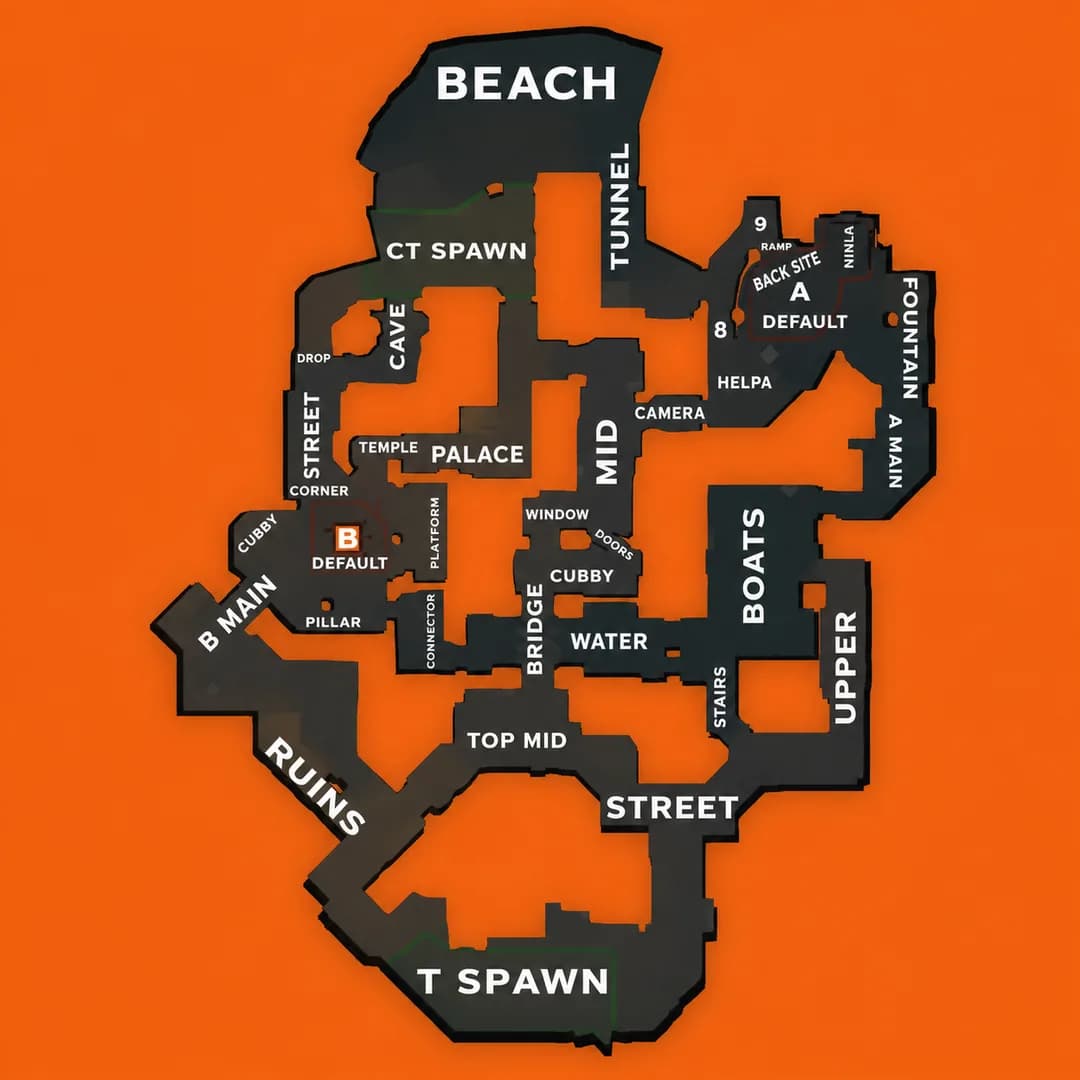
The central part of the map is the most important. Water, Bridge, Connector and Middle allow players to move between the bombsites and create attacks from several directions.
A team that controls these areas can hide its final destination until late in the round.
Anubis A Site Callouts
A is an open bombsite with several elevated defensive positions.
Terrorists usually attack through A Main or split the site through Connector. The CT side can defend from Heaven, Plateau, Back Site and the positions surrounding Fountain.
The essential A site callouts are:
- A Site
- A Main
- Fountain
- Default
- Heaven
- Plateau
- Back Site
- Headshot
- Grill
- Corner
- Connector
- Camera
- Tunnel
- Beach
- CT
Anubis B Site Callouts
B is surrounded by pillars, walls and several entrances at different elevations.
Terrorists can attack through B Long and Gate, split through Connector or pressure the site through the central routes. The CT side can defend from Pillar, Back Site, Corner, Ninja and the approaches from Street or Palace.
The main B site callouts are:
- B Site
- B Long
- B Main
- Gate
- Default
- Pillar
- Corner
- Back Site
- Ninja
- E Box
- Connector
- Platform
- Palace
- Ruins
- Ivy
- Street
- Cave
- CT
Anubis Mid and Water Callouts
Middle and Water form the strategic center of Anubis.
Controlling these areas gives the Terrorists access to Connector, both bombsites and several rotation routes. The CT side uses Mid information to identify where the final attack is developing.
The essential central callouts are:
- Middle
- Top Mid
- Mid Doors
- Water
- Canal
- Pool
- Bridge
- Arches
- Door
- T Stairs
- Upper
- Drop
- Boat
- Connector
- Sniper’s Nest
- CT Spawn
Important Connections on Anubis
Learning individual callouts is not enough. Anubis is defined by how its routes connect.
Water to A Main
Water gives the Terrorists access to the primary A approach.
Control of Boat and Water allows the attacking team to prepare an A execute while maintaining the possibility of returning toward Mid.
Middle to Connector
This route creates splits and cuts defensive rotations.
Once the Terrorists control Connector, both bombsites become harder to read. The CT side may need to give up advanced positions and prepare for a retake.
B Long to Gate
This is the fastest direct route into B.
The narrow entrance makes utility essential. Terrorists must isolate Pillar, Corner and the defensive rotation routes before crossing.
CT Spawn to Both Sites
CT Spawn is the main defensive hub.
Rotating too early can leave one bombsite open. Rotating too late can force the defenders into an expensive retake through predictable entrances.
How to Play Anubis on the CT Side
Anubis defense is based on information and controlled space.
The CT side cannot watch every entrance with equal strength. Players must identify where the Terrorists are applying pressure and preserve enough utility for the final execute.
Contest Water Without Overcommitting
Water provides the attackers with multiple rotation options.
CT players can use early utility to delay control, gather information or force the Terrorists into less comfortable routes. Aggression should have a clear escape plan.
A player trapped in Water may be attacked from several directions and become impossible to trade.
Protect Connector
Connector influences both bombsites.
Losing it gives the Terrorists access to splits and allows lurkers to interrupt rotations. The defense should communicate immediately when Connector is smoked, pressured or lost.
Delay B Long
The B defenders can use Molotovs, smokes and HE grenades to slow the approach through Gate.
The objective is not always to find the opening kill. Removing ten seconds from the attacking clock can be enough for the rotations to arrive.
Build Crossfires on A
A defenders should cover A Main and Connector from positions that allow immediate trades.
One player can watch Main from Heaven or Fountain while another covers Connector or plays deeper on the site. The defenders should avoid exposing themselves to both entrances simultaneously.
Save Utility for Retakes
Both Anubis bombsites contain strong post-plant positions.
A smoke, flash or Molotov saved for the retake may be more valuable than a grenade thrown at the first sign of pressure. CT players should communicate which utility remains available before beginning the retake.
Communicate Elevation
Calls should specify whether the opponent is above or below.
“Two Water, one Bridge” is far more useful than “three Mid.” The same applies to Heaven, Connector and the elevated B positions.
How to Play Anubis on the T Side
Anubis rewards patient map control and late changes of direction.
Fast attacks can work, but repeating them allows the CT side to prepare with early utility and site stacks.
A structured T round normally follows three stages:
- Contest Water or Middle.
- Force the defense to reveal utility and positions.
- Attack after identifying the weaker bombsite.
Take Water Control
Water provides access to A, Connector and the central rotation routes.
The team does not need to commit immediately after taking it. Simply controlling the lower area forces the defense to watch several possible exits.
Pressure B Long
B Long pressure forces the defenders to use utility or keep additional players near B.
Even if the final plan is an A execute, showing presence near Gate can slow CT rotations.
Use Connector to Split the Sites
A direct attack through one entrance is easier to defend.
Connector creates a second direction and forces the site anchors to divide their attention. Both groups should enter together so the defense cannot eliminate them separately.
Track CT Utility
Anubis rounds are often decided by grenade economy.
If the B defenders have already used their Gate smoke and Molotovs, a late execute becomes much stronger. The same applies to A after Heaven and A Main utility has been exhausted.
Choose the Plant for the Post-Plant
The safest plant is not always the best plant.
The bomb should be visible from the positions the Terrorists expect to control. Before planting, the team should communicate whether it plans to hold from Main, Connector, Gate or Back Site.
Essential Utility on Anubis
Anubis contains open bombsites and narrow entrances.
Smokes isolate elevated defenders, Molotovs clear protected corners and flashes allow entry players to cross exposed areas.
Utility for an A Execute
A standard A execute can include:
- A Heaven smoke
- CT or Tunnel smoke
- Connector smoke
- Molotov for Grill
- Molotov for Headshot
- Molotov for Back Site
- Flashes above A Main
- HE grenades for Fountain and close corners
The exact combination depends on whether the team attacks only through A Main or creates a split through Connector.
The objective is to separate the defenders. Terrorists want to fight Fountain, Heaven and Back Site individually instead of facing a complete crossfire.
Utility for a B Execute
A B execute can include:
- Street smoke
- Palace smoke
- Connector smoke
- Molotov for Pillar
- Molotov for Corner
- Molotov for Ninja or Back Site
- Flashes above Gate
- HE grenades for common anchor positions
The entry players should know which angles remain open after the grenades land. A smoke blocks vision but does not prevent defenders from pushing through it.
Utility for Mid and Water Control
A basic central setup can use:
- Smoke for Sniper’s Nest
- Smoke for Mid Doors
- Molotov for close Connector positions
- Flashes above Middle
- HE grenades for defensive pushes
- Utility to protect the Drop into Water
The timing should support the players taking space. Throwing the utility too early may allow the CT side to wait for it to disappear before fighting.
Effective T-Side Strategies
A Split Through Main and Connector
One group prepares near A Main while another controls Middle and enters Connector.
After Heaven and defensive rotations are smoked, both groups attack simultaneously. The split forces the A anchors to watch two directions.
Late A Execute
The Terrorists pressure B Long and Middle before returning toward A.
After the CT side has used part of its utility, the team executes through Main with smokes for Heaven and Tunnel. A Connector lurker can stop rotations or join the final attack.
Fast B Through Gate
The team uses early utility to isolate Street, Palace and the site anchors.
Entry players cross Gate behind flashes and immediately clear Corner, Pillar and Back Site. The speed is valuable only if the grenades land before the defenders can take the first clean duel.
B Split Through Gate and Connector
One group attacks from B Long while another enters through Connector.
The two groups must arrive together. If the Connector players activate too early, the CT side can eliminate them before turning toward Gate.
Water Control Into a Late Rotation
The Terrorists take Water without revealing the final plan.
From there, they can pressure A Main, enter Connector or rotate toward B. This strategy becomes especially effective after showing several direct site executes.
Effective CT-Side Strategies
Early Water Control
The CT side sends supported players toward Water with flashes and incendiary grenades.
The objective is to collect information and disrupt the T-side default. The players should fall back if the attackers respond with heavy utility.
Aggressive B Long Setup
A B defender can contest Long with support from a teammate and early grenades.
This may reveal whether the Terrorists are preparing a fast execute. Repeating the same aggression makes the setup easy to punish with flashes and prefires.
Passive A Crossfire
The A players allow the Terrorists to approach before activating a crossfire from Heaven, Fountain and Back Site.
This setup can punish teams that enter without Connector control. It becomes weaker once the attackers smoke Heaven and create pressure from two directions.
B Retake Setup
Instead of fighting until death, the B anchor delays the execute and remains alive behind Pillar or Back Site.
Rotating players then approach through Street, Palace or Connector. Utility must be coordinated before the defenders enter the bombsite.
Teams to Study on Anubis
Team Spirit, Team Vitality, G2, FaZe and NAVI provide useful examples of high-level Anubis play.
Their demos can help players study:
- Water control
- B Long protocols
- Connector pressure
- Coordinated site splits
- CT utility management
- Late-round rotations
- Post-plant positioning
- Multi-route retakes
AWP players should focus on how professionals use Sniper’s Nest and the elevated site positions without repeating the same angle.
Riflers can study the spacing between entry players and traders around Gate, A Main and Connector.
Learn the Routes, Then Read the Match
Learning Anubis callouts improves communication. Understanding Water control, Connector pressure, utility timing and rotations explains why professional rounds develop in a particular way.
These factors also influence match probabilities. A team’s performance on Anubis depends on its map pool, side-specific results, player roles, recent form and ability to convert central control into successful executes.
Winio analyzes these variables across thousands of matches to show what the data says before the server decides the result.
Explore upcoming CS2 matches and data-driven predictions at Winio.