
Cache Callouts in CS2
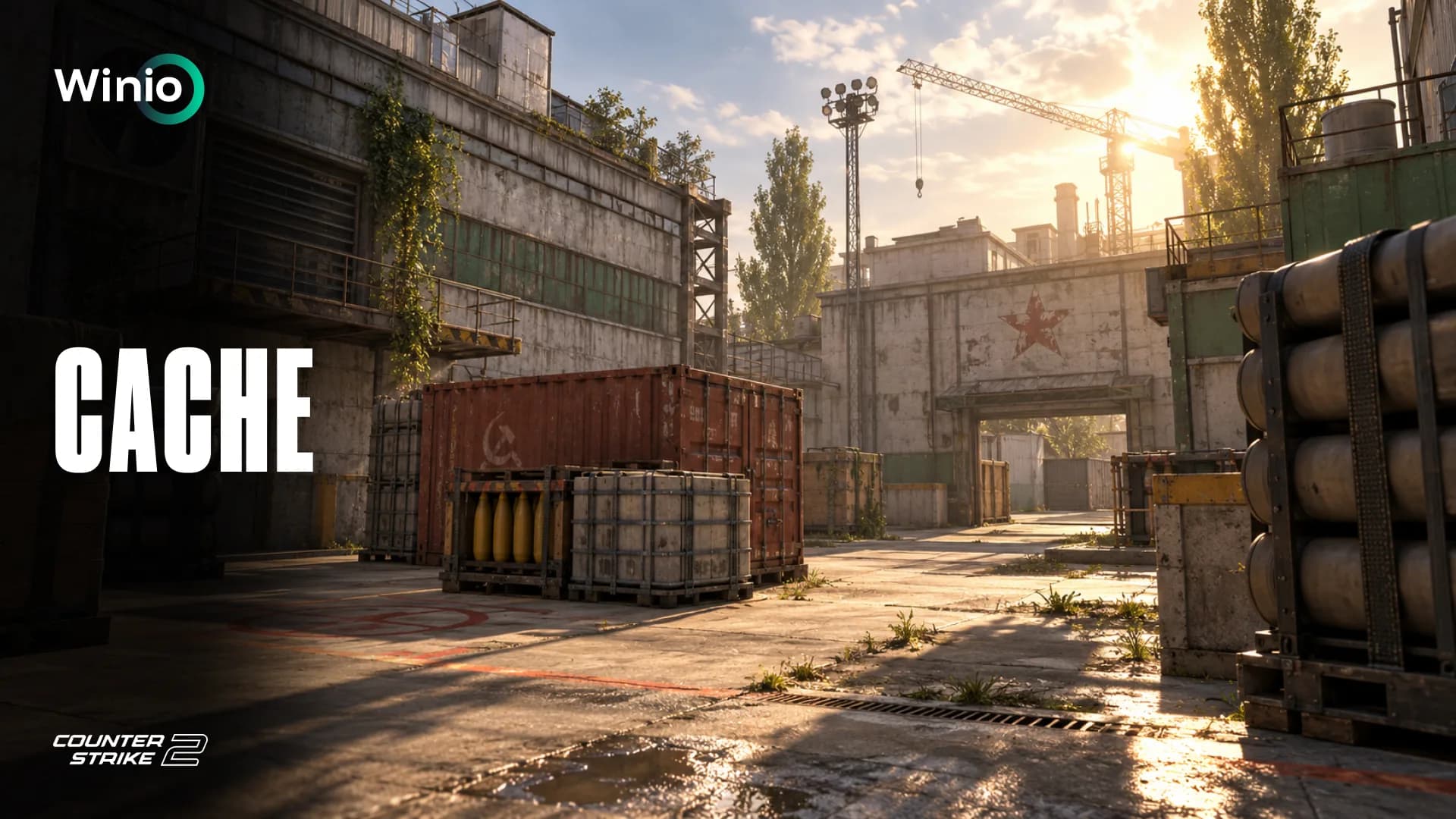
Cache returned to Counter-Strike 2 on April 28, 2026. Valve initially added it to Competitive, Casual, Deathmatch and Retakes before moving it into the Active Duty pool on July 8 for Premier Season Five.
The map replaced Overpass and returned to professional competition for the first time since 2019.
Cache is often described as easy to learn because of its clear three-lane structure. A site, Mid and B site are connected through recognizable routes that make the basic layout understandable after only a few matches.
Playing the map well is much harder. Mid control, utility timing, rotations and precise communication can completely change the direction of a round.
This guide covers the essential Cache callouts, both bombsites, Mid control, utility, team roles and the factors that matter when analyzing professional matches.
The History of Cache
Cache was originally created by Salvatore “Volcano” Garozzo for Counter-Strike: Source. The final Source version appeared in 2011, followed by a CS port in 2012.
Who wins?
All MatchesFree Today NODWIN Clutch Series #12
Tomorrow 11:00
 SPARTABAKS
 Free for everyone · factor breakdown
Prediction: SPARTA
71%29%NODWIN Clutch Series #12
Today 11:00
 BRUTEG2 Ares

Shawn “FMPONE” Snelling later joined the project and helped rebuild the map’s visuals and gameplay for CS. The updated version entered Operation Bravo in 2013 and eventually became one of the first community-created maps to establish a permanent place in the professional pool.
Cache appeared at multiple Majors and became a regular choice for elite teams. Its straightforward structure encouraged aim duels, but coordinated teams could also build complex rounds around Mid control and split attacks.
Valve removed Cache from Active Duty in March 2019 and replaced it with Vertigo. A redesigned version was revealed later that year, featuring brighter colors, additional visual detail and several gameplay adjustments.
FMPONE began rebuilding Cache for Source 2 after the release of CS2. A Workshop version appeared in 2025, and Valve later acquired the map.
The official CS2 version arrived on April 28, 2026. After several months of public testing and updates, Cache entered Active Duty on July 8, replacing Overpass.
What Makes Cache Different?
Cache uses a clear three-lane structure:
- A Main leads toward A site
- Garage opens into Mid
- B Main leads toward B site
The lanes are connected by Squeaky, Highway, Vents, Checkers and the CT rotation routes.
This creates a map that is easy to read but difficult to control. Every area lost by the defense opens another option for the attacking team.
Mid is especially important. Terrorists who control it can:
- Split A through Highway
- Pressure B through Vents and Checkers
- Cut CT rotations
- Force defenders away from the bombsites
- Fake one direction before changing the attack
The CT side must decide how much utility and manpower to spend on Mid without leaving either bombsite vulnerable.
Cache A Site Callouts
A is the more open bombsite on Cache. Terrorists can attack through A Main, Squeaky and Highway, creating several possible combinations.
The essential A callouts are:
- A Site
- A Main
- A Long
- Squeaky
- Forklift
- Quad
- Default
- NBK
- Truck
- Highway
- Catwalk
- CT
- Back Site
How to Attack A Site
A direct A attack through A Main can work, but it becomes predictable if used repeatedly.
A stronger execute usually combines at least two entrances:
- A Main and Squeaky
- A Main and Highway
- Squeaky and Highway
- All three routes during a full execute
The attacking team should use smokes to remove long defensive sightlines, Molotovs to clear Forklift and Quad, and flashes to help the entry players cross onto the site.
Timing matters more than the number of entrances. If the Highway group arrives too early, the defense can eliminate it before the A Main players leave their position.
How to Defend A Site
A defenders need to support each other without standing in positions that can be cleared by the same grenade.
One player can hold the initial A Main contact while another watches Squeaky or Highway. The defenders should communicate immediately when Mid or Highway control has been lost.
Remaining focused on A Main after the Terrorists reach Highway creates an easy split.
A defenders also need an escape plan. A player at Forklift or Quad may be able to find an opening kill, but staying in the same position after being discovered often leads to an immediate trade.
Cache B Site Callouts
B is more compact than A and contains several close defensive positions.
The main B callouts are:
- B Site
- B Main
- Sun Room
- Checkers
- Toxic
- Default
- Back Site
- Headshot
- Heaven
- Hell
- Rafters
- CT
- Vents
- Tree Room
How to Attack B Site
A basic B execute needs to solve three problems:
- Remove Heaven from the fight.
- Clear close positions around B Main.
- Prevent defenders in Checkers or Back Site from delaying the plant.
A Heaven smoke is usually central to the execute. Molotovs can clear Toxic, Headshot or another protected position, while flashes allow entry players to cross B Main.
The attack becomes more effective when another player controls Checkers through Vents. The defenders then need to watch B Main and the side entrance simultaneously.
How to Defend B Site
A B anchor does not always need to find multiple kills.
Delaying the execute, communicating the number of attackers and staying alive long enough for rotations can be enough to win the round.
Utility should be used with a purpose. An early incendiary can prevent a rush, while a later smoke may remove ten or more seconds from the attacking team’s clock.
The B player should also communicate when Vents or Checkers are lost. A defender watching only B Main can be eliminated from the side during a Mid split.
Cache Mid Callouts
Mid is the strategic center of Cache.
The essential Mid callouts are:
- Mid
- Garage
- Boost
- White Box
- Sandbags
- Vents
- Roof
- Catwalk
- Highway
- Z
- Connector
Why Mid Control Matters
Mid control does not guarantee a round win, but it increases the number of decisions the defense must make.
Without Mid, the Terrorists are usually limited to direct attacks through A Main, Squeaky or B Main. These routes are easier to read and delay.
With Mid, the Terrorists can threaten:
- Highway into A
- Vents into Checkers
- A full A split
- A B split
- CT rotation routes
- A late change of direction
The CT side must spend utility, information or additional players to manage these possibilities.
Essential Utility on Cache
Exact lineups can change after map updates, so players should practice grenades in the current version of CS2.
The most valuable utility is defined by what it accomplishes rather than where it is thrown from.
Utility for Mid Control
A Mid setup can include:
- Smoke to block Z or another defensive sightline
- Smoke to isolate White Box
- Molotov for Sandbags
- Molotov or HE grenade for Boost
- Flashes above Garage
- Utility to control Vents
- A late smoke for Highway
The objective is to leave Garage without giving the defense several uncontested angles.
Mid utility also has value as a fake. Forcing the CT side to use grenades or move an additional player toward the center can weaken a bombsite.
Utility for an A Execute
A coordinated A attack commonly uses:
- Smoke for Truck or the CT rotation
- Smoke to isolate Highway
- Molotov for Forklift
- Molotov for Quad or NBK
- Flashes over A Main
- Squeaky flashes
- HE grenades for common defensive positions
The exact combination depends on whether the team controls Highway and Squeaky.
The attackers should avoid blocking their own routes with poorly timed smokes. Utility must divide the defenders while preserving enough visibility for the entry players to trade.
Utility for a B Execute
Useful B utility includes:
- Heaven smoke
- CT smoke
- Molotov for Toxic
- Molotov for Headshot
- Molotov for Back Site
- Flashes through or above B Main
- Utility for Checkers
- Post-plant grenades to delay the retake
One grenade is rarely enough. The execute should remove the elevated sightline, clear close positions and help the bomb carrier reach a safe plant.
How to Play Cache on the T Side
The T side needs to create uncertainty.
Repeatedly sending all five players through one Main entrance allows the defense to prepare utility and stack the correct positions.
A structured attacking round usually follows four stages:
- Establish presence across the map.
- Contest Mid or force CT utility.
- Identify the weaker area.
- Execute with enough time to clear the site.
Contest Mid
Mid control provides the greatest tactical flexibility.
The team does not always need to occupy every part of Mid. Even forcing the defenders away from aggressive positions can create more space for the final attack.
Pressure Multiple Routes
Opening Squeaky, showing utility at B and fighting around Garage forces the CT side to process several threats.
The pressure must be credible. A fake that uses no players or meaningful utility may not produce a defensive reaction.
Change the Pace
Cache supports both fast attacks and patient defaults.
A fast A or B execute can punish passive setups, while a slower round can drain CT utility and reveal aggressive tendencies.
The attacking team should avoid repeating the same timing.
Trade the Entry Player
The first player through A Main, B Main or Garage will often encounter a prepared defender.
The second player must be close enough to trade. Entering in a long line turns one difficult duel into several separate fights for the same CT player.
Plan the Post-Plant
Players should know their post-plant positions before the bomb is planted.
The best setup depends on:
- Which entrances are controlled
- Where the remaining CT players can rotate from
- Whether the bomb is visible from A Main or B Main
- Which utility remains
- Whether the team has enough space to play actively
How to Play Cache on the CT Side
The CT side must protect information as carefully as territory.
Losing Mid without communicating it can compromise both bombsites. Rotating too early can leave an anchor alone against a full execute.
Define Defensive Responsibilities
A balanced setup needs players responsible for:
- A Main and Squeaky
- B Main
- Mid and Garage
- Vents and Checkers
- Fast rotations through CT, Z or Highway
Every player should know which area they must watch when a teammate uses utility or changes position.
Do Not Abandon Mid for Free
The CT side does not need to win every Mid duel.
It does need information about how much space the Terrorists control. A player can fall back from an aggressive angle while continuing to watch Highway, Vents or the next stage of the attack.
Preserve Late Utility
A smoke or incendiary becomes more valuable as the round clock decreases.
Using every grenade during the opening seconds allows the Terrorists to execute without resistance later. Anchors should communicate what utility remains so the team can plan the defense.
Avoid Unnecessary Rotations
A Squeaky door opening or a single B flash does not confirm an execute.
The defense should communicate:
- Number of attackers spotted
- Bomb location, if known
- Utility used
- Mid control
- Vents status
- Whether an anchor can delay the attack
- Which rotation routes remain safe
Change Defensive Positions
Holding the same Forklift, Heaven or Mid angle every round makes the defense predictable.
Changing positions and timings forces the attacking team to clear more possibilities and spend additional utility.
Important Roles on Cache
Mid Player
The Mid player controls one of the most influential areas on the map.
This role requires strong communication, utility knowledge and an understanding of when to fight, fall back or support a bombsite.
Entry Fragger
The entry player creates space through Garage, A Main or B Main.
Their value is not limited to eliminations. Revealing defensive positions and allowing an immediate trade can be enough to make the execute successful.
Support
The support player prepares smokes, flashes and Molotovs for the entry group.
Poor utility timing can leave teammates exposed or blind the players entering the site.
Anchor
The anchor holds a bombsite while teammates contest other areas.
The B anchor is particularly important because the site may initially be defended by one player. Delaying the plant can be more valuable than taking an unnecessary early duel.
Rotator
The rotator moves between Mid and the bombsites.
This player needs accurate information. Rotating on weak audio cues can open the opposite site and give the Terrorists a free plant.
Lurker
A lurker can operate around Squeaky, B Main, Highway or Mid.
The goal is to punish rotations and preserve uncertainty. A lurker who makes noise or reveals their position too early loses much of their value.
How Cache Affects Professional Match Analysis
Cache is now part of the Active Duty pool, so it directly affects Premier and professional map vetoes.
However, it remains a relatively new competitive map in CS2. Historical reputation alone is not enough to determine which teams are strongest on it.
Analysts should consider:
| Factor | Why It Matters |
|---|---|
| Veto priority | Shows whether a team treats Cache as a strength, a neutral map or an immediate ban |
| Number of maps played | A strong win rate based on two or three matches may not be reliable |
| Opponent quality | Results against lower-ranked teams may not translate to tier-one competition |
| T-side protocols | Reveals whether the team can create varied rounds through Mid, Highway and Vents |
| CT Mid control | Shows how well the defense collects information without weakening the sites |
| Utility efficiency | New lineups and timings can create an early preparation advantage |
| Player roles | A roster may need to change its anchors, rotator or Mid responsibilities |
| Adaptation speed | Recently added maps reward teams that update their approach quickly |
| Previous CS experience | Familiarity helps, but old results do not automatically predict CS2 performance |
| Recent updates | Geometry or utility changes can affect prepared strategies |
Cache can also change the entire veto before it is played.
A team with a strong Cache may force its opponent to spend an early ban on it. This can leave another comfortable map available later in the series.
The map therefore influences both direct performance and the strategic structure of a matchup.
Learn the Map, Then Read the Match
Cache rewards clear communication and purposeful map control.
Players need to understand how A Main, B Main and Garage connect to Squeaky, Highway, Vents and Checkers. Teams that control these connections can create splits, delay rotations and force opponents into uncomfortable decisions.
The same details matter when evaluating professional CS2.
A team’s performance on Cache depends on more than its overall ranking. Veto priorities, sample size, Mid protocols, player roles, utility efficiency and adaptation to the current version all affect the real probability of winning.
Winio analyzes these factors across thousands of matches to show what the data says before the server decides the result.
Explore upcoming CS2 matches and data-driven predictions at Winio.