
Dogtown Grenade Callouts in CS2
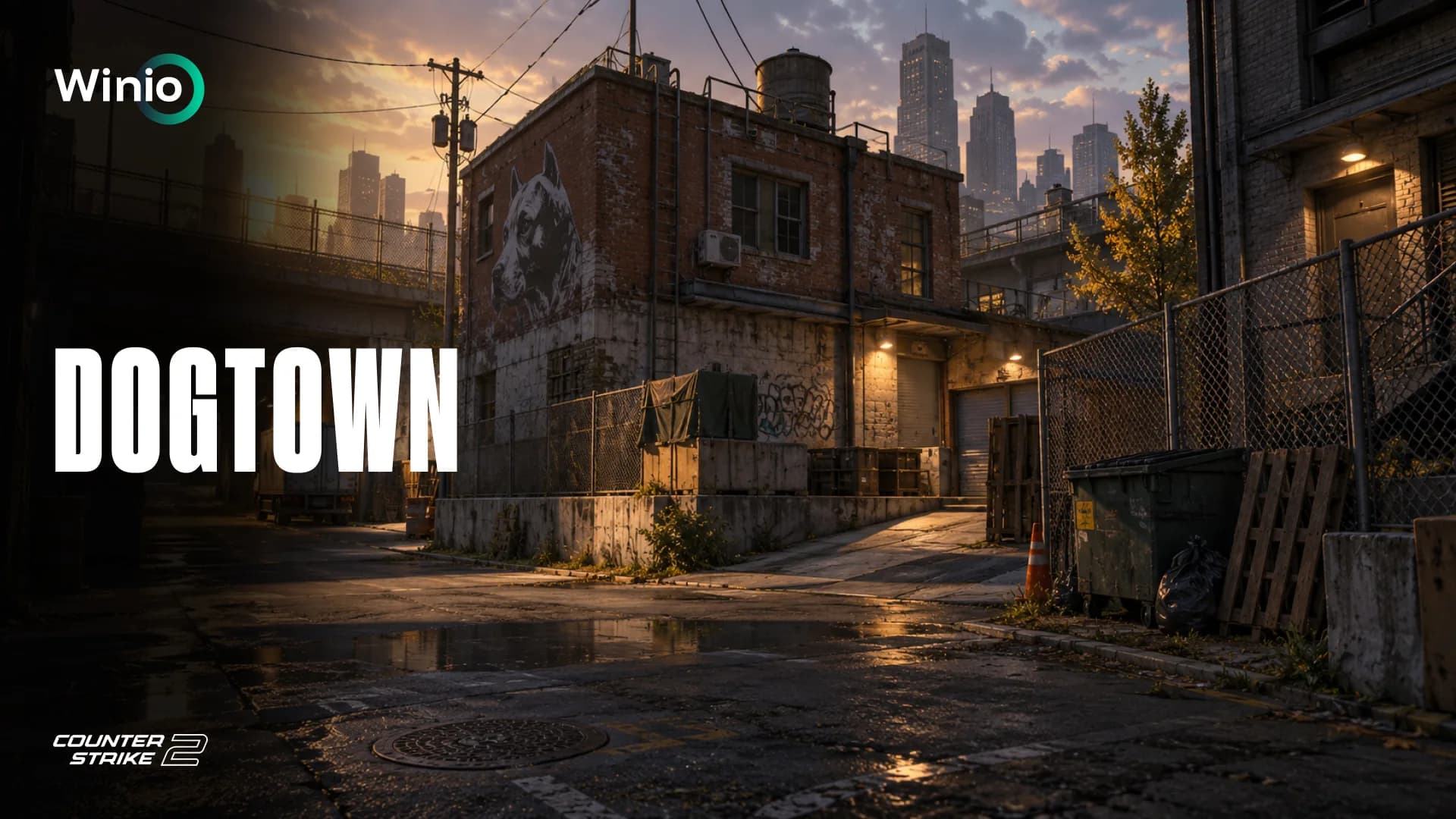
Dogtown is a compact CS2 Wingman map where utility can decide a round before the first direct duel begins.
The map combines narrow approaches, elevated positions, close corners and a single bombsite. Because each team has only two players, losing one teammate creates an immediate disadvantage. A well-placed smoke or flash is often more valuable than an aggressive dry peek.
This guide covers the most useful types of grenades on Dogtown, explains how to practice reliable lineups and shows how both sides can use utility to control the map.
What Is Dogtown in CS2?
Dogtown is a community-created Wingman map developed by JimFK, Angel and Ksvly.
Its setting is inspired by a coastal amusement park, with visual references to Pacific Park and the Santa Monica Pier. The map features colorful attractions, seaside scenery and a compact layout designed specifically for two-versus-two rounds.
Dogtown was officially added to CS2 on May 7, 2025, alongside Brewery. Valve later removed both maps from the official matchmaking rotation on October 1, 2025.
Who wins?
All MatchesFree Today NODWIN Clutch Series #12
Tomorrow 11:00
 SPARTABAKS
 Free for everyone · factor breakdown
Prediction: SPARTA
71%29%NODWIN Clutch Series #12
Today 11:00
 BRUTEG2 Ares

Dogtown can still be played through the Steam Workshop and compatible community servers. This makes it possible to explore the map, practice utility and organize private matches even when it is not part of the active official rotation.
Because community maps can receive updates, always test your lineups after downloading a newer version.
Why Utility Is So Important on Dogtown
Wingman rounds develop faster than standard five-versus-five matches.
There is less space, fewer defenders and almost no room for an early mistake. If one player is eliminated, the surviving teammate must cover the entire bombsite and every remaining route alone.
Utility helps prevent this situation by allowing players to:
- Block dangerous sightlines
- Clear protected corners
- Cross exposed areas
- Force defenders out of cover
- Delay the bomb plant
- Create safe two-player entries
- Hide rotations and repositioning
- Isolate one opponent from their teammate
A successful grenade does not always need to deal damage. If it prevents an opponent from seeing the entry for several seconds, it has already created a meaningful tactical advantage.
Essential Dogtown Callouts
Dogtown does not have a universally established callout system comparable to maps such as Mirage, Inferno or Dust II.
Community players may use different names for the same areas. Before starting a private match, agree on a simple set of callouts with your teammate.
Useful descriptive callouts can include:
- T Spawn
- CT Spawn
- Bombsite
- Plant Box
- Main
- Side Entrance
- Upper
- Lower
- Ramp
- Stairs
- Connector
- Close Corner
- Back Site
- Long
- Beach
- Pier
- Arcade
- Wave
- Mid
The exact terminology is less important than consistency. If both teammates immediately understand what “Upper,” “Plant Box” or “Back Site” means, the callout is doing its job.
How to Practice Dogtown Grenades
The fastest way to learn utility is to open Dogtown in a private practice server.
Useful console commands include:
- sv_cheats 1
- mp_warmup_end
- mp_roundtime_defuse 60
- mp_freezetime 0
- mp_buy_anywhere 1
- mp_buytime 9999
- sv_infinite_ammo 1
- ammo_grenade_limit_total 5
- sv_grenade_trajectory_prac_pipreview 1
- sv_rethrow_last_grenade
- bot_kick
The picture-in-picture grenade preview helps you see where a grenade lands. The rethrow command allows you to repeat the last throw while standing at the destination and checking its effect from an opponent’s perspective.
When testing a lineup, record four details:
- The exact starting position.
- The object or texture used as the aiming reference.
- Whether the throw is standing, running, walking or jumping.
- Which defensive angles the grenade blocks or clears.
Do not rely only on memory. Screenshots or short clips make complex lineups much easier to reproduce later.
Plant Box Entry Smoke
One of the most practical documented Dogtown lineups begins near the Plant Box.
Stand tightly in the corner of the box and locate the cross-shaped reference below the wave decoration. Place your crosshair on the reference point and perform a jumpthrow.
The smoke is designed to help the attacking side enter the bombsite by blocking a key defensive sightline.
This grenade is useful because it allows the Terrorists to:
- Reduce exposure during the initial entry
- Isolate one of the defenders
- Cross toward the planting area
- Force CT players to move closer
- Combine the smoke with a flash or Molotov
Test the lineup on your current Workshop version before using it in a serious match. Small changes to geometry, textures or collision can affect the landing position.
T-Side Smokes on Dogtown
The attacking side should use smokes to divide the bombsite into smaller sections.
Walking into the site without utility can expose both Terrorists to several defensive positions simultaneously. A good smoke removes at least one of these angles and allows the attackers to concentrate on the remaining defender.
Entry Smoke
The entry smoke should block the longest or most dangerous sightline toward the main approach.
After the smoke lands, the first player can move forward while the second prepares a flash, watches a smoke push or clears a close corner.
Do not stand directly behind the smoke without a plan. CT players may spray through it or push its edge while the attackers are preparing to enter.
Rotation Smoke
A rotation smoke blocks the route used by the second CT player to support the bombsite.
Its purpose is not only to hide the attackers. It separates the defenders and creates a temporary two-versus-one fight.
After the bomb is planted, the same smoke can delay a retake and remove several seconds from the CT side’s limited clock.
Site Isolation Smoke
Some Dogtown positions allow defenders to watch the plant from cover.
A site isolation smoke can remove one part of the bombsite from the fight. The attackers can clear the visible section, plant the bomb and then prepare for the defender emerging from the smoke.
The smoke should not create unnecessary cover for the CT side. Always consider where an opponent can hide when the grenade blooms.
One-Way Smoke Potential
Compact maps frequently contain steps, boxes and elevation changes that can create one-way smoke angles.
These positions can be powerful, but they are also version-sensitive. A small update to the map or smoke behavior can remove the advantage.
Test both perspectives before depending on a one-way. If the opponent can see your legs or weapon before you see them, the smoke is working against you.
T-Side Flashes on Dogtown
Flashes are particularly strong in Wingman because blinding one defender can leave the entire bombsite temporarily protected by only one player.
Entry Flash
An entry flash should explode behind or above the attacking players as they move onto the site.
The first player must communicate exactly when they are entering. If the timing is too early, the flash expires before contact. If it is too late, it blinds the teammate instead of the defenders.
A simple countdown works well:
- Flash ready
- Throwing
- Turn
- Go
Pop Flash
A pop flash gives the opponent very little time to react.
Use nearby walls, roofs or elevated structures to hide the grenade until the final moment. Pop flashes are effective against defenders holding common static angles.
The thrower should remain ready to trade. In Wingman, spending several seconds away from the fight can leave the entry player isolated.
Retake Flash
Terrorists can also save a flash for the post-plant.
Throw it when the CT players begin entering the site rather than immediately after planting. A late flash can interrupt the defuse, force a defender to turn away or create an easy final duel.
Molotovs for Attacking Dogtown
Molotovs are used to remove defenders from positions that are difficult to clear with rifles.
Close Corner Molotov
Dogtown contains several compact corners where a CT player can wait for the attackers to pass.
A Molotov forces the defender to:
- Move into the open
- Take fire damage
- Use a smoke to extinguish the flames
- Give up the position completely
The attacking player should be ready for an immediate swing. The Molotov does not eliminate the opponent automatically.
Back-Site Molotov
A back-site Molotov prevents a defender from delaying the plant from protected cover.
Combine it with a smoke that blocks the rotation route. This leaves the attackers with fewer angles to clear during the entry.
Avoid throwing the Molotov onto the exact location where you plan to plant. Fire lasts long enough to disrupt your own execute if the timing is poor.
Post-Plant Molotov
Saving a Molotov for the post-plant can be more valuable than using it during the entry.
Throw it onto the bomb when you hear the defuse or when the round timer forces the CT side to commit. Even a few seconds of fire can decide the round.
Do not wait too long. If the defender has already completed most of the defuse, the grenade may land after the round is effectively over.
HE Grenades on Dogtown
HE grenades are most effective when the opponent’s position is predictable.
On a small map, players frequently stand near familiar corners, boxes and entry points. This makes early HE grenades useful for dealing safe damage before the main fight.
Common applications include:
- Punishing an aggressive opening peek
- Damaging a player trapped by a Molotov
- Finishing a low-health defender behind cover
- Interrupting a bomb plant
- Dealing damage through thin geometry
- Forcing an opponent away from the defuse
Coordinate double HE grenades when both teammates know the defender’s location. Two grenades landing together can eliminate an opponent before a rifle duel begins.
Avoid throwing grenades without information. In Wingman, wasting utility has a greater impact because the team has only two inventories.
CT-Side Smokes on Dogtown
The defending side should treat smokes as tools for controlling time.
Main Entrance Smoke
An early entrance smoke can stop a fast attack and force the Terrorists to reveal their plan.
The CT side can use the delay to:
- Reposition both defenders
- Prepare counter-utility
- Take a stronger crossfire
- Collect sound information
- Save a second smoke for the late round
Avoid watching the center of the smoke from an exposed position. Attackers can use flashes or spam likely angles.
Defensive Escape Smoke
A CT player caught near the entrance can use a smoke to retreat toward the site.
This is often safer than taking an isolated duel. Staying alive preserves the two-player defense and gives the teammate time to establish a crossfire.
Bomb Smoke
During a retake, smoking the bomb can create enough cover to attempt a defuse.
The second CT player should protect the defuser or pressure the remaining Terrorist. Both players should not disappear into the smoke unless the situation requires a coordinated stick.
Listen for Molotovs and HE grenades. Experienced attackers will often save utility specifically to stop a smoke defuse.
CT-Side Flashes and Incendiaries
Anti-Rush Incendiary
An early incendiary can block a narrow approach and prevent a fast bombsite entry.
The main value is time. Every second spent waiting behind the fire gives the defenders more information and reduces the attackers’ options.
Throwing the incendiary too early can waste it before the Terrorists arrive. Use sound, previous-round tendencies and spawn timing to choose the correct moment.
Defensive Pop Flash
A CT player can throw a flash for their teammate before an aggressive peek.
This is safer than a solo push because the peeking player receives support and can immediately fall back after collecting information.
Change the timing between rounds. Repeating the same flash makes it easier for the Terrorists to turn away or prepare a counter-peek.
Retake Flash
A high flash over the bombsite can force post-plant players away from their angles.
The first CT should enter as the flash explodes while the second clears the opposite side. Entering separately gives the Terrorists two independent fights.
Example T-Side Utility Sequence
A simple Dogtown execute can follow this order:
- Throw an entry smoke to block the main defensive sightline.
- Use a Molotov to clear the closest protected corner.
- Throw a pop flash over or through the entrance.
- Send the first player into the site.
- Keep the second player close enough to trade.
- Plant for the area controlled by the team.
- Save any remaining grenade for the retake.
The utility should land within a short window. If the smoke blooms long before the Molotov and flash arrive, the defenders have time to reposition.
Example CT-Side Utility Sequence
A basic defensive plan can look like this:
- Use an incendiary to delay the fastest approach.
- Hold the opening angle with support from the second player.
- Fall back if the attackers commit multiple grenades.
- Save at least one smoke or flash for the plant.
- Retake together instead of taking consecutive solo fights.
CT players do not need to contest every area. Giving up a small amount of space is acceptable if it preserves health, utility and a coordinated two-player setup.
How to Learn Dogtown Faster
Start with a small, reliable utility set:
- One entry smoke
- One smoke for a defensive rotation
- One close-corner Molotov
- One T-side pop flash
- One CT anti-rush incendiary
- One retake flash
Once you can reproduce these grenades consistently, add more specialized lineups.
A smaller collection of dependable throws is more useful than dozens of grenades that require several attempts to remember.
You should also practice the follow-up action. A lineup is incomplete if you do not know where to move, which angle to clear or how your teammate should respond after the grenade lands.
Dogtown Strategy for the T Side
Terrorists should use utility to create isolated fights.
Do not allow both defenders to watch the same entrance. Block one sightline, clear a close position and attack the remaining angle together.
Changing the pace is also important. After several structured executes, a faster contact round may catch the defenders preparing utility. After a fast attack, a slower round can punish CT players who expect another rush.
The bomb should be planted for the area the team controls. A fast default plant is not always the safest option if it exposes the planter to an uncontested angle.
Dogtown Strategy for the CT Side
CT players should avoid unnecessary solo aggression.
A two-player crossfire is difficult to break on a compact map. If one defender pushes without support and dies, the remaining player must defend the entire site alone.
Utility should be used to delay, collect information and preserve strong positions. Early aggression can still work, but it should be supported by a flash and changed regularly.
During a retake, communicate who will make first contact and who will cover the bomb. Clear the site systematically instead of both players focusing on the same corner.
Learn the Utility, Then Read the Round
Memorizing a smoke is only the first step.
The real advantage comes from understanding why the grenade is being thrown, which defender it isolates and what your teammate should do while it is active.
Dogtown rewards coordinated entries, disciplined crossfires and careful utility management. Even though the map is no longer part of official matchmaking, it remains an interesting environment for practicing Wingman communication and two-player tactics.
The same principles influence professional CS2 matches. Team coordination, map preparation, utility efficiency and recent performance all affect how likely a lineup is to succeed.
Winio analyzes these factors across thousands of matches to show what the data says before the server decides the result.
Explore upcoming CS2 matches and data-driven predictions at Winio.