
Mansion Callouts in CS2
Dust, Nuke and Inferno are usually the first maps people associate with Counter-Strike. However, the history of the series began with much simpler community creations.
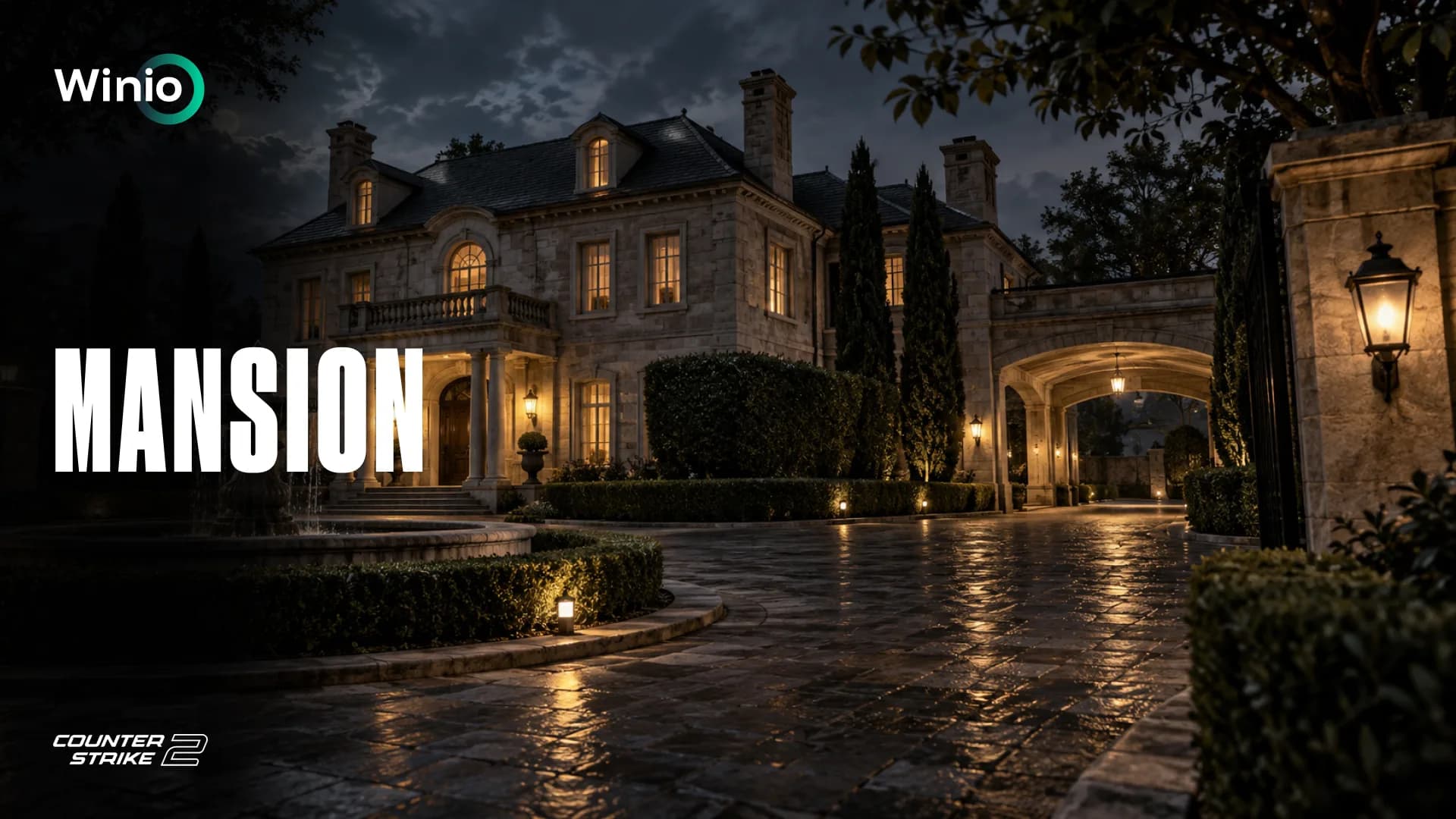
Mansion, known as cs_mansion, was one of only four maps included in Counter-Strike Beta 1.0. Its compact hostage-rescue layout, open courtyard and highly penetrable walls created fast and chaotic rounds that would be almost impossible to imagine in modern competitive CS2.
Mansion was never balanced enough to become a professional standard. Its importance comes from something else: the map helped define how the earliest Counter-Strike players understood hostage scenarios, team roles and multiplayer level design.
Was Mansion the First Counter-Strike Map?
Mansion is frequently described as the first Counter-Strike map, but that description requires context.
Counter-Strike Beta 1.0 launched on June 19, 1999 with four hostage-rescue maps:
- Mansion
- Siege
- Prison
- Wpndepot
Mansion was therefore not the only map available at launch. It was one of the first official community maps selected for the original public beta.
Who wins?
All MatchesFree Today Circuito Retake Season 13
30.10 12:00
 BASEMENT BOYSToobisie
 Free for everyone · factor breakdown
Prediction: Toobisie
27%73%Tesla Cup 2026
Today 11:00
 B8Alliance

Its reputation as “the first map” probably comes from its connection to early development and testing, as well as the strong impression it made on the first generation of players.
While several other Beta 1.0 locations disappeared from public memory, Mansion continued circulating on community servers and inspired numerous remakes.
Who Created Mansion?
Mansion was created by Swedish level designer Magnus Lind.
Lind was a university student in Örebro when he began experimenting with level design. He had previously worked with mapping tools for games such as Quake II before moving to Half-Life.
Jess Cliffe, one of the creators of Counter-Strike, discovered Lind’s work after seeing SpyHard, a map created for Team Fortress Classic. Cliffe contacted him and asked whether he could produce a map for the first Counter-Strike beta.
Lind initially declined because of his university commitments. He soon reconsidered and began working on Mansion under significant time pressure.
The first version was completed within a very short development window. Counter-Strike was still a community-driven Half-Life modification, and its creators needed enough playable locations for the public release.
This explains both the originality and the limitations of Mansion. It was built through experimentation rather than a long process of professional testing.
Mansion in Counter-Strike Beta 1.0
Mansion appeared in the first public version of Counter-Strike on June 19, 1999.
At that point, many features now considered fundamental to Counter-Strike were still evolving. The game did not have an established competitive map pool, standardized level-design principles or decades of professional match data.
All four launch maps used the hostage-rescue scenario. The bomb-defusal mode that later became the foundation of professional Counter-Strike had not yet been introduced.
Mansion immediately stood out because of its clear visual concept. The map centered on a large two-story house surrounded by a courtyard, fence and smaller structures.
Players could understand the basic objective quickly:
- Terrorists controlled the mansion and guarded the hostages.
- Counter-Terrorists approached from outside.
- Counter-Terrorists had to enter the building, find the hostages and escort them to safety.
The simplicity made Mansion accessible, but the placement of each team created serious balance problems.
Mansion Map Layout
Mansion had a compact structure compared with modern Counter-Strike maps.
The main areas included:
- The two-story mansion
- The front courtyard
- The swimming pool
- The garden and bushes
- A small external building
- Counter-Terrorist spawn
- The underground sewer
- Windows and balconies around the house
The mansion contained similar rooms connected by corridors and staircases. Hostages were positioned inside the building, while the Counter-Terrorists started outside the property.
This created a direct assault scenario. Counter-Terrorists had to cross exposed territory before they could begin clearing the building.
Terrorists started closer to the strongest positions and could prepare before the rescue team reached the house.
The Hostage-Rescue Objective
Mansion was built around the original hostage-rescue mode.
Three hostages were placed inside the house. One was located on the lower floor, while two were held on the upper level.
Counter-Terrorist Objective
The Counter-Terrorists needed to enter the mansion, locate the hostages and escort them back to the rescue zone.
A typical CT round involved:
- Leaving the protected spawn area.
- Crossing the open courtyard.
- Reaching a window, door or alternative route.
- Clearing the rooms and staircases.
- Finding the hostages.
- Escorting them through the same dangerous territory.
This placed an enormous burden on the rescuing team. Winning the first fights was not enough because the Counter-Terrorists still had to complete the objective and return with the hostages.
Terrorist Objective
The Terrorists needed to prevent the rescue.
They could defend the rooms and staircases, hold the windows or take aggressive fights outside the house. Since they began inside the objective area, they usually had enough time to establish favorable positions.
The layout also allowed Terrorists to leave the mansion and pressure the Counter-Terrorist spawn.
This frequently turned the intended defensive side into the more aggressive team.
Why Mansion Was Heavily T-Sided
Mansion strongly favored the Terrorists.
The Counter-Terrorists had to approach the house across open ground with limited cover. At the same time, Terrorists could watch the courtyard from windows, balconies and protected rooms.
Several design decisions increased this imbalance.
Exposed CT Approaches
The main routes toward the mansion were visible from multiple windows.
Counter-Terrorists could be attacked before reaching the building, especially when the Terrorists used sniper rifles or coordinated their positions.
Strong Defensive Positions
The Terrorists controlled the objective from the start.
They could hold staircases, hide inside rooms and watch the entrances without needing to take control of additional territory.
Aggressive Windows
The windows were not only defensive positions.
Terrorists could jump outside, attack the Counter-Terrorists early and retreat or continue toward CT spawn. This made the opening seconds of each round unpredictable.
Difficult Hostage Extraction
Even after reaching a hostage, the Counter-Terrorists still had to leave the house.
The return route could be watched from upper windows or contested by surviving defenders. Rescuing the hostages was often more difficult than simply eliminating the opposing team.
Wall Penetration on Mansion
One of Mansion’s most memorable features was the ability to shoot through large parts of the house.
The building offered less protection than its appearance suggested. Players could take damage through walls without seeing the opponent directly.
This produced chaotic fights and rewarded players who understood common positions.
Wall penetration also made defensive camping less reliable. A Terrorist hiding in a familiar room could be eliminated by an opponent firing through the wall from outside or from an adjacent area.
However, the mechanic created frustration as well. New players often had no way to understand where the shots were coming from.
Modern competitive maps use materials, visual feedback and carefully designed angles to make penetration more predictable. Mansion came from a period when experimentation was more important than consistency.
Interactive Features
Mansion included several environmental details that were unusual for an early multiplayer map.
Light Switches
Players could turn lights on and off inside individual rooms.
The feature could be used to reduce visibility or confuse an opponent entering the building. It also gave night vision equipment a practical purpose.
The lighting system did not fundamentally balance the map, but it made the environment feel more interactive.
Security Cameras
Counter-Terrorist spawn contained security monitors connected to cameras around the mansion.
Players could use them to observe parts of the building and courtyard before beginning the assault.
The cameras represented an early attempt to give the attacking team information. Their practical value was limited because checking a monitor also left the player inactive and vulnerable.
The Sewer Route
An underground sewer provided an alternative approach toward the mansion.
In theory, the route helped Counter-Terrorists avoid the exposed courtyard. In practice, it created another narrow area that the Terrorists could watch.
Some community servers modified or blocked the sewer because players considered it frustrating or poorly balanced.
These server-specific adjustments show how actively the community participated in shaping early Counter-Strike maps.
Basic CT Approach on Mansion
Mansion was not designed for modern tactical play, but coordinated Counter-Terrorists still had several ways to improve their chances.
Move Before the Defense Settles
Waiting at CT spawn gave the Terrorists more time to establish window angles and aggressive positions.
A faster approach could help the Counter-Terrorists reach intermediate cover before every defensive angle was occupied.
Use Utility Before Crossing
Flashbangs and smoke grenades could reduce the danger of the open courtyard.
Utility was especially valuable against window positions. Crossing without support usually allowed the Terrorists to take uncontested shots.
Enter as a Group
A single player entering the mansion could be attacked from several rooms or floors.
Counter-Terrorists needed to move together, trade eliminations and clear each part of the building systematically.
Watch for Aggression
Terrorists frequently jumped through windows or pushed toward CT spawn.
At least one player needed to watch for early aggression while the rest of the team prepared the main approach.
Basic T Approach on Mansion
The Terrorist side had more freedom.
A passive setup could protect the hostages through layered defensive positions. An aggressive setup could pressure the courtyard and prevent the Counter-Terrorists from reaching the house.
Control the Windows
Windows provided information and early engagement opportunities.
A player holding a window could watch the main approach, support teammates outside and fall back into the building when necessary.
Cover the Staircases
The staircases connected the hostage areas and allowed Counter-Terrorists to move between floors.
Defenders needed to avoid concentrating everyone in the same room. Spreading across the stairs, corridors and windows created opportunities for trades.
Watch the Sewer
The alternative underground route could place a Counter-Terrorist close to the mansion.
Ignoring it completely allowed the rescue team to bypass some of the strongest courtyard positions.
Change the Tempo
Terrorists did not need to play passively every round.
Occasional window jumps or pushes toward CT spawn made the Counter-Terrorists spend more time checking for aggression.
Why Mansion Was Removed
Mansion had a very short official lifespan.
The original version was removed with Counter-Strike Beta 2.0 in August 1999. By then, feedback had exposed the map’s balance and geometry problems.
Magnus Lind created an updated version, and Mansion returned in Beta 3.0 in September 1999.
The update improved parts of the visual design and adjusted player spawn positions. However, it did not solve the fundamental problem: the Terrorists still controlled the most valuable territory from the beginning of the round.
Mansion was removed again with Beta 4.0 in November 1999. This time, it did not return to the official game.
The complete timeline was:
- June 19, 1999: Mansion released with Counter-Strike Beta 1.0
- August 13, 1999: Removed in Beta 2.0
- September 14, 1999: Returned in Beta 3.0
- November 5, 1999: Removed again in Beta 4.0
Its official life lasted less than five months, including the period when it was unavailable.
How Mansion Influenced Estate
Mansion’s concept later inspired Estate, created by David “Zaphod” Marsh.
Estate used a similar hostage-rescue scenario centered on a large house. However, its creator attempted to produce a more polished and playable version of the idea.
The map included a mansion, exterior approaches, underground access and defensive windows. Its geometry and presentation were more detailed than the original Mansion.
Estate entered the official game in Counter-Strike Beta 6.5 and remained available longer than Mansion.
The relationship between the two maps demonstrates Mansion’s influence. Even though the original design was removed, its central idea remained strong enough to inspire a successor.
Mansion’s Community Legacy
Mansion survived outside the official map pool.
Community servers continued distributing versions of the map, particularly during the Counter-Strike 1.6 era. For many players, Mansion became associated with computer clubs, public servers and informal matches rather than professional competition.
Its appeal came from immediacy.
Players did not need to learn complicated rotations or dozens of grenade lineups. The objective was visible, the routes were understandable and the first fight could begin within seconds.
Numerous remakes and adaptations later appeared for Counter-Strike: Source, CS and other versions of the game.
These projects preserved the original structure while changing textures, lighting, hostage placement or individual routes.
Is Mansion Available in CS2?
Mansion is not part of the official CS2 map pool.
Unofficial remakes inspired by cs_mansion can be found in the Steam Workshop. These versions allow players to explore the map in the Source 2 engine, but they are community projects rather than Valve-supported releases.
The layout would require substantial changes before it could meet modern competitive standards.
An official CS2 version would need:
- More cover on CT approaches
- Better balance between the teams
- Clearer wall-penetration rules
- Improved visibility
- Safer hostage extraction routes
- More meaningful map-control decisions
- Updated lighting and collision
- Extensive playtesting
A faithful remake could work as a nostalgic community map, but a competitive version would need to move far beyond the original design.
What Mansion Shows About Early Counter-Strike
Mansion is valuable as a record of how Counter-Strike evolved.
The earliest maps were not built using established competitive principles. Their creators were discovering those principles while players tested the game.
Mansion revealed several ideas that became important later:
- Team starting positions determine the pace of a round.
- Objectives must be reachable without crossing excessively exposed areas.
- Alternative routes need to create real tactical choices.
- Strong positions require meaningful counters.
- Environmental interaction can make a map memorable.
- Simple layouts can be popular even when they are not balanced.
Modern Counter-Strike maps are the result of decades of testing, match data and professional feedback. Mansion shows what the game looked like before those standards existed.
The Map That Captured Early Counter-Strike
Mansion did not become a competitive classic like Dust2, Nuke or Inferno.
It was created quickly, heavily favored the Terrorists and disappeared from the official game only a few months after its debut. Yet players continued to remember and remake it for decades.
That longevity shows that a map does not need perfect balance to become part of gaming history.
Mansion captured the experimental character of early Counter-Strike, when community creators were still defining what the game could become.
Modern professional matches are far more structured, but maps continue to shape team performance, tactical options and winning probabilities.
Winio analyzes current map pools, team form, player statistics and match history to show what the data says before the server decides the result.
Explore upcoming CS2 matches and data-driven predictions at Winio.