

Nuke Callouts in CS2
Nuke is one of the most demanding maps in the CS2 competitive pool.
Its two-level structure, vertical gameplay and unusual routes between the bombsites completely change how rounds develop. Footsteps above you may belong to an opponent attacking the other site, while a player spotted Outside can disappear into Secret and reach the lower level within seconds.
Individual aim still matters, but Nuke is primarily decided by timing, communication, utility and spatial awareness.
This guide covers the essential Nuke callouts, the history of the map, CT and T-side strategies, useful grenades and the areas that determine most rounds.
The History of Nuke
Nuke first appeared during the Counter-Strike beta period in 1999. The map was created by Jo Bieg, who introduced a concept that was unusual for the time: two bombsites placed on different floors of the same industrial complex.
The vertical layout immediately separated Nuke from traditional maps. Players had to understand not only horizontal routes but also how sound, vents and stairways connected the upper and lower levels.
Who wins?
All MatchesFree Today European Pro League Series 10 Play-In
Tomorrow 12:00
 RyvexRounds
 Free for everyone · factor breakdown
Prediction: Ryvex
62%38%Tesla Cup 2026
Tomorrow 11:00
 B8Alliance

Nuke received new versions in Counter-Strike: Source and CS. Valve repeatedly adjusted its geometry, visuals and balance while preserving the central idea of a nuclear facility with two vertically connected bombsites.
The current version takes place at the Cedar Creek nuclear power plant in the United States. Earlier versions were set in Germany, but the environment was moved to an American industrial zone during the 2016 rework.
The upper A site sits inside the main building. The lower B site is positioned almost directly beneath it, which creates the vertical rotations and sound cues that define the map.
Nuke A Site Callouts
A is the upper bombsite inside the main building. Terrorists can enter through Hut, Squeaky or Mini, while CT players can defend from Heaven, Rafters, Main and several positions inside the site.
The essential A site callouts are:
- A Site
- Hut
- Squeaky
- Mini
- Main
- Vent
- Rafters
- Heaven
- Hell
- Tetris
- Mustang
- Blue Box
- Default
- Silo
- Lobby
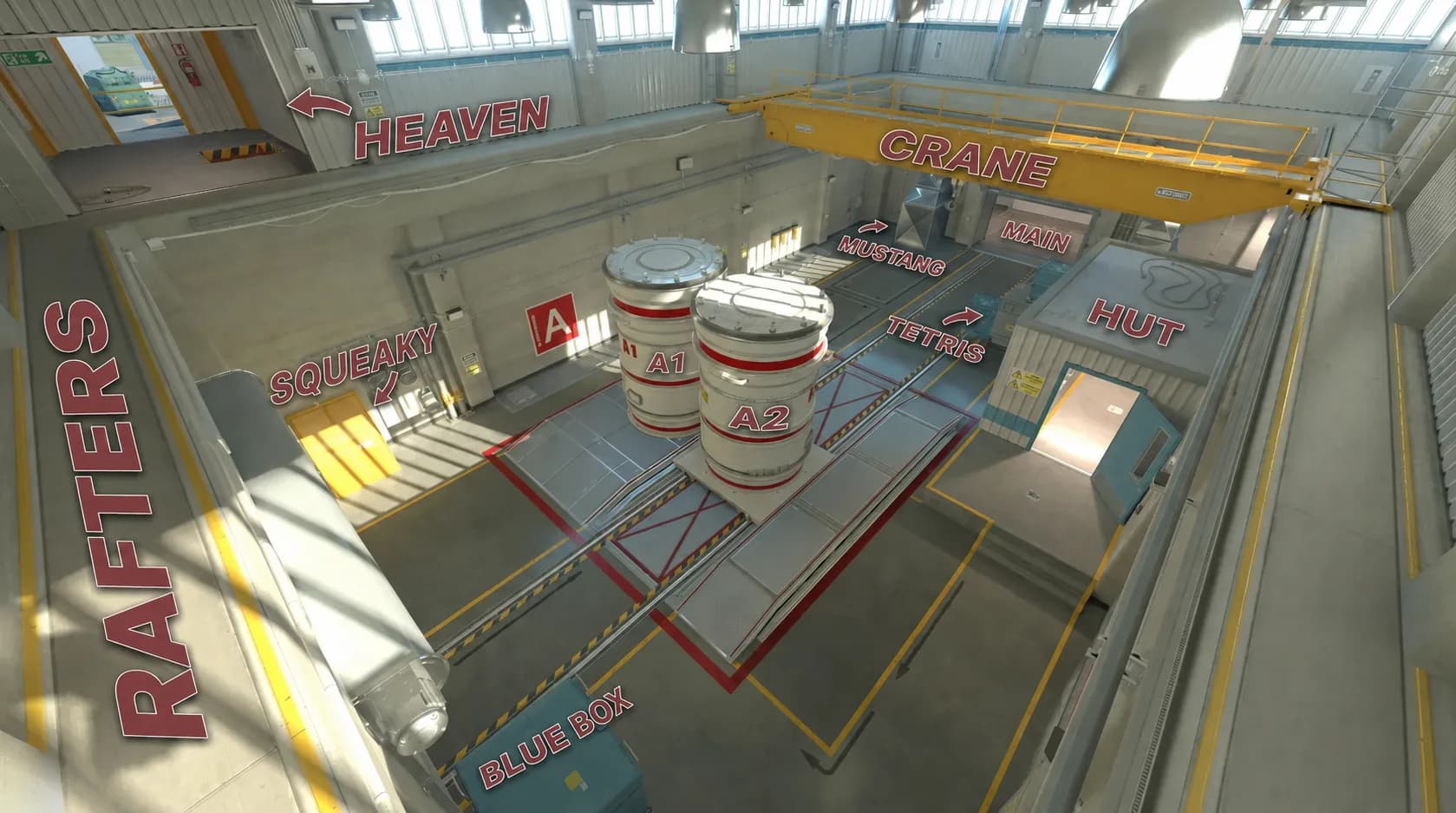
Callout names can vary between regions and teams. Mini is sometimes called Main, while Main can refer to the larger connecting area outside the doorway. Confirming terminology before a match helps prevent confusion.
Hut
Hut is one of the main entrances from Lobby into A. It creates a close-range fight against defenders on Rafters, Tetris and the site.
A player leaving Hut can quickly pressure Heaven or drop toward Vent, but the doorway is narrow and easy to block with utility.
Squeaky
Squeaky is the small door connecting Lobby with the front of A.
Terrorists can open or destroy the door before using flashes and Molotovs to enter. Squeaky also provides one of the fastest routes to Vent, allowing a player to drop toward B.
Mini
Mini connects Outside with the upper bombsite.
Controlling Mini gives the Terrorists another entrance to A and forces the defenders to watch both the inside routes and Outside. CT players often use this position to support Outside before falling back to the site.
Rafters
Rafters run along the upper walls of A.
A defender on Rafters can watch Hut, Squeaky and parts of the site. The position is powerful because it provides elevation, but it becomes vulnerable once the attackers control Heaven or use flashes above the site.
Heaven
Heaven is the elevated room overlooking A.
It provides strong sightlines across the site and connects to the ladder leading down to Hell. Heaven is valuable during both the initial defense and an A retake.
Hell
Hell is the area directly beneath Heaven.
A player in Hell can hide from attackers on the site, support Mini and prepare a late peek during the retake.
Tetris
Tetris refers to the boxes near Hut and the center of A.
The position provides cover against several entrances but can be cleared with Molotovs and grenades. It is often used by defenders playing close to Hut.
Vent
Vent connects the upper and lower levels.
Terrorists can break the vent and drop toward B, while CT players can use the same route for fast rotations. Sound from the vent often reveals whether a player is committing to the lower level.
Default
Default is the most common planting position on A.
It provides cover from some angles but remains exposed to Heaven, Rafters and parts of Main. The best plant position depends on which areas the attacking team controls.
Nuke B Site Callouts
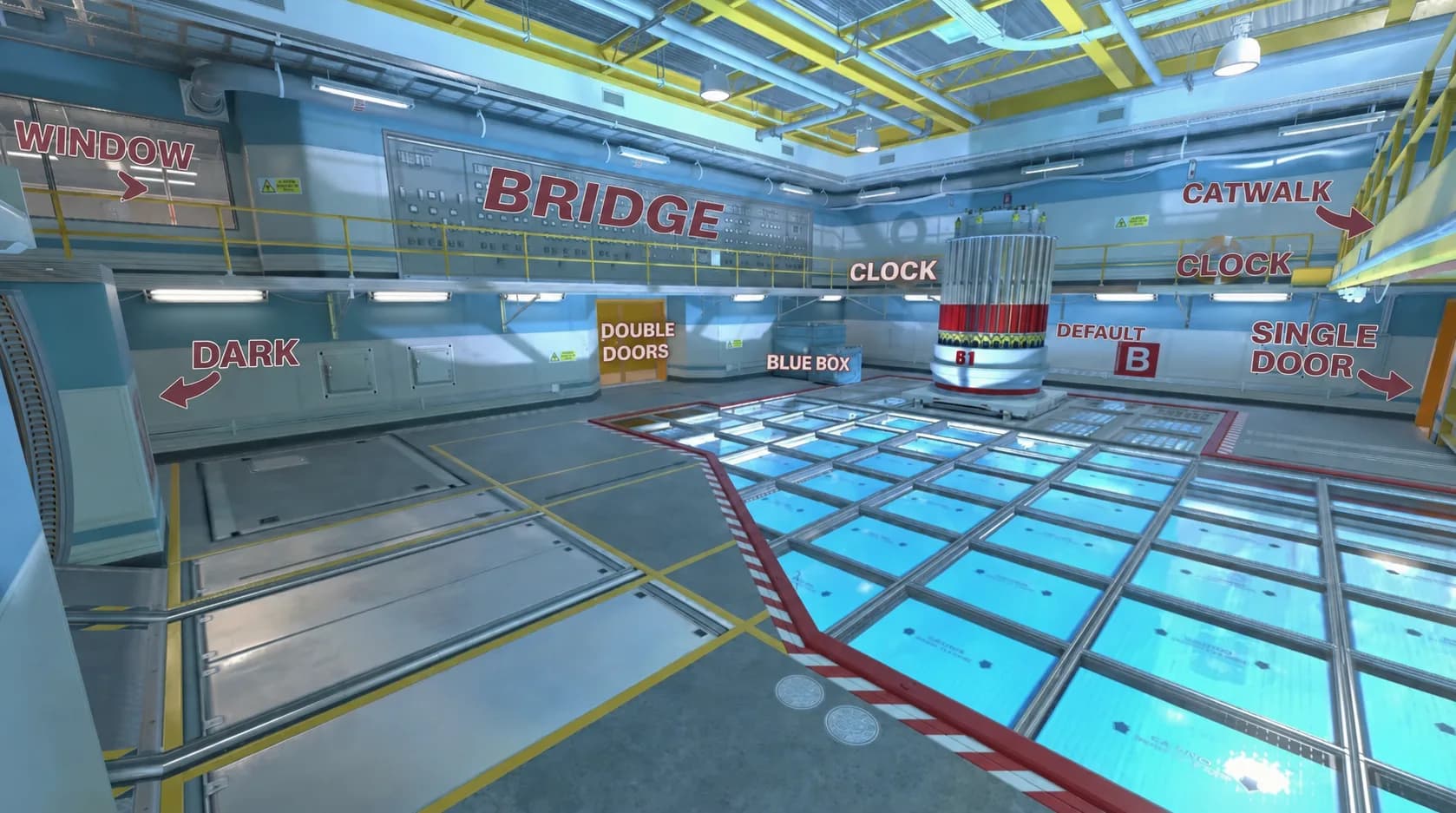
B is the lower bombsite and the center of Nuke’s vertical gameplay.
Terrorists can reach it through Ramp, Secret, Vent or the Double Doors area. Because several routes converge on the lower level, precise callouts are essential.
The main B site callouts are:
- B Site
- Ramp
- Ramp Room
- Radio
- Trophy
- Control Room
- Double Doors
- Single Door
- Decon
- Toxic
- Dark
- Back Vents
- Tunnel
- Secret
- Window
- Blue Box
- Default
Ramp
Ramp is the sloped route from Trophy toward the lower level.
It is one of the most important areas on Nuke. If the Terrorists take Ramp, they can continue toward B, rotate into Secret or force the Ramp defender to call for support.
Radio
Radio is the room connecting Lobby with Trophy and Ramp.
It is a common staging area for Ramp attacks. Close corners and narrow doorways make coordinated flashes essential.
Trophy
Trophy connects Radio, Ramp and the route back toward Lobby.
It is named after the display cases inside the room. CT players can hold from Trophy, but staying too long risks being trapped by utility.
Control Room
Control Room sits near the lower section of Ramp.
A defender can use it to delay an attack or surprise players moving toward B. Terrorists should clear it before committing to the lower site.
Double Doors
Double Doors provide one of the main entrances into B.
They connect the lower hallway with the bombsite and offer long sightlines across the room. Smokes and flashes can isolate defenders watching from the site.
Single Door
Single Door is the narrower entrance on the opposite side of the site.
It can be used during a split to pressure defenders from another angle. A player controlling Single Door also limits CT movement during the post-plant.
Decon
Decon is the small room connecting the lower hallway with B.
The room has a door that can reveal movement through sound. It is a frequent position during executes, retakes and post-plant situations.
Dark
Dark is a concealed position near the edge of B.
Players entering the site often overlook it, making it dangerous during fast executes. It should be cleared with a grenade, Molotov or coordinated peek.
Back Vents
Back Vents connect B with the ventilation system.
They allow players to rotate between levels and appear behind opponents who are focused on the main entrances.
Default
Default is the most common planting area on B.
The plant can be covered from several positions, including Double Doors, Single Door and the site itself. Teams should choose the plant based on which entrances they control.
Nuke Outside Callouts
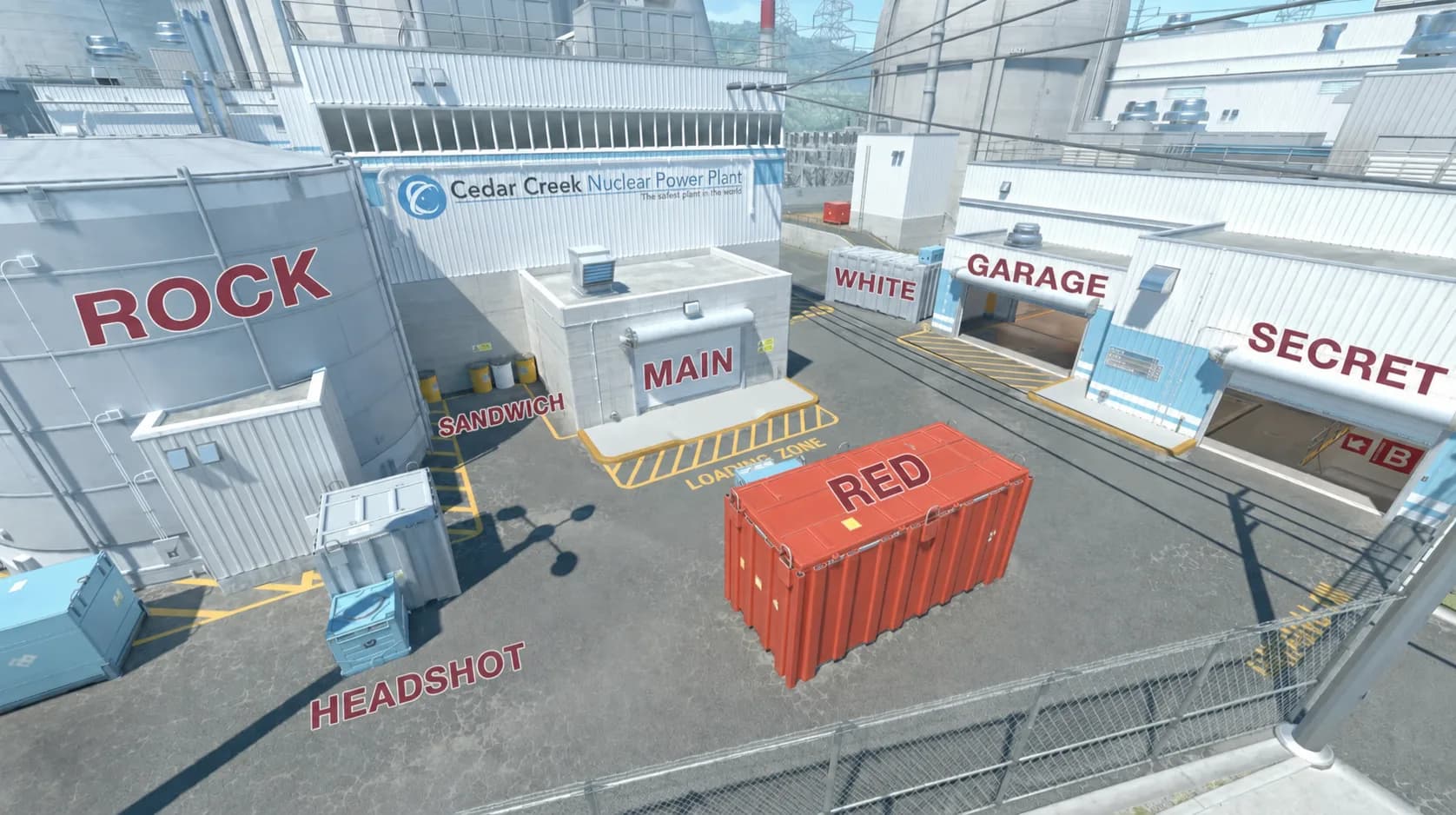
Outside, sometimes called Yard, is the largest open area on Nuke.
Control of Outside opens routes toward Secret, Mini, Garage and Heaven. Losing information in this area can leave the CT side unsure whether the attackers are moving toward A or B.
The essential Outside callouts are:
- Outside
- Yard
- T Red
- Red Container
- Garage
- Secret
- Main
- Mini
- Silo
- Marshmallow
- Blue Box
- White Box
- Credit Card
- Sandwich
- CT Spawn
- Hell
- Heaven
T Red
T Red is the large red container near the Terrorist side of Outside.
It provides cover during early fights and is commonly used as a reference point for smoke lineups.
Garage
Garage is the large structure at the far side of Outside.
It offers cover and long sightlines toward T Red, Silo and Secret. CT AWPers frequently use Garage to contest Outside.
Secret
Secret is the staircase leading from Outside to the lower level.
Once the Terrorists reach Secret, they can pressure B through Tunnel and create difficult rotations for the defense.
Main
Main connects Outside with the A site.
Control of Main allows the attacking team to split A with players coming from Hut or Squeaky.
Silo
Silo is the large structure near T Spawn.
Players can climb onto it to gain an elevated view of Outside and the roof. Because the position is exposed, it is most effective when combined with flashes or smoke cover.
Marshmallow
Marshmallow refers to the top of Silo.
The unusual name comes from the rounded white surface. A player in this position can watch Outside but becomes visible from several defensive angles.
Red Container
Red is the central container in Outside.
It provides cover from Garage, CT Spawn and Main. Attackers often use it while moving toward Secret.
Credit Card
Credit Card is the narrow position near the outside wall and Blue Box.
The area can hide a defender attempting to surprise Terrorists moving through Outside.
Sandwich
Sandwich is the space between the large containers and nearby structures.
Players use it to avoid open sightlines while progressing toward Secret or Main.
Important Connections on Nuke
Understanding the individual bombsites is not enough. Nuke is defined by the routes connecting them.
Lobby
Lobby connects Hut, Squeaky, Radio and the route toward Ramp.
Terrorists often begin rounds here because it allows them to threaten both bombsites without immediately revealing the final plan.
Vent
Vent provides the fastest connection between A and B.
A Terrorist dropping through Vent can reach the lower level before some CT rotations arrive. Defenders should immediately communicate when Vent is broken.
Secret
Secret connects Outside with the lower tunnels.
It is the foundation of most Outside-to-B strategies. Once Secret control is lost, the CT side must watch both the lower site and possible rotations back toward Ramp.
Ramp
Ramp connects Trophy with the lower level and Secret.
It can be used for a direct B attack, a delayed rotation or a fake designed to pull defenders away from A.
Heaven and Hell
Heaven and Hell connect the upper site with Outside and CT rotations.
Controlling these areas gives a team strong vertical influence over A and limits how defenders can retake the site.
Teams to Study on Nuke
Team Falcons, Team Vitality, Astralis, MOUZ and FURIA are useful teams to study when learning high-level Nuke.
Their matches demonstrate:
- Structured Outside control
- Fast vertical rotations
- Coordinated upper-site executes
- Effective Ramp protocols
- Late-round fakes
- Strong CT information systems
AWP players can study m0NESY and device to understand how elite snipers approach Outside, Ramp and rotations between the two levels.
Riflers can focus on players such as flameZ, especially when studying aggressive CT positioning, opening duels and retakes.
How to Play Nuke on the CT Side
Nuke defense is built around information.
Passive setups can work, but CT players cannot afford to lose Outside, Ramp and Lobby without knowing where the Terrorists are moving.
Control the Upper Level
The upper part of the map determines the pace of the round.
A CT setup normally needs players responsible for:
- Hut and Squeaky
- Mini and Outside
- Heaven and Rafters
- Ramp
- Fast lower-site rotations
If the defense loses both Outside and Lobby control, the Terrorists gain access to almost every important route.
Define Roles Before the Round
Each player should know their responsibility.
The Outside defender tracks movement toward Secret and Main. The Ramp player delays pressure and reports lower rotations. The A players watch Hut, Squeaky and Vent.
Clear roles prevent multiple CT players from reacting to the same sound while another route remains completely open.
Use Utility to Collect Information
Utility on Nuke does more than stop an execute.
An HE grenade can reveal whether players are crossing Outside. A Molotov can delay a Hut rush. A smoke can isolate Squeaky or prevent an immediate Ramp push.
CT players should avoid using every grenade during the first seconds. Late utility becomes extremely valuable because Nuke executes often happen after long periods of map control and fakes.
Read Outside Smokes Carefully
Terrorists commonly create a wall of smokes across Outside to reach Secret.
The defense can respond in several ways:
- Throw HE grenades through the smoke
- Use incendiaries to delay the cross
- Boost a player for an elevated view
- Push through one edge with a flash
- Fall back and prepare for a lower execute
Blindly spraying every smoke can reveal the defender’s position without providing reliable information.
Change Positions
Nuke rewards unpredictable defense.
A player who holds the same angle from Garage or Heaven every round becomes easy to isolate. Moving between Garage, Main, CT Spawn and Secret makes Outside harder to read.
How to Play Nuke on the T Side
A successful T side needs a clear plan but must remain flexible.
Fast attacks can work, yet Nuke gives CT players several early information opportunities. Structured rounds usually combine pressure, utility and sound cues before the final execute.
Establish a Round Plan
Before the round begins, decide which areas the team needs to control.
Common objectives include:
- Cross Outside into Secret
- Pressure Ramp
- Take Lobby control
- Execute A through Hut and Squeaky
- Split B through Secret and Vent
- Force CT utility before changing direction
Every player should understand which part of the plan creates space and which part delivers the final attack.
Use Fakes and Sound
Nuke is heavily influenced by audio.
Running on A, breaking Squeaky or throwing utility into the upper site can force CT players to rotate. The Terrorists can then move through Ramp or Secret toward B.
A convincing fake needs enough pressure to produce a reaction, but the team should not spend every grenade before the real execute.
Control Outside
Outside control creates access to Secret, Main and Heaven.
A standard smoke wall allows Terrorists to cross toward Secret while limiting the defenders’ vision from Garage and CT Spawn.
The attacking team should still watch for CT players pushing through the smokes or holding from elevated positions.
Communicate Vertical Movement
Calls should specify both the position and level.
“Two site” is not enough on Nuke. Teammates need to know whether the opponents are on upper A, lower B, Heaven, Vent or Ramp.
The same applies to sound. A player heard above B may actually be moving through A or Vent.
Essential Utility on Nuke
Nuke’s limited entrances and long Outside sightlines make utility a central part of every round.
Utility for an A Execute
A standard A execute can include:
- Molotov for Hut
- Molotov for Rafters
- Smoke for Heaven
- Smoke for Mini
- Flashes through the roof windows
- Flashes above Hut or Squeaky
- HE grenades for Tetris and Default
The goal is to isolate the defenders and prevent Heaven, Rafters and Mini from watching the entire site.
Timing is essential. Hut and Squeaky players should enter together so the defense cannot focus on one doorway.
Utility for Outside Control
The standard Outside smoke wall creates a protected route toward Secret.
The setup normally uses:
- Smoke near Red
- Smoke near Garage
- Smoke blocking CT or Heaven vision
- Flashes above Outside
- Molotovs for common close positions
The exact lineup can vary, but the objective stays the same: remove the Garage and CT sightlines long enough for the team to cross.
A smoke wall can also be used as a fake. Terrorists can throw the utility without sending anyone to Secret, forcing the CT side to respect a possible lower attack.
Utility for a B Execute
A lower-site execute should remove defenders from the entrances and protected corners.
Useful grenades include:
- Smoke for Double Doors
- Smoke for Decon
- Molotov for Dark
- Molotov for behind the reactor
- Flashes through Single Door
- HE grenades for Default
- Utility to block the Ramp rotation
The attacking team should identify which route the defenders can use during the retake and choose the plant position accordingly.
Effective T-Side Strategies
Outside to Secret B Split
The team creates an Outside smoke wall and sends several players toward Secret.
Another group holds Lobby, Vent or Ramp to prevent CT rotations. The two groups then attack B from different directions.
The split works because the lower defenders must watch Secret, Ramp, Decon and Vent simultaneously.
A Execute Through Hut and Squeaky
This is the most direct upper-site attack.
The team uses flashes above A and Molotovs for Rafters, Hut or Tetris. Hut and Squeaky players enter together while another player watches Mini.
The execute becomes much stronger if Outside pressure has already forced one defender away from A.
Ramp Pressure Into Lower
Several players take Radio and Trophy before attacking Ramp with flashes.
After forcing the Ramp defender back, the team can continue toward B, move into Secret or return to Lobby.
The value of Ramp control comes from flexibility. The Terrorists do not need to commit immediately after winning the area.
A Fake Into B
The team creates noise and throws utility on A.
After the CT side begins rotating upward, the bomb moves toward Ramp, Vent or Secret. The fake must be timed carefully because Nuke rotations between the two levels can be very fast.
Outside Fake Into A
The Terrorists throw the standard Outside smokes but keep most players in Lobby.
Once the CT side adjusts toward Secret and the lower level, the main group executes A through Hut and Squeaky.
Effective CT-Side Strategies
Aggressive Outside Control
A CT player can push Outside with support from flashes or a Garage teammate.
The objective is to collect information, disrupt the smoke wall and identify whether the Terrorists are preparing a Secret cross.
This strategy carries significant risk. The player should have a clear escape route and immediate support.
Default Defense
A balanced setup assigns players to A, Ramp and Outside while preserving fast rotations.
The defense should avoid overreacting to individual grenades. Information from Outside, Lobby and Ramp determines where the extra player should move.
Active Hut and Ramp Play
Aggression around Hut or Ramp can disrupt the Terrorists before they establish their default.
Close defenders should change positions and timings regularly. Repeating the same push makes it easy for the attackers to prepare a flash or prefire.
Advantages and Disadvantages of Nuke
Advantages
- Tactical variety. Nuke supports fast executes, long defaults, fakes, splits and aggressive CT setups.
- Vertical gameplay. The two levels create unusual rotations and sound-based decisions.
- High skill ceiling. Map knowledge, positioning and utility provide a significant advantage.
- Strong team identity. Organized teams can develop detailed systems for every important area.
- Multiple rotation routes. Players can move through Vent, Ramp, Secret, Heaven and Main.
Disadvantages
- Difficult for new players. The overlapping floors and similar rooms make navigation confusing.
- Heavy dependence on communication. Missing one Outside or Ramp call can compromise both bombsites.
- Complicated sound information. Footsteps do not always reveal which level the opponent is on.
- Utility knowledge is essential. Dry peeks into Outside or A often favor prepared defenders.
- Mistakes can affect the entire map. Losing Secret or Vent creates immediate pressure on both levels.
Nuke becomes more rewarding as players understand its structure. Once the rotations make sense, the map feels far less chaotic.
Interesting Facts About Nuke
- Nuke first appeared in 1999 and is one of the oldest competitive Counter-Strike maps.
- Its bombsites are positioned on separate floors of the same building.
- The bombsite cover uses radioactive waste containers instead of the standard wooden crates found on many maps.
- Earlier versions were set in Germany.
- The setting was moved to the American Rust Belt during the 2016 rework.
- The current location is known as the Cedar Creek nuclear power plant.
- Nuke has received major visual and structural updates across Counter-Strike, Counter-Strike: Source, CS and CS2.
- A vehicle at CT Spawn in CS2 contains a musical reference to Left 4 Dead.
Learn the Structure, Then Read the Match
Learning the callouts helps you navigate Nuke. Understanding rotations, utility and vertical pressure explains why professional teams make particular decisions.
These details also influence match probabilities. A team’s performance on Nuke depends on its map pool, side-specific results, Outside protocols, player roles and ability to manage rotations between the two levels.
Winio analyzes these factors across thousands of matches to show what the data says before the server decides the result.
Explore upcoming CS2 matches and data-driven predictions at Winio.