
Office Callouts in CS2
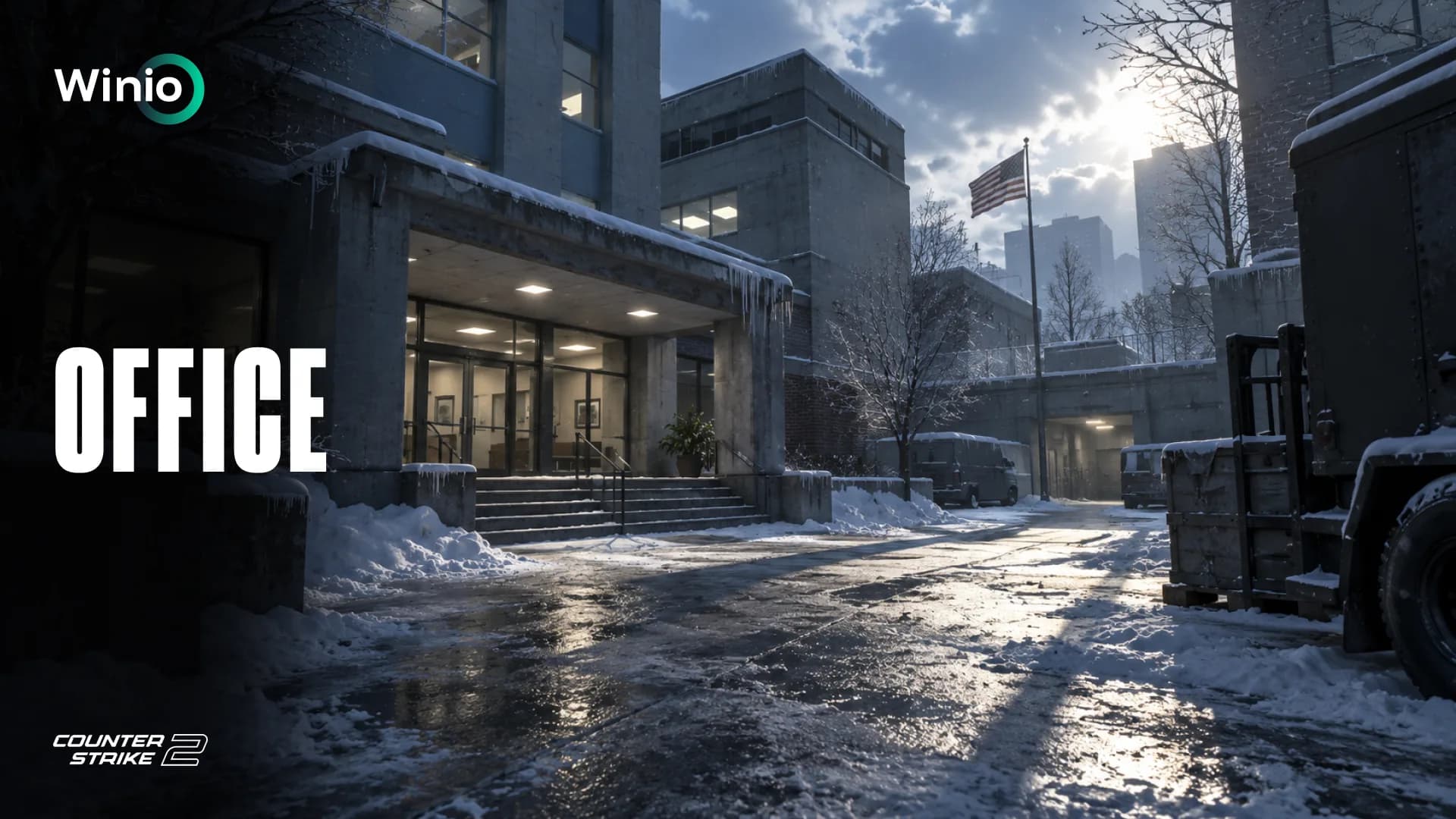
Office is one of the oldest and most recognizable hostage-rescue maps in Counter-Strike.
Its snow-covered exterior, narrow corridors, cubicle-filled rooms and long sniper angles create a style of play that feels completely different from the bomb-defusal maps used in Premier and professional tournaments.
Counter-Terrorists must enter the building, locate a hostage and carry them to a rescue zone. Terrorists begin inside the office and must prevent the rescue.
This reversal of the usual attacking and defending roles makes Office unusual. The Terrorists control the objective from the beginning, while the Counter-Terrorists need to break through narrow entrances and return safely with a hostage.
This guide covers the history of Office, its essential callouts, hostage mechanics, utility, team strategies and the mistakes that decide most rounds.
The History of Office
Office was created by Alexander “Hobbit” Manilov and introduced in Counter-Strike Beta 7.0 in August 2000.
Who wins?
All MatchesFree Today NODWIN Clutch Series #12
Tomorrow 11:00
 SPARTABAKS
 Free for everyone · factor breakdown
Prediction: SPARTA
71%29%NODWIN Clutch Series #12
Today 11:00
 BRUTEG2 Ares

The map appeared near the end of Counter-Strike’s beta period and quickly became one of the game’s most recognizable hostage-rescue locations.
Its central concept has remained consistent across the series:
- Terrorists control an office building.
- Hostages are held inside the building.
- Counter-Terrorists begin outside near the parking area.
- The CT side must enter, secure a hostage and return to a rescue zone.
Office later appeared in Counter-Strike 1.6, Counter-Strike: Condition Zero, Counter-Strike: Source, CS and CS2.
Different developers updated its visuals and individual areas over the years, including Ritual Entertainment, Turtle Rock Studios, Hidden Path Entertainment and Valve. However, the basic layout and winter office setting remained recognizable.
The CS2 version uses Source 2 lighting and materials, making the snow, glass, interior rooms and environmental objects more detailed. The map’s fundamental structure remains close to the version familiar to CS players.
Is Office in the CS2 Map Pool?
Office is an official CS2 map and can be played through supported matchmaking modes.
However, it is not part of Premier or the Active Duty map pool. It is also not a standard map at professional tier-one tournaments.
Office belongs to the Hostage Group rather than the competitive bomb-defusal pool.
This distinction is important. Office can have its own Competitive rank, but it does not normally affect professional map vetoes or Winio predictions for standard CS2 tournaments.
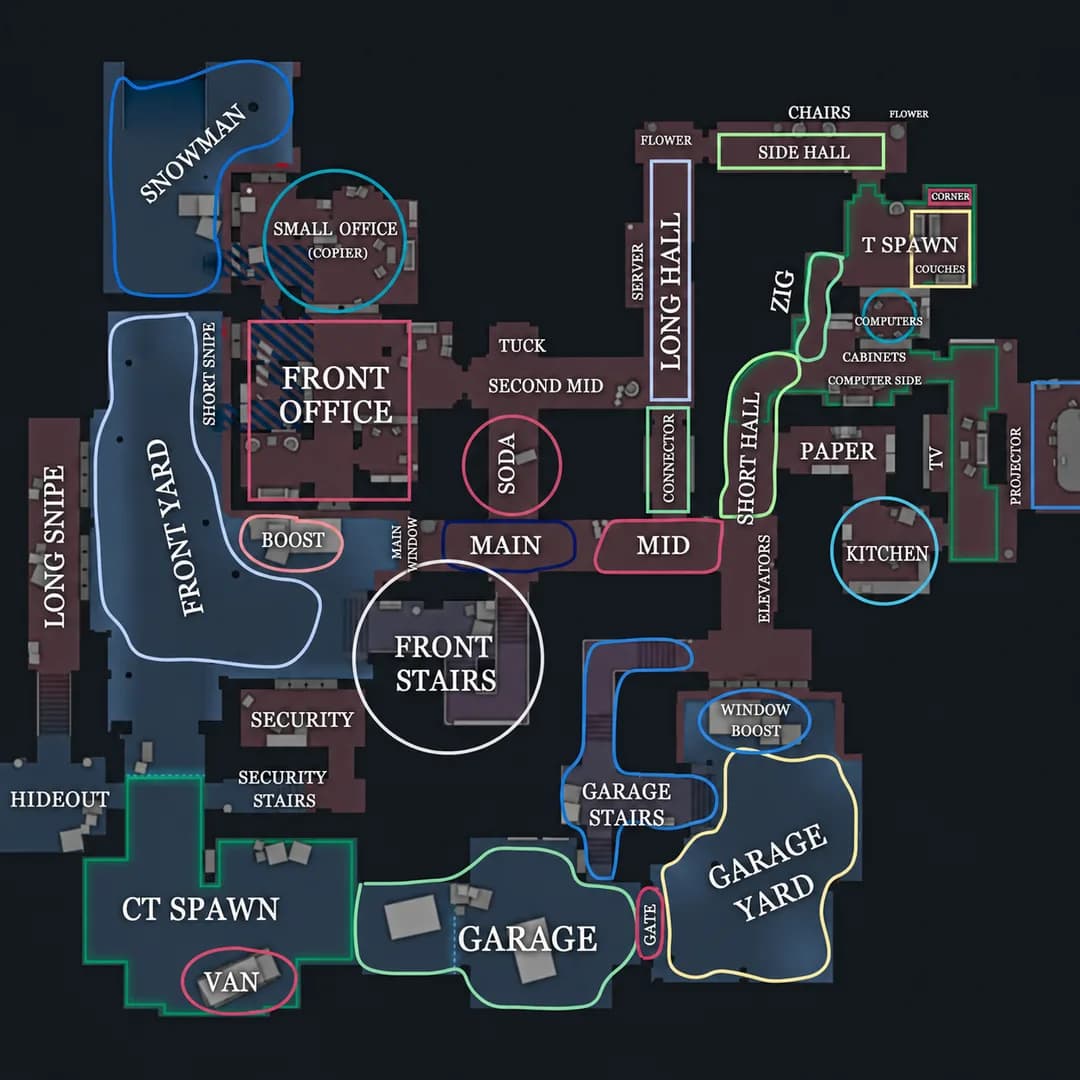
Office CT and Exterior Callouts
The Counter-Terrorists begin outside the main office area.
The essential CT-side callouts are:
- CT Spawn
- Van
- Rescue Zone
- Rescue Dumpster
- Garage
- Garage Yard
- Garage Windows
- Garage Stairs
- Front Yard
- Front Dumpster
- Snowman
- Long Snipe
- Long Snipe Hideout
- Short Snipe
- Short Snipe Stairs
- Front Stairs
Office Interior Callouts
The interior contains most of the map’s important engagements.
The essential central callouts are:
- Front Office
- Front Hall
- Main Hall
- Long Hall
- Side Hall
- Elevators
- Bathroom
- Vending
- Soda
- Paper
- Copier
- Cubicles
- Tuck
- Connector
Office T-Side and Hostage Callouts
The deepest part of the building contains T Spawn and several possible hostage positions.
The main callouts are:
- T Spawn
- Couch
- Radio
- Kitchen
- Projector
- Conference Room
- Storage
- Light
- Dark
- T Books
- CT Books
- Clock Wall
- Back Wall
How to Play Office on the CT Side
The Counter-Terrorists are the attacking team on Office.
They need to enter a building already controlled by the Terrorists, locate a reachable hostage and preserve enough time to complete the rescue.
Identify the Hostage Locations
The first strategic decision should be based on where the hostages have spawned.
A hostage near Paper or Side Hall may support a faster attack. A deeper hostage around Projector or T Spawn requires more map control and a longer return route.
The team should build its plan around the more accessible objective instead of automatically attacking the same area.
Use Multiple Entrances
A five-player attack through one hallway is easy to delay.
The CT side can divide pressure between:
- Garage
- Front Office
- Main Hall
- Front Stairs
- Exterior windows
- Side routes toward Paper
The groups should remain close enough to trade and create simultaneous pressure.
Buy a Rescue Kit
At least one player in the group targeting the hostage should carry a Rescue Kit.
Reducing the pickup time from approximately four seconds to one second can determine whether the Terrorists have time to respond.
The team should know who has the kit before beginning the final push.
Preserve Utility for the Hostage Rooms
Using every grenade at the first entrance can leave the team without tools for Projector, Paper or T Spawn.
CT players need flashes for narrow corridors, smokes to isolate long angles and incendiaries to remove defenders from corners.
Plan the Return Route
Reaching the hostage is only half of the round.
Before picking it up, the team should know:
- Which rescue zone it will use
- Which route has already been cleared
- Who will protect the carrier
- Which Terrorists may still be flanking
- How much utility remains
The hostage carrier moves more slowly and should not be expected to clear every angle alone.
How to Play Office on the T Side
The Terrorists defend the hostages and begin with positional control.
Their greatest advantage is time. The CT side must enter, clear the building and complete the rescue before the round expires.
Build the Defense Around the Hostages
The hostage locations should influence the setup.
If one hostage appears near Paper, that area requires more support. If both objectives are deep, the Terrorists can build layered positions through Main Hall, T Spawn and Projector.
Use Crossfires
Office contains many narrow corridors where two defenders can cover the same entrance from different angles.
A good crossfire forces the first CT player to expose themselves to both positions. Even if one Terrorist is eliminated, the second can trade immediately.
Treat Utility as Time
A defensive smoke does not need to produce an elimination.
If it blocks a corridor for several seconds, the CT side loses time needed for the rescue. Incendiaries can delay an entry, while flashes interrupt coordinated pushes.
Terrorists should avoid throwing every grenade during the opening seconds.
Avoid Excessive Aggression
Pushing into Front Yard or CT Spawn can produce an early advantage, but repeated aggression becomes predictable.
Losing two players outside may leave the hostages defended by an incomplete setup.
Track the Rescue Kit
If the player carrying the Rescue Kit is identified or eliminated, the CT side may need much longer to secure a hostage.
Communicating the kit’s location can influence how aggressively the Terrorists defend the objective.
Protect the Escape Routes
After a hostage is picked up, the round changes immediately.
The Terrorists should identify the likely rescue route and move to intercept the carrier. One player can pressure the route while others prevent the CT team from creating a safe escort.
Essential Utility on Office
Office’s narrow corridors make utility extremely powerful.
Players should avoid memorizing lineups without understanding their purpose.
CT Utility
Useful CT utility includes:
- Smokes for long sniper sightlines
- Flashes for Main Hall
- Pop flashes for Paper
- Incendiaries for Kitchen
- Incendiaries for close Projector positions
- Smokes to isolate one side of a hostage room
- Flashes for the final hostage pickup
- Smokes protecting the return route
The CT side should preserve at least some utility for the final objective.
T Utility
Useful T utility includes:
- Smokes to block Main Hall
- Incendiaries for Garage entrances
- Incendiaries for Front Stairs
- Flashes against Front Office pressure
- HE grenades for grouped CT players
- Late smokes around Projector or Paper
- Utility to slow the hostage carrier
Defensive grenades should be distributed between players rather than used simultaneously.
Best Weapons for Office
Office contains both close corridors and long exterior sightlines.
SMGs
The MP9 and MAC-10 are effective in tight rooms and hallways.
Their mobility is valuable when clearing corners or taking aggressive fights. They can also generate strong economic returns against lightly equipped opponents.
Shotguns
Shotguns can dominate Kitchen, Paper, Garage and other close positions.
Their effectiveness drops significantly across Front Yard and long interior sightlines, so players should choose positions that match the weapon.
Rifles
The AK-47, M4A4 and M4A1-S remain the most flexible options.
They can handle both interior fights and exterior angles without forcing the player into one specific role.
AWP
The AWP is powerful around Long Snipe, Garage Yard and long hallways.
It becomes less comfortable in rooms filled with close corners. An AWPer should have a safe fallback route when holding an interior angle.
Rescue Kit
The Rescue Kit is not a weapon, but it should be treated as an essential part of the CT loadout.
A team attempting the objective without one gives the Terrorists more time to react.
Why Office Is Not a Professional Map
Office has never become a standard map in modern professional Counter-Strike.
The main reason is not simply popularity. Its hostage-rescue structure creates a fundamentally different competitive environment.
Terrorists begin around the objective and can build deep defensive setups. Counter-Terrorists must enter through a limited number of narrow routes and complete a second journey after reaching the hostage.
Randomized hostage positions also affect the difficulty of the objective.
The professional scene is built around bomb-defusal maps with standardized vetoes, economy patterns and side-switching strategies. Adding Office would require teams to prepare for an entirely different mode.
Office remains valuable as a distinctive matchmaking map, but it is not currently relevant to normal tier-one veto analysis.
How Office Relates to Match Analysis
Office does not usually appear in the professional matches analyzed by Winio.
If it were used in a community event, showmatch or specialized tournament, its results would need to be evaluated separately from Active Duty performance.
Important factors would include:
- Hostage locations
- CT rescue success
- Rescue Kit usage
- T-side delay efficiency
- Exterior sniper control
- Close-range weapon selection
- Utility preserved for late rounds
- Performance in hostage mode
- Experience on Office specifically
Results on Mirage, Cache or Nuke would provide limited evidence because the objectives and team responsibilities are different.
This is an important analytical principle: map statistics only become meaningful when the format, opponent quality and tactical context are comparable.
Learn the Objective, Not Only the Map
Office rewards a different type of Counter-Strike.
Counter-Terrorists must combine entry utility, room clearing and escort protection. Terrorists must manage time, defend the hostage areas and know when to abandon a position to intercept the carrier.
Precise callouts make these decisions faster. Understanding Paper, Projector, Main Hall, Garage and the exterior routes allows a team to coordinate instead of entering the building as five isolated players.
Office does not influence the current professional CS2 map pool, but it demonstrates why context matters in match analysis.
Results from one map or mode cannot automatically predict performance in another. Team roles, objectives, map structure and available data must all be considered together.
Winio analyzes the relevant variables across thousands of professional matches to show what the data says before the server decides the result.
Explore upcoming CS2 matches and data-driven predictions at Winio.