

Tuscan Callouts in CS2
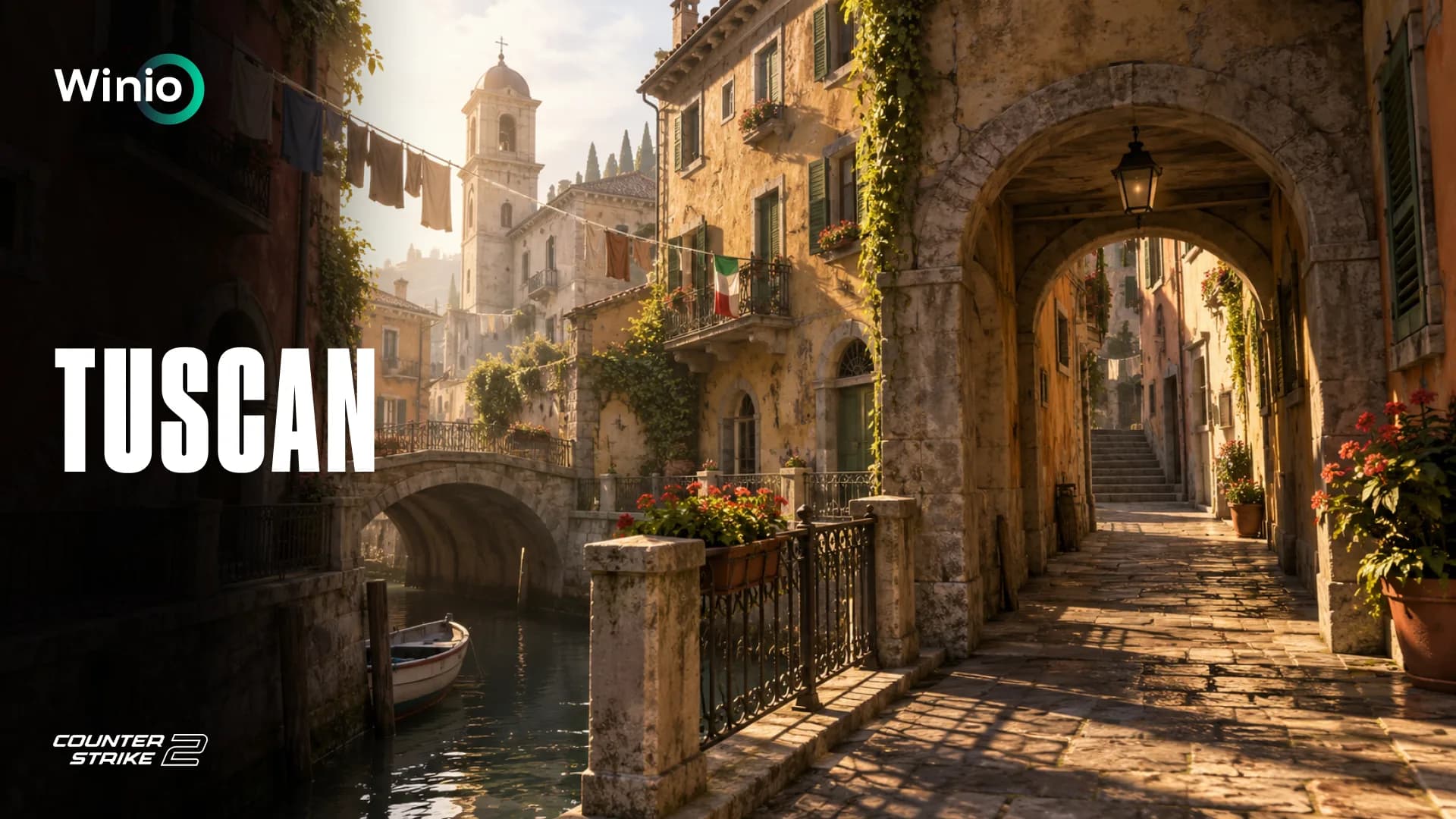
Tuscan is one of the most recognizable maps from the classic Counter-Strike era.
Set in a Mediterranean town inspired by the Italian region of Tuscany, the map combines stone buildings, narrow streets, underground passages and open courtyards. Its layout rewards coordinated map control, quick rotations and carefully timed attacks.
Tuscan was once a regular part of professional Counter-Strike 1.6. However, it never secured the same position in CS and has not become an official competitive map in CS2.
Its history explains how tournament organizers, community mapmakers and professional players helped shape Counter-Strike long before Valve controlled every part of the competitive map pool.
What Is Tuscan?
Tuscan, usually identified by the filename de_tuscan, is a bomb-defusal map with two bombsites.
Its visual identity is based on a traditional Italian settlement. Players move through streets, arches, courtyards, tunnels and compact interior spaces surrounded by pale stone buildings and Mediterranean vegetation.
Who wins?
All MatchesFree Today European Pro League Series 10 Play-In
Tomorrow 12:00
 RyvexRounds
 Free for everyone · factor breakdown
Prediction: Ryvex
62%38%Tesla Cup 2026
Tomorrow 11:00
 B8Alliance

The map is known for combining:
- Long rotation routes
- Several interconnected lanes
- Strong opportunities for flanking
- Narrow entrances into important areas
- Open spaces that reward AWP players
- Close corners that require utility
- Flexible attacking defaults
Tuscan is relatively easy to understand at a basic level, but difficult to play consistently. Teams need to control multiple areas before committing to a bombsite, and losing one part of the map can open a fast route behind the defense.
The Origins of Tuscan
Tuscan did not begin as a completely original layout.
Its predecessor was de_cpl_mill, a map developed for the Cyberathlete Professional League. The CPL was one of the most influential esports organizations during the early years of professional Counter-Strike.
At the time, major tournament organizers sometimes created their own maps. These locations could become essential parts of competitive play even if they were not included in the standard map pool available to every organizer.
Mill became one of the most respected examples.
The map had a relatively simple visual style, but its layout offered considerable tactical depth. Teams discovered boosts, aggressive timings, defensive crossfires and different ways to divide the map before an execute.
However, the rights to de_cpl_mill were connected to the CPL. Other tournament organizers wanted a similar competitive map without depending on CPL-owned content.
This created the opportunity for Tuscan.
The Creation of Tuscan
Tuscan was developed in 2005 by Colin “Brute” Volrath, who was also known for creating de_russka.
The project was associated with CEVO, a North American tournament organizer that wanted a competitive alternative to de_cpl_mill.
Brute used Mill as the foundation but changed its appearance and parts of its structure. Routes were adjusted, underground areas were redesigned and the environment was transformed into a Mediterranean town.
The result remained familiar to experienced Mill players while becoming a separate map with its own identity.
Tuscan quickly spread across community servers and professional competitions. Its combination of tactical freedom and recognizable structure made it one of the defining maps of the later Counter-Strike 1.6 period.
Tuscan in Counter-Strike 1.6
Tuscan became especially important after the decline of the CPL.
When the organization ceased operating, de_cpl_mill gradually disappeared from major tournaments. Tuscan could fill the same role without the same ownership restrictions.
Professional teams embraced the map because it supported several styles of play.
Patient teams could establish control slowly, collect information and execute late in the round. Aggressive teams could contest important areas early or use quick rotations to overwhelm an isolated defender.
Tuscan also created opportunities for individual players. Its combination of tight corners and open lanes allowed both riflers and AWPers to influence the round.
For many players, the map is inseparable from the classic Counter-Strike 1.6 competitive scene.
Edward’s Iconic Tuscan Ace
One of the most famous moments associated with Tuscan happened in 2010.
During a match between NAVI and Fnatic at the Arbalet Cup Best of Four, Ioann “Edward” Sukhariev eliminated all five opponents with USP headshots during the opening pistol round.
The entire sequence lasted only a few seconds.
The play became one of the defining highlights of Edward’s career and was later recognized as one of the best Counter-Strike moments of 2010.
It also helped preserve Tuscan in the collective memory of the community. Even players who never competed on the map may recognize it from this particular highlight.
How Tuscan Plays
Tuscan is based on map control rather than immediate bombsite attacks.
The Terrorist side usually needs to pressure several areas before choosing the final destination. If the attackers reveal their plan too early, the Counter-Terrorists have enough time to reposition and establish strong crossfires.
At the same time, defenders cannot remain completely passive. Giving up too much space creates multiple rotation routes for the attacking team and makes the final execute difficult to predict.
Long Rotations
The distance between important areas makes rotation timing particularly valuable.
A defender leaving one bombsite too early may not be able to return before the bomb is planted. Attackers can exploit this with fakes, delayed utility and changes of direction.
Clear communication is essential. Players must report not only where an opponent was spotted but also which routes may now be open.
Narrow Entrances
Several important routes on Tuscan contain narrow doorways, tunnels or arches.
These areas can be delayed with grenades and defended through crossfires. Attackers need coordinated flashes and Molotovs to avoid entering prepared angles one player at a time.
Multiple Levels
Tuscan includes elevated positions and underground connections.
These height differences create unusual sightlines and make sound information important. A player heard nearby may be moving through a different section of the map or preparing to appear from another level.
Flexible Defaults
The attacking side does not need to commit immediately.
A structured default can spread players across several areas, watch for defensive aggression and preserve enough utility for the final execute. This flexibility was one of the main reasons professional teams enjoyed playing Tuscan in Counter-Strike 1.6.
Tuscan in CS
Brute began working on a CS version after the release of Global Offensive.
A beta version appeared in the Steam Workshop in 2014, followed by a more complete release in 2015. The return generated considerable interest because many veteran players wanted Tuscan back in professional Counter-Strike.
However, the map struggled to meet the requirements of modern competition.
Players reported visual and technical issues, including problematic clipping, inconsistent textures and positions that could be exploited. The introduction of Molotovs also changed how narrow routes functioned compared with Counter-Strike 1.6.
Areas that had once supported varied fights could now be blocked by fire, forcing the attacking team to wait or spend additional utility.
The map received some competitive exposure, particularly in North American events, but it never entered the main professional map pool.
Attempts to Revive the Map
Several people expressed interest in helping Tuscan return.
FMPONE, known for his work on Cache and Season, considered participating in the project. Former professional player and content creator Mohamad “m0E” Assad also explored the possibility of acquiring or supporting the map.
Neither attempt resulted in a permanent competitive version.
The situation demonstrated one of the major difficulties facing classic community maps. A famous name can create initial attention, but long-term success requires regular development, testing and cooperation with tournament organizers or Valve.
Without that support, even a popular map can remain outside professional competition.
The 2022 Tuscan Remake
Tuscan received another major opportunity in 2022.
Brute worked with mapmaker catfood, known for maps including Ruby, to rebuild the location for CS. The new version preserved the recognizable structure while substantially updating the environment.
The visual design became brighter and more modern. Geometry, textures and visibility were adjusted to meet the expectations of contemporary Counter-Strike.
The remake was presented publicly in June 2022 and officially added to CS in August as part of the game’s tenth-anniversary update.
Valve made Tuscan available across the game’s main modes, giving regular players direct access to the map without requiring a community server.
This was an important moment for Tuscan, but it arrived late in the life of CS. Counter-Strike 2 was announced the following year, leaving the remake with limited time to build a new competitive ecosystem.
Is Tuscan Available in CS2?
Tuscan is not currently part of the official CS2 matchmaking or professional map pool.
Community-made ports can be found in the Steam Workshop, allowing players to explore versions of the classic map in the Source 2 engine. These ports are unofficial and should not be confused with a Valve-supported CS2 release.
This means Tuscan can still be played in private matches and on compatible community servers, but players should not expect to encounter it in Premier or official professional tournaments.
A complete official return would require an updated Source 2 version, extensive testing and inclusion in one of Valve’s map collections.
Why Tuscan Never Secured a Permanent Place
Tuscan’s absence from modern professional Counter-Strike cannot be explained by one problem.
Several factors contributed to its limited success.
The CS Version Arrived Too Late
The first CS adaptation appeared after the professional map pool had already developed a stable identity.
Tournament organizers and teams had invested heavily in established maps. Adding Tuscan would have required practice time, new tactical systems and confidence that the map would receive long-term support.
Technical Problems Reduced Confidence
The early CS version needed additional polish.
Visibility issues, clipping problems and exploitable positions made tournament organizers cautious. Professional maps must produce reliable results across hundreds of matches, not simply offer an entertaining experience on community servers.
Modern Utility Changed the Layout
Tuscan was originally designed around an older version of Counter-Strike.
Molotovs, improved smoke systems and modern grenade lineups changed the value of narrow passages and defensive positions. Some areas required redesign rather than a direct visual remake.
Limited Tournament Adoption
A map becomes competitively important only when teams have a reason to practice it.
Because Tuscan rarely appeared in major events, professional organizations could not justify dedicating significant preparation time to it. This created a cycle in which limited tournament use led to limited strategic development.
The Transition to CS2 Interrupted the Revival
The 2022 remake had little time to establish itself before the Counter-Strike community moved to CS2.
Without an immediate official Source 2 version, the momentum behind the remake gradually disappeared.
Could Tuscan Return to Professional Counter-Strike?
A return remains possible, but nostalgia alone would not be enough.
A competitive CS2 version would need:
- Native Source 2 visuals and lighting
- Consistent collision and clipping
- Improved visibility
- Adjustments for modern utility
- Reliable performance
- Extensive community testing
- Support from Valve
- Enough time in matchmaking before professional adoption
Valve has repeatedly introduced community maps into different CS2 modes. A polished Tuscan remake could therefore receive attention, especially because the name already has strong recognition among veteran players.
However, inclusion in casual or competitive matchmaking would not guarantee a place in the Active Duty pool. Professional adoption requires a much higher level of balance, stability and long-term support.
Why Tuscan Still Matters
Tuscan represents an important period in Counter-Strike history.
It shows how tournament organizers and independent mapmakers once influenced the competitive environment directly. The map also demonstrates that strong level design can survive across different games, even when individual remakes fail to become permanent.
Its legacy comes from more than nostalgia.
Tuscan supported tactical variety, produced memorable professional matches and gave the community an alternative to a map restricted by ownership. It became part of competitive Counter-Strike because players and organizers actively chose to support it.
That history makes Tuscan one of the most significant maps never to secure a permanent place in modern Counter-Strike.
From Classic Maps to Modern Match Analysis
Tuscan belongs to Counter-Strike history, but its story remains relevant to modern competition.
Maps influence team roles, utility usage, side balance, rotations and the probability of winning individual rounds. A team that looks dominant on one map may struggle when the veto produces a less comfortable environment.
This is why evaluating a professional match requires more than comparing recent scores.
Winio analyzes current map pools, team form, player performance, side-specific results and match history to identify the factors that can influence the outcome before the server decides it. Explore upcoming CS2 matches and data-driven predictions at Winio.