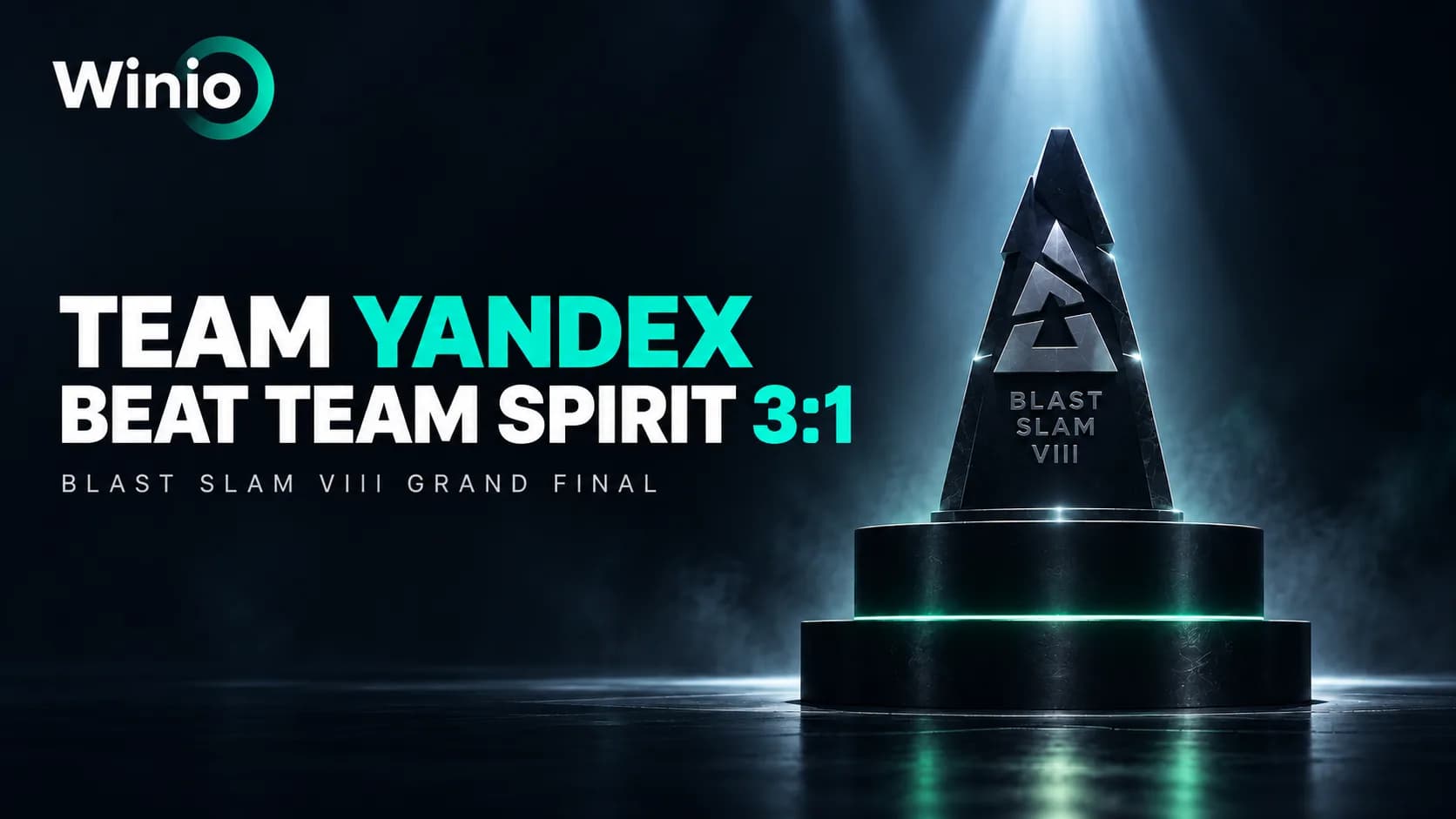
Team Yandex Beat Team Spirit 3-1 to Win BLAST Slam VIII
Team Yandex defeated Team Spirit 3-1 in the BLAST Slam VIII Grand Final, winning the Dota 2 title and $270,000 in Malta. Slug:
October 11, 202608:01 PM5 min

Rune Eaters came back from one map down to beat Virtus.pro 2–1 in the Esports World Cup Survival Stage. The result eliminated VP and sent Rune Eaters into the next round against Aurora Gaming, securing the organization’s best tournament finish to date.
Virtus.pro controlled the opening map and won it 38–18, putting Rune Eaters in the position they had not consistently solved during the group stage: needing two complete maps rather than one isolated strong performance. Rune Eaters responded by taking a much closer second game 47–42, then closed the deciding map 30–21.
The second map was the turning point. It lasted around 64 minutes and demanded more than a successful draft or early advantage. Rune Eaters had to remain competitive through a long adjustment-heavy game, which directly addressed one of the main doubts surrounding them before the series.
During groups, Rune Eaters had already taken maps from Xtreme Gaming and BetBoom Team but finished several series at 1–1. Those results showed that they could challenge stronger opponents, while leaving open the question of whether they could repeat that level after teams adjusted between maps.
The victory over VP provided the missing evidence. Rune Eaters lost the first map, adapted, survived the longest game of the series and then produced their cleanest result in the decider. This was not a single upset map protected by the Bo2 format; it was a recovery across three different game states.
Virtus.pro’s late group-stage improvement now looks less convincing. Their consecutive 2–0 victories over Inner Circle and OG showed that they could punish weaker opposition, but they had already lost cleanly to 1win and Team Yandex. Against Rune Eaters, VP again struggled once the series became more competitive and required successful adjustments rather than straightforward execution.
EPL Masters III Play-In
Today 09:00
 Inner CircleTeam Lynx
DreamLeague Season 30: EEU CQ
Today 12:00
 Nemiga GamingKalmychata
Rune Eaters’ individual form also translated into the match result. Copy and Malik entered the series with stronger recent statistical samples than their direct counterparts, and the team’s ability to contest the middle of the map gave them enough stability to recover after the opening loss. The comeback was therefore supported by the same player-level strengths visible before the series, rather than emerging from an entirely unexpected source.
Winio read: the pre-match analysis identified Virtus.pro as the more reliable side because of their Bo3 experience and previous success against this core. Rune Eaters overturned that advantage by solving the exact issue they still needed to prove: they maintained their level after losing a map and adapted more effectively across the series. Their group-stage performances against stronger teams now look like repeatable form rather than isolated resistance.
The next match against Aurora raises the level considerably. Rune Eaters will face a team with a stronger tournament record and fewer visible structural weaknesses than VP. However, they enter that series with something they did not have before: evidence that their individual form and competitive maps can survive the full adjustment cycle of a Bo3.
Virtus.pro leave EWC after another uneven tournament. Their ceiling remained visible, but their strongest results came against the lower end of their group, while the matches that demanded more reliable execution ended in defeat. Rune Eaters, meanwhile, have turned gradual progress into a result that changes how seriously the rest of the bracket must treat them.


Inner Circle
Team Lynx
Nemiga Gaming
Kalmychata
Team Lynx

PuckChamp
Prediction: Team Lynx wins

Yakult Brothers

Team Resilience

Yellow Submarine

_PowerRangers

Yangon Galacticos

Ivory

OG

potn9ki-
Inner Circle
Team Lynx
Nemiga Gaming
Kalmychata
Team Lynx
PuckChamp
Prediction: Team Lynx wins
Yakult Brothers
Team Resilience
Yellow Submarine
_PowerRangers
Yangon Galacticos
Ivory
OG
potn9ki-
Inner Circle
Team Lynx
Nemiga Gaming
Kalmychata
Team Lynx
PuckChamp
Prediction: Team Lynx wins
Yakult Brothers
Team Resilience
Yellow Submarine
_PowerRangers
Yangon Galacticos
Ivory
OG
potn9ki-