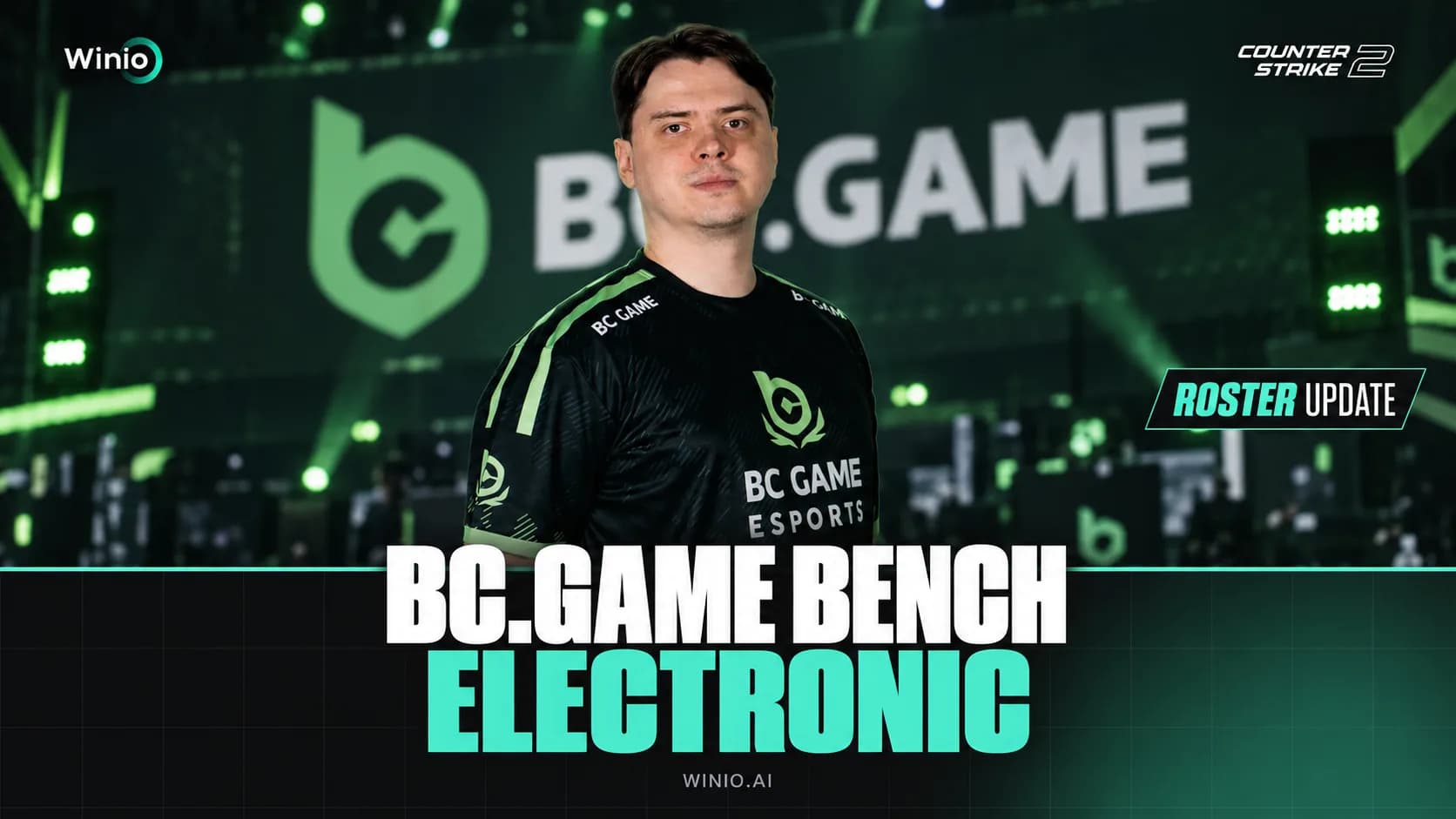
BC.Game Bench electroNic From Active CS2 Roster
BC.Game have moved Denis «electroNic» Sharipov to the bench. The organization has not announced his replacement.
September 22, 202612:12 PM

XSE Pro League 2026 starts on July 1 in Guangzhou, with 16 teams competing for a $1,000,000 prize pool. The event runs until July 12 and opens with a Swiss stage before the playoffs. The team list includes FaZe, BetBoom, 9z, B8, MIBR, PARIVISION, TYLOO, BIG, Ninjas in Pyjamas, 3DMAX, Monte, Alliance, Lynn Vision, EYEBALLERS, Nemesis, and SINNERS.
The most interesting part is the map pool. XSE Pro League is set to feature Cache shortly after Valve brought the map back into the Active Duty pool in place of Overpass. For teams, this turns the event into more than a normal post-Major LAN.
Cache creates a different kind of uncertainty. On established maps, predictions can lean heavily on recent results, side balance, veto patterns, and team-specific comfort. With a newly added map, there is less reliable official data. Teams may have practice ideas, but early LAN matches are where those ideas get tested under pressure.
Urban Riga Open #7
Tomorrow 17:00
 HAVENsInner Circle Academy
Prediction: Inner Circle Academy
CCT Eu 2026 Series #10
Today 11:00
 WRAITH PCIFICEsports BERG
That can make the opening stage more volatile. A stronger team can lose value if its Cache prep is shallow or if it avoids the map so hard that the rest of its veto becomes predictable. A weaker team can gain value if it has prepared specific defaults, fast executes, or anti-strats before opponents have enough match footage to react.
Winio’s prediction model treats early Cache games with extra caution. The map adds noise to normal form reads, especially in best-of-one matches, where one veto surprise or one prepared T side can change the whole result. In this event, adaptation speed may be just as important as ranking.
The teams that benefit most are not necessarily the biggest names. They are the teams that can use Cache without breaking their usual structure. If a team can add it as a real weapon instead of a forced weakness, XSE Pro League may give it an edge before the rest of the scene catches up.
That makes the event useful beyond the trophy. XSE Pro League will show which teams are ready to treat Cache as a serious competitive map, and which teams are still playing around it. It will also show adaptation speed, which can become a useful signal for future predictions on Winio.
What to watch on Cache:
- how often teams leave Cache open in the veto;
- whether favorites avoid the map or are ready to pick it themselves;
- how prepared teams look on the T side;
- how quickly teams adjust after their first failed Cache game;
- who uses Cache as a real weapon, and who is just trying not to lose on it.


WRAITH PCIFIC
Esports BERG

SINNERS

BET-M

THUNDER dOWNUNDER

Ground Zero

Black Phoenix

Zero Tenacity

FOKUS

Nemiga

FORZE Reload

megoshort

Fire Flux

BIG Academy

Leo

Noir Verse
WRAITH PCIFIC
Esports BERG
SINNERS
BET-M
THUNDER dOWNUNDER
Ground Zero
Black Phoenix
Zero Tenacity
FOKUS
Nemiga
FORZE Reload
megoshort
Fire Flux
BIG Academy
Leo
Noir Verse
WRAITH PCIFIC
Esports BERG
SINNERS
BET-M
THUNDER dOWNUNDER
Ground Zero
Black Phoenix
Zero Tenacity
FOKUS
Nemiga
FORZE Reload
megoshort
Fire Flux
BIG Academy
Leo
Noir Verse