


BLAST Open Porto 2026 Results: Spirit Win the Title
Spirit beat MOUZ 3:1 to win BLAST Open Porto 2026 after an 11:1 map run. Full results, donk’s MVP numbers and key tournament takeaways.
September 8, 202607:06 AM10 min


Aim wins gunfights in Counter-Strike 2, but economy management determines which gunfights your team is equipped to take.
Every purchase affects more than the current round. Spending an extra $700 on a weak buy may leave you without armor or utility in the next one. A failed force buy can cost two rounds, while one saved rifle can repair an otherwise broken team economy.
The most important economy rule is therefore not “buy the best weapon you can afford.” It is:
Do not ask only what you can buy now. Ask what all five players can buy next round if the current purchase fails.
This guide explains how money works in CS2, when to full buy or save, how loss bonuses change, and how to make coordinated decisions during freeze time.
| Situation | Default decision |
|---|---|
| Everyone can afford suitable weapons, armor, and essential utility | Full buy |
| A limited purchase preserves the next planned full buy | Half buy |
| Winning now is worth risking the following round | Force buy |
| Spending would also ruin the next round | Eco |
| One player can carry a saved or dropped rifle | Consider a hero buy |
| Cheap weapons survived a successful conversion round | Consider a bonus round |
| It is the final round of the half or match | Spend everything useful |
These are guidelines rather than rigid rules. The score, side, saved equipment, opponent economy, and number of remaining rounds can all justify a different decision.
What should remain consistent is team coordination. Five modest purchases supporting one plan are usually stronger than five individually sensible purchases made without one.
Logitech G Play Connect 2026
17.09 11:00
 B8Metizport
Prediction: B8
Logitech G Play Connect 2026
17.09 12:00
 nipM80
Each player starts a regulation half with $800 and can hold a maximum of $16,000. Money is earned through four main sources:
Money that is not spent carries into the next round. Weapons, armor, kits, and grenades also carry over if the player survives, making survival an important part of the economy.
The economy resets at halftime. Everyone begins the new half with $800 regardless of how much money or equipment they had before the side switch.
The standard competitive rewards are:
| Round result | Team reward per player |
|---|---|
| Win by eliminating the enemy | $3,250 |
| CT win because the round timer expires | $3,250 |
| T win by bomb detonation | $3,500 |
| CT win by defusing the bomb | $3,500 |
| T loss after planting the bomb | Loss bonus plus $800 |
The player who plants the bomb also earns an individual $300 when the plant is completed.
This makes a bomb plant extremely valuable in a low-buy round. If the Terrorists lose after planting, each player receives an additional $800 on top of the normal loss bonus. Across five players, that is $4,000 of extra team income before counting the planter’s personal reward.
Since July 2025, Counter-Terrorists also receive a $50 team reward for every Terrorist eliminated in a competitive round. The reward goes to every CT, not only the player who secured the kill. Eliminating all five Terrorists can therefore give each CT another $250, or $1,250 across the team. Valve introduced the change to strengthen the more expensive CT economy (official update).
Losing a round still provides income. The loss bonus grows as defeats accumulate, preventing one team from remaining permanently trapped on pistols.
| Loss-bonus level | Reward per player |
|---|---|
| 0 | $1,400 |
| 1 | $1,900 |
| 2 | $2,400 |
| 3 | $2,900 |
| 4 or higher | $3,400 |
There are two details that regularly cause confusion.
First, teams begin each half at level one. That means losing the pistol round pays $1,900, not $1,400. A second consecutive loss raises the next payout to $2,400.
Second, winning a round does not completely reset a large loss bonus. It moves the counter down one level. If a team reaches the maximum $3,400 bonus and then wins, its next loss pays $2,900 rather than falling directly to $1,400.
Valve introduced this step-down system to reduce the punishing economic cycle that previously followed the end of a losing streak (official loss-bonus notes).
A simplified sequence looks like this:
| Result | Payout for the loss, if applicable | Next loss-bonus position |
|---|---|---|
| Begin half | — | $1,900 |
| Lose pistol | $1,900 | $2,400 |
| Lose again | $2,400 | $2,900 |
| Lose again | $2,900 | $3,400 |
| Lose again | $3,400 | $3,400 |
| Win | $3,250 or $3,500 | Drops to $2,900 |
| Lose next round | $2,900 | Returns to $3,400 |
This is why a team on a long losing streak can sometimes afford another full buy immediately after losing. Its equipment disappeared, but the maximum loss bonus replaced a large portion of the investment.
Conversely, a team that wins after several losses can still be fragile. Winning one round does not guarantee enough money to rebuy everything if most players die.
Kills provide personal income in addition to their value within the round. The reward depends on the weapon.
| Weapon category | Typical reward per kill |
|---|---|
| Most rifles and pistols | $300 |
| Most SMGs | $600 |
| Shotguns | $900 |
| AWP | $100 |
| Knife | $1,500 |
There are exceptions. The P90 pays the standard $300 rather than the larger SMG reward, while the CZ75-Auto pays less than most pistols. Exact values can be checked in current weapon data, as Valve may rebalance individual weapons.
Higher kill rewards make SMGs and shotguns economically attractive against opponents expected to have weak armor and pistols. Three MAC-10 or MP9 kills can generate $1,800 for the player who earns them, helping finance a later rifle purchase.
That does not mean every anti-eco player should replace a saved rifle with an SMG. The first priority is winning the round without donating weapons. Kill income is a secondary advantage.
A full buy means the team has the equipment required to execute a credible round plan. It does not simply mean that five players own rifles.
A typical full buy includes:
A T-side rifle buy commonly costs around $4,000 to $5,100 per player depending on utility. An AK-47, armor and helmet already consume $3,700 before grenades.
CT full buys are usually more expensive. M4 rifles cost more than the AK-47, and the defense must also account for $400 defuse kits. A comfortable CT purchase can exceed $5,000 per player when armor, a rifle, a kit, and utility are included.
Not every player needs the maximum possible utility. A successful buy distributes resources according to the plan. The support player may carry the smoke and multiple flashes, while an aggressive rifler prioritizes armor and the weapon needed for the opening duel.
The question is not whether everyone has identical equipment. It is whether the team has enough collective equipment to perform its intended strategy.
An eco is a deliberate low-spending round used to guarantee a stronger future purchase.
A full eco may involve buying nothing. A lighter eco might allow P250s, a flash, or another inexpensive item, but only when the purchase does not compromise the next full buy.
An eco is not necessarily a surrendered round. A weakly equipped team can still:
T-side ecos should prioritize the plant whenever it is realistically available. The $800 team bonus after a lost planted round can transform the following purchase.
CT ecos should use positions that bring opponents into pistol or shotgun range. Scattered one-on-one fights against rifles usually achieve little. Five pistols attacking the same opponent can produce a dropped weapon and a winnable round.
The most common eco mistake is spending different amounts across the team. If four players save while one buys an unsupported rifle, the team risks losing the weapon while still entering the next round with uneven money.
A half buy—or partial buy—spends enough to contest the current round while preserving a planned full buy for the next one.
This may include:
A half buy must have a spending limit. Before purchasing, check the minimum amount you expect to receive next round and calculate how much can be spent without falling below the team’s target.
For example, suppose you have $3,200 and expect at least $2,400 after a loss. If your next-round target is $4,800, you can spend approximately $800 now and still reach the planned buy.
Without that calculation, a “half buy” often becomes a disguised force buy. Players purchase armor, a pistol, and two grenades, then discover that they are still short of a rifle and utility in the following round.
A force buy means spending aggressively when the team cannot afford an ideal purchase and normal economy logic would favor saving.
Force buys are high-risk decisions. Losing usually destroys the current equipment and delays the next complete buy. A team that repeatedly forces can spend an entire half trapped between pistols and rifles.
A force can still be correct when:
A good force buy uses the strengths of the available weapons. SMGs and shotguns need close engagements. Deagles need space for deliberate shots. A Scout benefits from long angles and teammates capable of finishing damaged opponents.
Buying weak weapons and then playing a standard rifle-round default wastes the reason for forcing.
A hero buy places one strong weapon—usually a saved or dropped rifle—among teammates making economical purchases.
The armed player may receive most of the utility, work for an opening kill, or hold a position from which teammates can recover the weapon. The other four players preserve enough money for the next full buy.
A hero buy is different from one player ignoring an eco call. It is an agreed strategy built around protecting and reusing the weapon.
The plan becomes wasteful if the hero takes an isolated duel in an unrecoverable position. The rifle’s value comes partly from its ability to pass through multiple teammates during the round.
A bonus round occurs when a team keeps the cheaper weapons that survived an earlier conversion instead of immediately replacing them with rifles.
The classic sequence is:
The bonus team accepts a weaker current loadout because replacing every surviving SMG would consume the money it just built. If the team loses, it can normally purchase rifles afterward. If it wins, it takes enemy weapons and creates a major economic advantage.
A bonus round is not an eco. The team is trying to win with carried equipment while protecting its accumulated cash.
Pistol-round decisions shape the opening three or four rounds of each half.
Buy enough to secure the conversion round. Common purchases include:
Do not assume the opponent has nothing. A T team that planted before losing may have enough money for armor, Galils, upgraded pistols, and utility. Even without a plant, the opponent may choose a coordinated force.
The conversion round should be played cautiously. Maintain range where appropriate, clear close corners with utility, and avoid giving isolated pistols a free rifle.
A standard option is to save most of the second-round money and buy properly in round three.
After losing pistol, players receive $1,900 plus any kill income and saved cash. Losing the next round raises the payout to $2,400. Someone who spends nothing in round two can therefore approach $4,300 before kills or leftover pistol-round money.
That funds an AK and armor on the T side, although utility may remain limited. CTs may still need compromises because their rifles and kits cost more.
The T side receives the $1,900 loss bonus plus the $800 plant compensation, along with the planter’s personal $300. This creates a meaningful decision.
The team can:
The right call depends on the opponent’s expected conversion purchase and whether all five players can support the same plan.
The two sides use the same loss-bonus ladder, but their spending requirements differ.
Counter-Terrorists generally face:
Terrorists have access to the $2,700 AK-47, the inexpensive Galil, and the lost-round bomb-plant bonus. They can also choose which site to attack, allowing limited purchases to be concentrated around a particular strategy.
The CT team reward introduced in 2025 helps. Every eliminated Terrorist now provides $50 to each CT in competitive modes, whether the CTs ultimately win or lose the round. However, it does not eliminate the underlying equipment-price difference.
CTs therefore need stricter buy synchronization. One defender without a kit or useful utility can leave an entire site vulnerable, even when the other four players appear fully equipped.
“Save” can refer to spending very little before a round, but it can also mean preserving equipment after a round has become unlikely to win.
A mid-round save makes sense when:
Saving is a probability decision. A 2v4 retake with no kit and little utility may offer less value than carrying two rifles into the next round. A 2v3 with kits, grenades, and isolated opponents may still be worth attempting.
The call should be made early. Hesitating until every escape route is covered often produces the worst outcome: no retake attempt and no saved weapon.
T-side saving has an additional complication. A Terrorist who remains alive when the round timer expires without a bomb plant does not receive normal loss income. The player keeps carried equipment but sacrifices the payout. Saving an AK may still be worthwhile; preserving a cheap pistol often is not.
CS2 displays money in five individual wallets, but good teams treat it as one shared resource.
During freeze time:
Suppose one player has $8,500 and another has $2,400. If both buy only for themselves, the second player may enter with a pistol. If the richer player drops a rifle, both can contribute while the team preserves a coherent buy.
Weapon drops are not favors. They are conversions of unused team money into round-winning firepower.
You cannot see the opponent’s current cash, but you can estimate what they are likely to purchase.
Track:
If the opponent lost a full buy with all five players dying, expect an eco, half buy, or desperate force. If three rifles survived, expect those weapons to be redistributed into a mixed but dangerous purchase.
When playing an anti-eco:
Economic damage matters even when the round winner does not change. Removing four CT rifles before losing forces the defense to spend heavily. Failing to kill any opponents lets the winning team build a bank capable of absorbing future losses.
Use this process at the start of every round:
Do not decide from your own money alone. Look for saved weapons, players who need drops, and large financial differences.
The interface estimates how much money you will have after a loss. Use that number to calculate how much can be spent without damaging the planned next buy.
Consider weapons, armor, kits, and the utility needed for the actual strategy. A rifle with no armor or support grenades may not constitute a useful buy.
Choose full buy, half buy, force, eco, hero, or bonus. Avoid vague calls such as “buy if you want.”
On a partial purchase, communicate the amount everyone must retain: “Spend to $2,000” is clearer than “light buy.”
Resolve uneven money before the round begins. Decide who has the kit, who carries the bomb, and which players possess essential grenades.
One rifle among four saving teammates rarely receives the support needed to justify its cost. Unless the team deliberately calls a hero buy, save together or buy together.
Five rifles without armor, kits, or useful grenades can be less effective than a cheaper, coordinated purchase. Judge the entire loadout.
A failed force should not automatically trigger another force. Serial buying keeps the team permanently short of the equipment needed to challenge a stable opponent.
A few unnecessary grenades or an expensive pistol can delay a complete buy. Plan backward from the equipment required next round.
Losing pistol pays $1,900 because teams begin each half one level up the loss ladder. Guides that start the pistol loss at $1,400 are using the base level without accounting for the standard half configuration.
A win normally moves the counter down one level. Teams coming off long losing streaks can remain financially resilient.
A lost T-side round with a plant provides $800 to every player. Especially on an eco, getting the bomb down can be nearly as important as damaging enemy equipment.
Against AK-47s, a helmet does not prevent a one-shot headshot. Depending on the opponent’s weapons, saving the helmet money for a kit or utility can be sensible. Helmets remain valuable against pistols, SMGs, Galils, and other weapons that do not always kill an armored opponent with one headshot.
A delayed save often ends with the player dying after abandoning the retake. Decide while escape routes and recoverable weapons still exist.
Money resets at halftime. There is no value in preserving cash during the final round of a half, so buy every item that can improve the team’s chance of winning.
If the entire guide is too much to remember during a match, use these rules:
A strong economy does not guarantee a round win. It guarantees that the team repeatedly enters rounds with a realistic chance to win and over a full match, that is one of the most dependable advantages CS2 offers.

B8
Metizport
Prediction: B8 wins
nip
M80

GamerLegion

Luminosity
B8
GamerLegion
Metizport
Luminosity
M80
GamerLegion
nip
B8
Metizport
nip
B8
Metizport
Prediction: B8 wins
nip
M80
GamerLegion
Luminosity
B8
GamerLegion
Metizport
Luminosity
M80
GamerLegion
nip
B8
Metizport
nip
B8
Metizport
Prediction: B8 wins
nip
M80
GamerLegion
Luminosity
B8
GamerLegion
Metizport
Luminosity
M80
GamerLegion
nip
B8
Metizport
nip

Spirit beat MOUZ 3:1 to win BLAST Open Porto 2026 after an 11:1 map run. Full results, donk’s MVP numbers and key tournament takeaways.
Preview of FISSURE Playground 3 CS2 with dates, teams, tournament format, favorites, prize pool and the complete opening-day schedule for September 8.
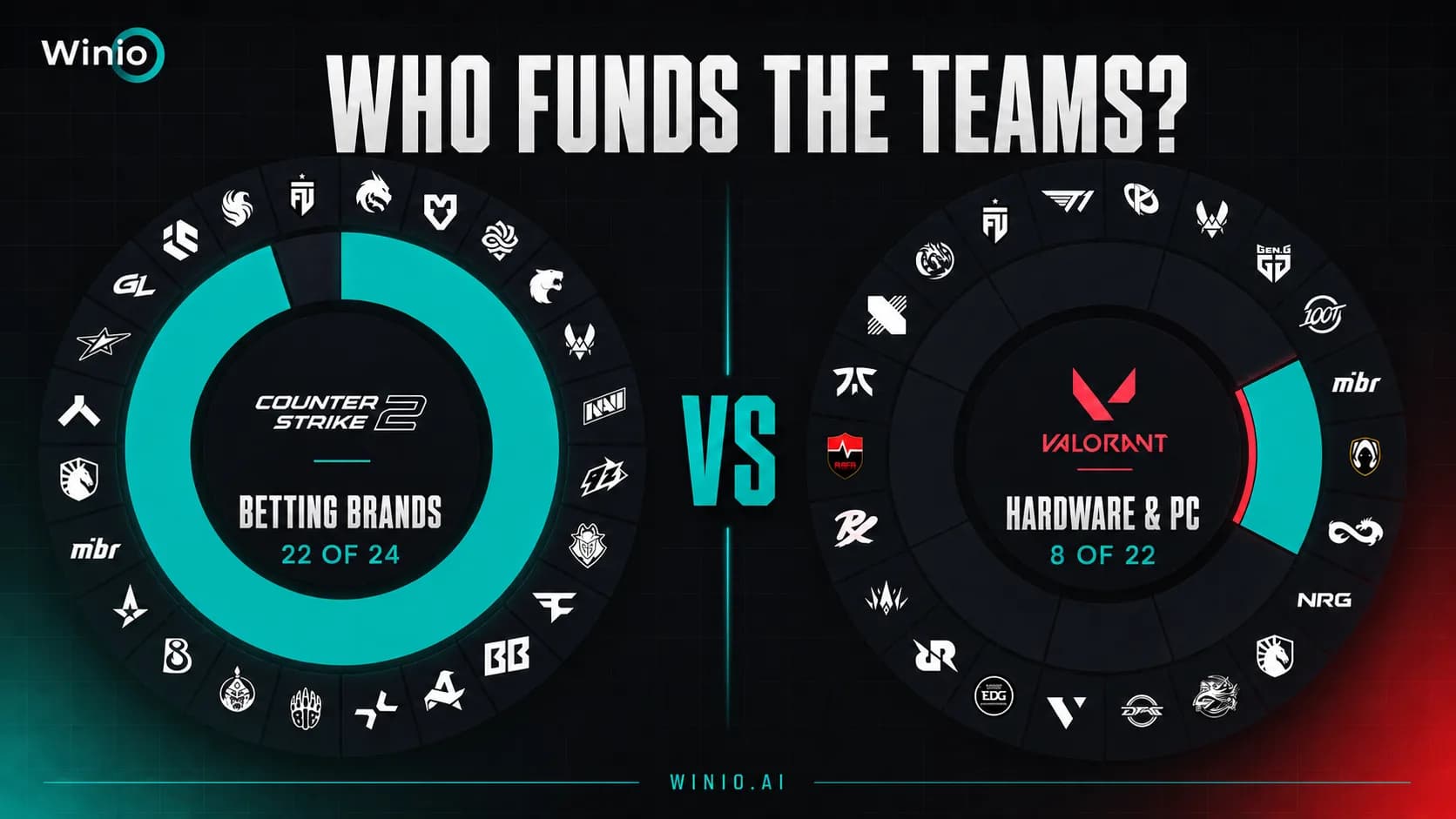
Compare esports sponsorships in CS2 and VALORANT. See why betting brands dominate CS2 while hardware companies lead the VALORANT market.
A ranking of the most reliable CS2 teams in BO3 series over the past two months. The analysis considers series win rate, map pool depth, first-map conversion, comeback ability and decider performance.

A data-driven review of EWC 2026 CS2, including Spirit’s title, FUT’s breakout, Legacy’s upsets and 87% prediction accuracy from Winio.

BLAST Open Porto 2026 runs from August 26 to September 6. See the CS2 schedule, groups, format, prize pool, map pool and Winio Power Ranking.
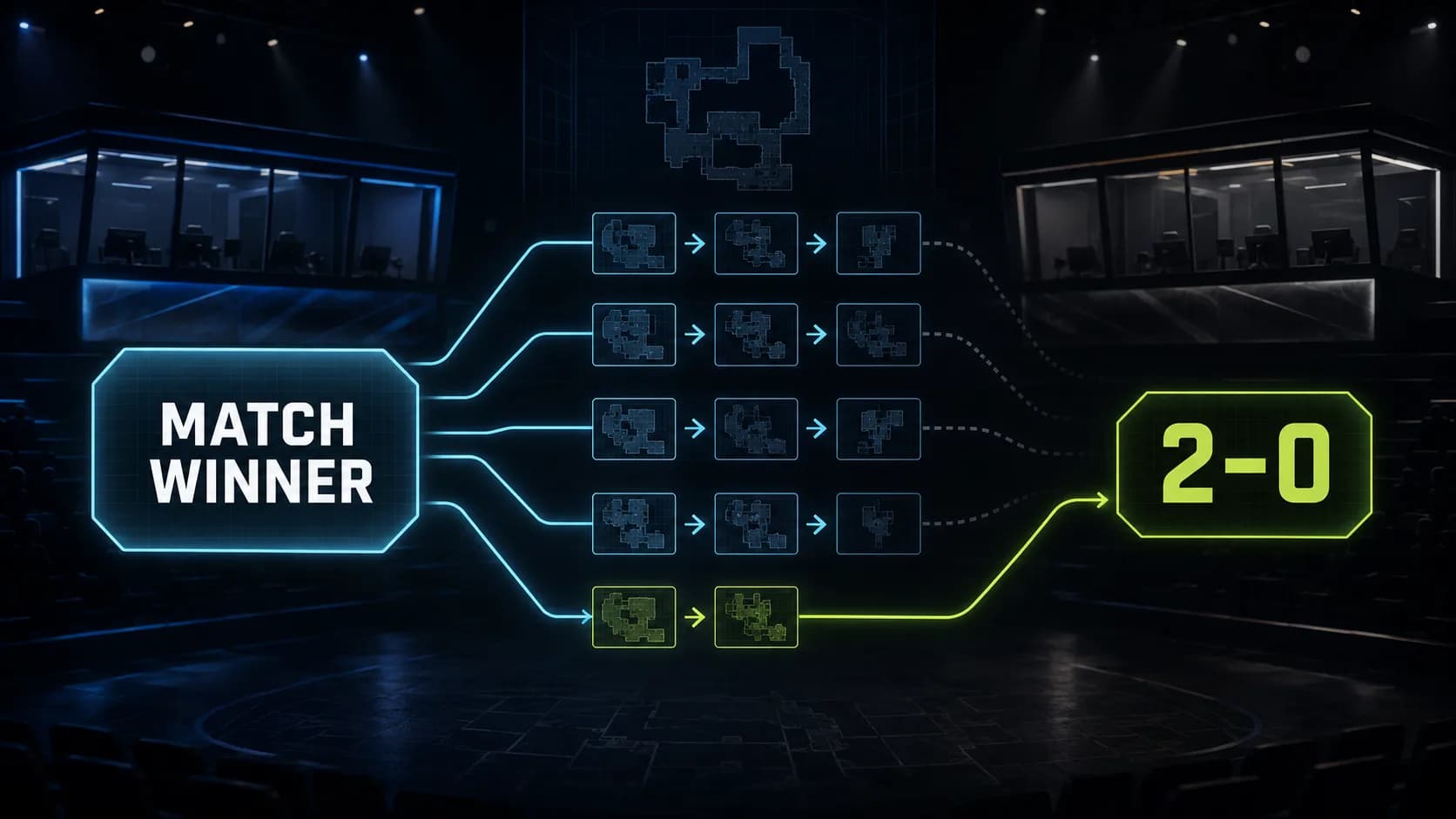
Predicting a 2–0 requires more than identifying the stronger team. Here’s why forecasting a clean sweep in a BO3 is significantly harder than simply picking the match winner.