CS2 Pets Guide: How to Get and Hatch a Chicken Egg
Learn how to get a Chicken Egg in CS2, how pets hatch and grow, all discovered chicken breeds, Pet Book features and current drop details.
October 1, 202607:54 AM10 min

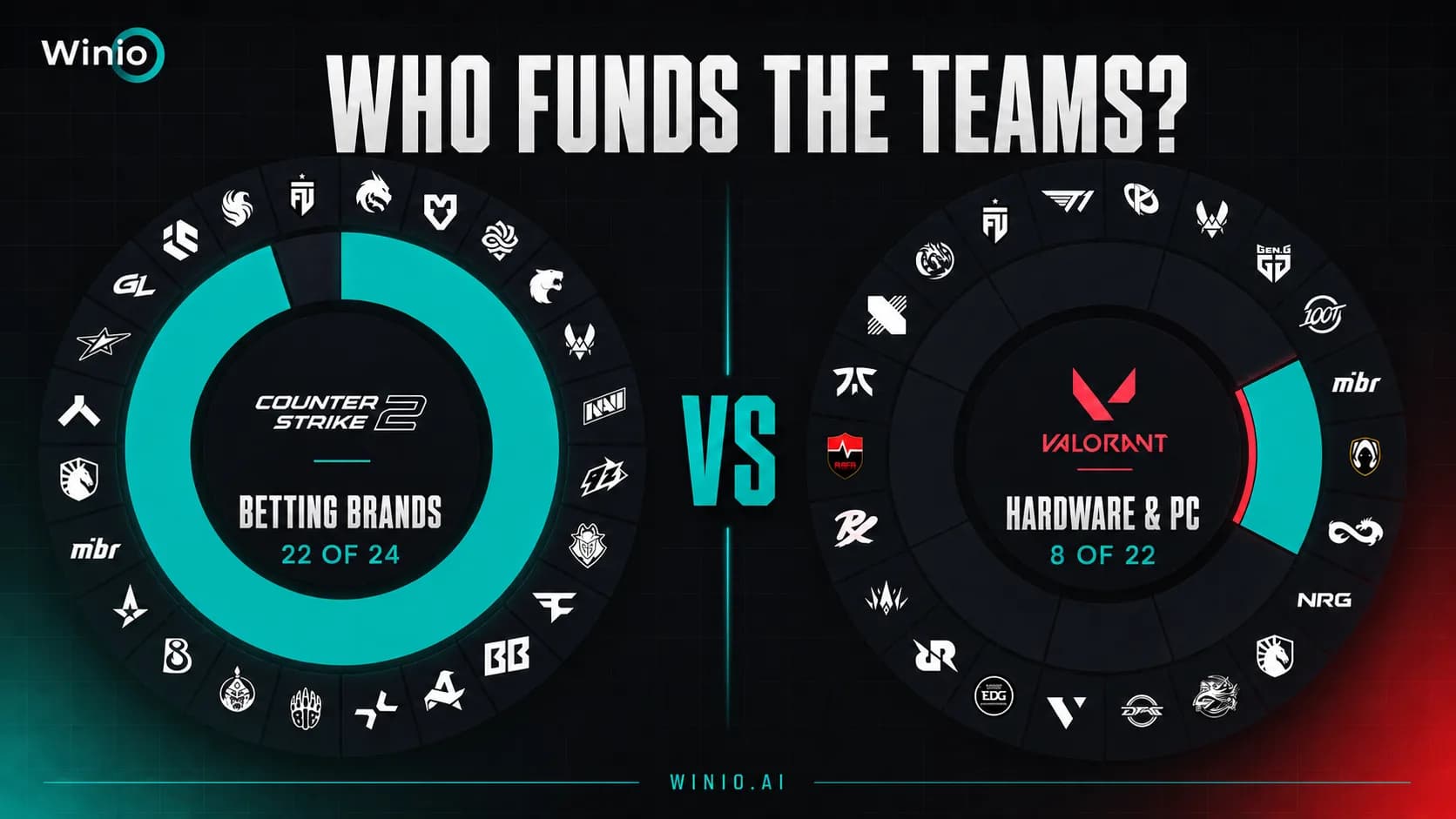
CS2 and VALORANT belong to the same genre, compete for many of the same viewers, and attract the world’s largest esports organizations. Yet the money surrounding them moves through two very different systems.
A comparison of sponsorships across leading teams reveals an almost mirrored picture. Betting companies dominate the CS2 market, while VALORANT attracts a broader mix of hardware manufacturers, telecom providers, financial services, retailers, automotive companies, and consumer brands.
This is more than a difference between logos on jerseys. It shows how two major esports ecosystems monetize their audiences.

Among the 24 prominent CS2 organizations included in the analysis, 22 have partnerships with betting companies. That represents 91.7% of the entire group.
CCT SA 2026 Series #7
Tomorrow 01:00
 Procyonyour endY
Prediction: Procyon
TP World Championship 2026
LIVE
 FURIABetBoom
The list includes Team Spirit, MOUZ, Vitality, NAVI, FURIA, G2 Esports, FaZe Clan, Team Liquid, Astralis, BIG, and many other recognizable names. The size and structure of each agreement may differ, but betting sponsorship in CS2 is no longer an exception. It has become a standard part of the commercial model.
The reason can be found in the rhythm of the game itself. CS2 has a packed calendar filled with tournaments of every size. Matches take place almost every day, while viewers constantly evaluate rankings, map statistics, recent form, head-to-head records, and win probabilities.
For betting brands, this creates a product that can be promoted during every new series rather than a few major events each season. For organizations, it provides access to sponsors whose business is directly connected to match engagement.
However, this model also creates risk. When almost an entire ecosystem relies on one commercial category, teams become more vulnerable to regulatory changes, advertising restrictions, and shifts within the betting industry.

The VALORANT sponsorship market looks far more fragmented.
Among the 22 organizations included in the comparison, hardware and PC manufacturers lead the market by sponsoring eight teams. That is 36.4% of the sample.
Betting companies appear alongside only four organizations, representing approximately 18.2%. Compared with CS2, the share is more than five times smaller.
The remaining partnerships are spread between telecom companies, financial services, retailers, automotive brands, and food and beverage businesses. As a result, VALORANT’s commercial ecosystem is less dependent on one specific industry.
Hardware manufacturers are a natural fit for the game. A professional player can demonstrate a monitor, keyboard, mouse, headset, or gaming PC directly inside the competitive experience. The sponsor is not selling interest in a single match. It is selling the equipment viewers could use to enter the game themselves.
The difference between the two games is not driven only by advertisers. Publisher policy also plays an important role.
For years, betting partnerships were heavily restricted within Riot Games esports ecosystem. The company only began allowing approved deals for top-level teams in the Americas and EMEA in June 2025.
Potential partners must pass Riot’s vetting process, use official data provided through GRID, and work with organizations that have internal integrity programs.
The restrictions remain significant. Betting advertisements cannot appear on official Riot broadcasts or social media channels, while partner logos are also prohibited from team jerseys.
This creates an unusual compromise. Betting money can now enter VALORANT, but Riot still controls who participates and where the sponsorship can be visible. In CS2, these partnerships are generally more prominent and more closely integrated into the daily content surrounding matches.
The most important conclusion is not simply which logos appear most often. It is what each sponsor wants the viewer to do.
In CS2, brands aim to reach fans at the moment they are making a decision. Before a match, viewers study recent form and map pools. During the series, they follow the score and live statistics. Afterward, they compare the result with their original prediction.
That behavior makes betting companies a natural commercial match for the discipline.
VALORANT more often sells a long-term association. Hardware brands want viewers to connect their products with professional players, popular organizations, and their own experience inside the game.
Neither model is automatically better. CS2 attracts major investment from a category that fits naturally around every match, but its clubs become more dependent on that category. VALORANT has a more diverse sponsor base, although organizations operate within a more tightly controlled publisher ecosystem.
The two games are not only competing for viewers. They are competing through different ways of monetizing attention. CS2 turns every match into a market of probabilities, while VALORANT turns esports into a showcase for technology and consumer brands.
Visit Winio, explore upcoming esports fixtures, and see what the data says before the action begins.

FURIA
BetBoom

DAMAJUANA
A NATA

FORZE Reload

BAKS

UNiTY

mellren
ex-RUSTEC

Nuclear TigeRES

Saint Sinners

MayBe

Quintessence

RED Canids Academy
6yuBoJlbl

HyperSpirit
FURIA
BetBoom
DAMAJUANA
A NATA
FORZE Reload
BAKS
UNiTY
mellren
ex-RUSTEC
Nuclear TigeRES
Saint Sinners
MayBe
Quintessence
RED Canids Academy
6yuBoJlbl
HyperSpirit
FURIA
BetBoom
DAMAJUANA
A NATA
FORZE Reload
BAKS
UNiTY
mellren
ex-RUSTEC
Nuclear TigeRES
Saint Sinners
MayBe
Quintessence
RED Canids Academy
6yuBoJlbl
HyperSpirit