CS2 Pets Guide: How to Get and Hatch a Chicken Egg
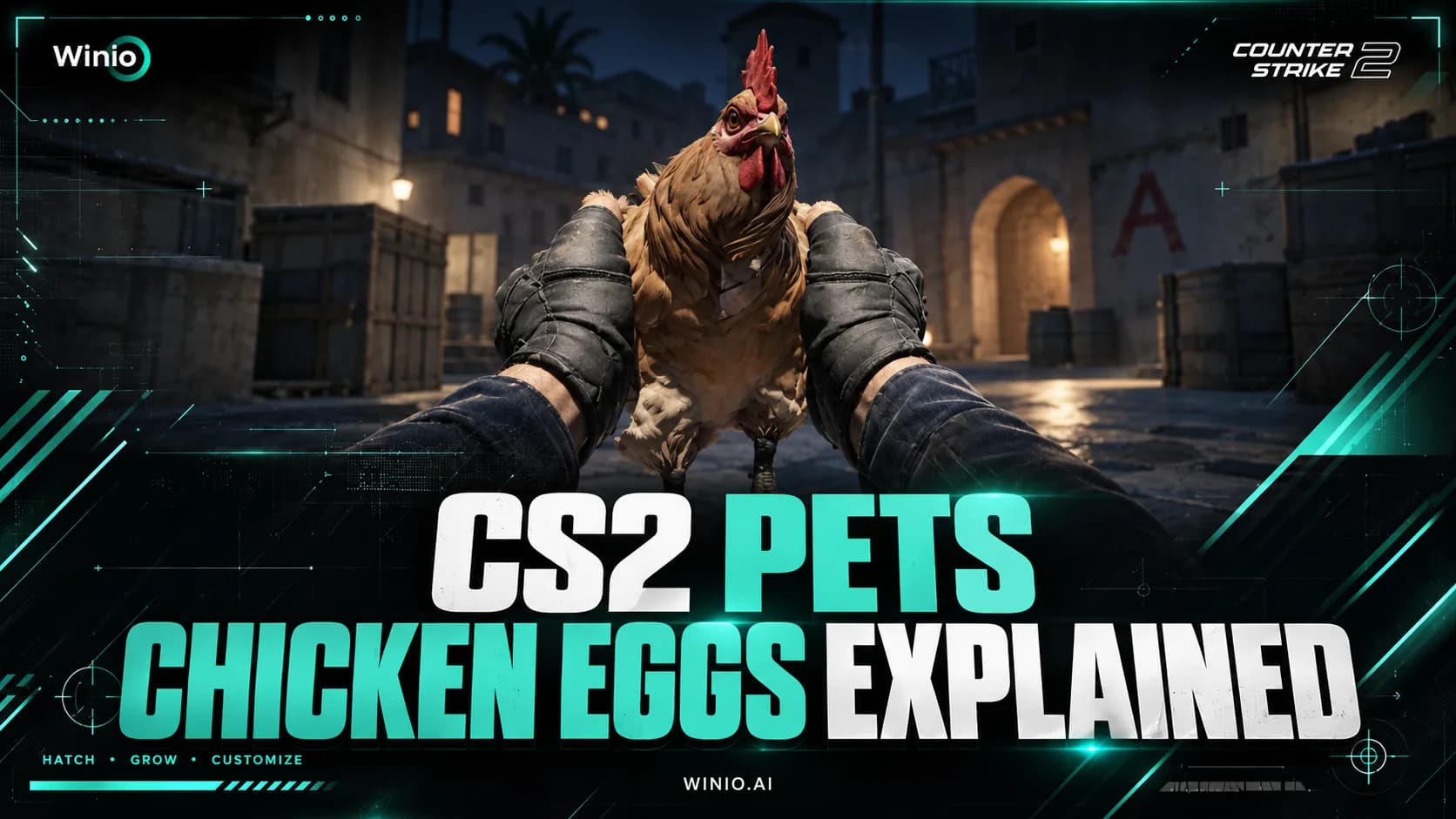
Learn how to get a Chicken Egg in CS2, how pets hatch and grow, all discovered chicken breeds, Pet Book features and current drop details.
October 1, 202607:54 AM10 min


VALORANT and Counter-Strike 2 appear to offer variations of the same competitive experience. Both are free-to-play 5v5 tactical shooters in which attackers attempt to plant an objective while defenders try to stop them. Both demand accurate shooting, careful economy management, map knowledge, and effective communication.
Spend a few matches with each, however, and the resemblance begins to fade. CS2 concentrates its complexity in gunplay, movement, grenades, and map control. VALORANT divides the tactical toolkit among Agents with different abilities and formal team roles.
That distinction matters more than declaring either game universally better. CS2 suits players who want their mechanical fundamentals exposed and tested every round. VALORANT suits those who want precise shooting combined with character mastery, team compositions, and a constantly changing tactical sandbox.
| If you care most about… | Better fit |
|---|---|
| Pure gunplay and movement mastery | CS2 |
| Agents, abilities, and defined roles | VALORANT |
| Learning your first tactical shooter | VALORANT |
| Repeatable recoil control | CS2 |
| Strategic variety between characters | VALORANT |
| Playing on a modern console | VALORANT |
| Linux support | CS2 |
| Tradable weapon skins | CS2 |
| A structured route from ranked play to esports | VALORANT |
| An established, open tournament ecosystem | CS2 |
The short verdict is that VALORANT is usually easier to enter, while CS2 forces players to confront its mechanical demands sooner. At higher levels, both become brutally difficult, but for different reasons.
Tesla Cup 2026
Tomorrow 14:00
 AllianceFaZe
Prediction: FaZe
PGL Masters Bucharest 2026
Today 11:00
 NemigaAurora
A standard match in either game revolves around short rounds, limited lives, an equipment economy, and an attack-and-defend objective. Players who die normally remain out until the next round, making every duel and piece of utility consequential.
CS2 gives every player access to the same fundamental equipment. Your tactical options come from the weapon and grenades you purchase, your position, the team’s economy, and the plan for that round. A smoke grenade behaves the same regardless of who throws it. Player roles emerge naturally: one teammate might carry an AWP, another may throw entry utility, and another may watch a flank, but the game does not lock anyone into those jobs.
VALORANT formalizes team roles through its Agents. Duelists are designed to initiate fights and take space. Controllers obstruct sightlines and shape the battlefield. Initiators gather information or disrupt defended positions, while Sentinels specialize in controlling territory and protecting teammates.
A team does not technically need all four roles, but Riot advises that a diverse composition makes it easier to handle different situations. A Controller, for example, can block dangerous sightlines while the team enters a site.
CS2 therefore gives everyone the same tactical vocabulary and asks teams to use it well. VALORANT divides that vocabulary among five selected Agents and asks players to combine their distinct tools.
CS2 has the stronger claim to mechanical purity. Its weapons feature largely repeatable recoil patterns that can be studied and committed to muscle memory. A player who learns how a rifle climbs and shifts during sustained fire can compensate by moving the mouse in the opposite direction.
This does not make spraying perfectly reliable at every distance. Bullet spread still matters, and experienced players choose between tapping, bursting, and committing to a spray based on the range and situation. Nevertheless, sustained recoil control is a deep, trainable skill.
Movement is equally important. Firing a rifle while moving makes it severely inaccurate, so players must learn how to stop before shooting. Counter-strafing – briefly pressing the opposite movement key to halt momentum – is part of the game’s mechanical rhythm. Peeking, stopping, firing, and returning to cover can demand hundreds of hours to refine.
VALORANT also penalizes moving rifle shots. Riot has repeatedly increased movement inaccuracy to reward players who deliberately stop before firing, particularly at medium and long ranges. Strong crosshair placement and controlled movement are essential in both games.
The difference lies primarily in recoil and the number of other systems competing for a player’s attention. VALORANT rifles provide a controllable opening portion of a spray, followed by horizontal recoil that can probabilistically change direction. Riot’s weapon documentation refers to the chance and timing of these horizontal switches, along with “protected” early bullets before a switch can occur.
That makes the familiar claim that “CS2 recoil is fixed and VALORANT recoil is random” too simplistic. VALORANT still rewards recoil control, but long sprays are less consistently repeatable. Tapping and short bursts are generally more dependable as the distance increases.
Gunplay verdict: CS2 offers greater depth in sustained recoil control and movement technique. VALORANT retains a demanding shooting model, but gunplay shares the spotlight with abilities.
CS2 utility consists principally of smoke, flashbang, high-explosive, incendiary, and decoy grenades. Everyone can buy the same equipment, but using it effectively takes knowledge and practice.
Players learn precise lineups, pop flashes, grenade trajectories, smoke timings, and ways to combine utility with teammates. Because grenades are limited and disappear at the end of a round, deciding when not to use one can be as important as throwing it correctly.
CS2’s dynamic smokes add another strategic layer. Smoke clouds interact with the environment and can temporarily disperse when struck by bullets or explosions. The official Steam page identifies these dynamic grenades as one of CS2’s defining technical features.
VALORANT distributes comparable, and often more dramatic, functions across its Agents. Abilities can block vision, reveal enemies, clear corners, create temporary walls, place traps, heal allies, provide mobility, or directly cause damage.
These tools are not intended to replace shooting. Riot describes VALORANT’s tactical cycle as gathering intelligence, creating a plan, executing it, and repeating the process. Abilities reduce the risk involved in an execute, but mechanical skill is still required to finish engagements.
Abilities also create a larger knowledge burden. Learning one Agent is only the beginning: players must recognize allied and enemy abilities, understand their ranges and timings, anticipate ultimate abilities, and learn how different kits interact on each map. Balance patches can then change those relationships.
Utility verdict: CS2 rewards mastery of a universal, relatively stable toolset. VALORANT offers greater character-based variety and more ways to influence a round without personally winning every duel.
CS2 maps derive much of their depth from geometry. Sightlines, chokepoints, rotations, boosts, penetrable surfaces, grenade trajectories, and spawn positions determine how each round develops. The layout remains neutral; the same routes and utility options are theoretically available to every player.
VALORANT maps must account for a much broader range of movement and information tools. Teleports, ropes, doors, deployable walls, recon abilities, and mobile Agents can alter how space is contested. A route that is safe against one composition may be dangerous against another.
That gives VALORANT more round-to-round variation, but it also makes the game more dependent on its current Agent meta. CS2 strategies evolve too, particularly after map or economy changes, but its universal equipment creates a more stable foundation.
Both games rotate competitive maps and continue to modify them. In June 2026, VALORANT added Summit to Competitive play, featuring droppable walls that can reshape the battlefield during a round. CS2’s fifth Premier season subsequently placed Cache in the Active Duty pool and removed Overpass.
Neither game has an objectively deeper map system. CS2 emphasizes mastering neutral geometry and repeatable utility. VALORANT adds composition-dependent routes, counters, and interactions.
The answer depends on whether “harder” refers to beginning, improving, or reaching the highest level.
CS2 has the harsher mechanical entry point. New players are immediately tested on stopping accuracy, recoil control, crosshair placement, grenade usage, sound, map callouts, and the economy. With no character ability to reveal an opponent or escape a poor position, mechanical and positional mistakes are exposed quickly.
VALORANT gives beginners more ways to make a useful contribution. A player can block a sightline, gather information, heal an ally, defend a flank, or delay an attack even when their aim is inconsistent. Its clearer character roles can also give new players an immediate sense of what the team expects them to do.
That lower initial barrier should not be confused with a low skill ceiling. As the Agent roster expands, VALORANT players must learn more abilities, compositions, counters, audio cues, and map-specific interactions. High-level players need elite mechanics while simultaneously processing this information.
The fairest conclusion is:
VALORANT is generally easier to start. Neither game is easy to master.
VALORANT Competitive uses named ranks from Iron through Radiant. Rank Rating shows progress toward promotion or demotion, while an underlying matchmaking rating helps determine opponents and RR gains. New accounts must reach level 20 before entering Competitive play.
Riot regularly adjusts the system. Patch 13.00 changed RR calculations and tightened PC matchmaking so opposing teams’ average ranks should more often remain within one sub-tier of each other.
CS2 offers multiple competitive ladders, but Premier is the closest equivalent. It uses a numerical CS Rating, an Active Duty map-veto process, seasonal progression, and regional and global leaderboards. Traditional Competitive matchmaking remains available with ranks associated with individual maps.
The anti-cheat comparison is less straightforward. VALORANT uses Riot Vanguard, which includes kernel-level components on PC and can require Windows security features such as TPM and Secure Boot. Riot combines Vanguard with hardware identification, reports, data analysis, and other detection methods. Confirmed cheating cases can also trigger Ranked Rating refunds for affected opponents.
CS2 uses Valve Anti-Cheat. Valve describes VAC as an automated system that detects identifiable cheat signatures on a player’s computer. Confirmed VAC bans permanently prevent access to protected servers for the affected game unless Valve determines that the ban was erroneous.
Vanguard is the more intrusive design. VAC places fewer visible security demands on the player’s PC. However, no public dataset provides a fair, current comparison of how often ordinary players encounter cheaters in each game. Declaring an objective winner would therefore rely more on anecdotes than verifiable evidence.
VALORANT has the clear advantage for console players. It is available on Windows, PlayStation 5, and Xbox Series X|S, with cross-progression and a shared inventory. Riot keeps PC and console matchmaking separate, however, and does not permit mouse-and-keyboard controls on console.
CS2 officially supports Windows and Linux but has no current console version.
VALORANT also publishes unusually clear PC performance targets. Its minimum configuration for 30 FPS requires 4 GB of RAM and low-end integrated or dedicated graphics. Separate specifications are provided for 60 FPS and 144 FPS or higher. Windows 11 users must enable TPM 2.0 and Secure Boot.
CS2 lists a minimum of 8 GB of RAM, a DirectX 11-compatible graphics card with at least 1 GB of memory, a four-thread processor equivalent to an Intel Core i5-750 or better, and 85 GB of storage.
VALORANT is the more accessible choice for console households and provides clearer guidance for low-end PCs. CS2’s native Linux support, Steam Workshop, and community infrastructure remain meaningful advantages for PC players.
Both games have more than enough players to sustain active matchmaking, but direct population comparisons are usually misleading.
Steam publicly reports CS2 concurrency. On July 26, 2026, the game recorded approximately 914,000 simultaneous players at the time of measurement and a daily peak of roughly 1.25 million. Those figures change continuously.
Riot does not publish an equivalent live concurrency number for VALORANT. Third-party estimates frequently measure daily or monthly users, which cannot be compared directly with simultaneous Steam players. It is reasonable to describe both communities as enormous; it is not possible to establish a credible population winner from the available measurements.
Their esports ecosystems are easier to distinguish.
VALORANT follows a publisher-led structure connecting Premier, Challengers, international leagues, Masters events, and Champions. The 2026 season includes Masters Santiago, Masters London, and Champions Shanghai, along with a more open route for Challengers teams to reach the season’s largest event.
Counter-Strike has a more decentralized ecosystem. Independent organizers operate major circuits and events throughout the year, while Valve-sponsored Majors provide the central world-championship stage. The current Major structure brings together 32 teams across three Swiss stages before an eight-team playoff bracket.
VALORANT provides the clearer publisher-controlled route from ranked play toward professional competition. Counter-Strike offers a longer-established, more open tournament culture involving multiple organizers.
Both games can be downloaded and played without purchasing the core experience.
CS2 offers an optional Prime Status upgrade. Prime players are matched with other Prime players and become eligible for exclusive item drops, weapon cases, and souvenirs.
Its cosmetics participate in a broader Steam economy. Eligible items can be traded or sold to other users for Steam Wallet funds. Weapon containers introduce randomized rewards, while some containers can alternatively be consumed to rent their standard weapon finishes for a limited period.
This system gives CS2 items scarcity and potential resale value, but it also introduces market volatility, scams, and the risks associated with randomized purchases.
VALORANT uses a closed cosmetic ecosystem. VALORANT Points purchase premium content, while Radianite Points upgrade certain skins with effects, animations, finishers, and variants. The game also offers free and premium battle-pass tracks.
Kingdom Credits, earned by playing, can unlock Agents, Agent Gear, and selected accessories. Players can therefore earn Agents without paying, although premium currency provides a faster route in some circumstances.
VALORANT skins often provide elaborate audiovisual customization, but they cannot be resold through an official player marketplace. CS2 offers transferable ownership within Steam’s ecosystem; VALORANT offers a more controlled and presentation-focused store.
Choose CS2 if you want:
Choose VALORANT if you want:
For someone entirely new to tactical shooters, VALORANT is usually the friendlier starting point. Its roles provide direction, and abilities offer useful ways to participate while mechanical fundamentals develop.
For someone who specifically wants to build precise shooting, movement, and positioning habits, CS2 is the more uncompromising teacher. It removes most character-specific escape routes and forces players to work with the same fundamental tools.
VALORANT and CS2 are not competing versions of exactly the same idea. They ask different questions of the player.
CS2 asks how far you can push a stable set of mechanics. Every player has access to the same guns and grenades, so improvement is highly visible: cleaner movement, better crosshair placement, smarter utility, and stronger decisions.
VALORANT asks how well you can combine tactical-shooter fundamentals with an evolving roster of specialized characters. Aim remains decisive, but information, composition, timing, and ability coordination create additional ways to win, or make mistakes.
Choose CS2 for concentrated mechanical competition. Choose VALORANT for character-driven tactical variety. If both learning loops sound appealing, there is no reason to treat the choice as permanent: the strongest fundamentals transfer, even when the games express them differently.

Nemiga
Aurora

The MongolZ

MOUZ

Falcons Force

KUUSAMO

Nemesis

INOX Division

gothboiclique

UNiTY

FUT

Vitality
9z

TYLOO

WonderKids

CPH Wolves
Nemiga
Aurora
The MongolZ
MOUZ
Falcons Force
KUUSAMO
Nemesis
INOX Division
gothboiclique
UNiTY
FUT
Vitality
9z
TYLOO
WonderKids
CPH Wolves
Nemiga
Aurora
The MongolZ
MOUZ
Falcons Force
KUUSAMO
Nemesis
INOX Division
gothboiclique
UNiTY
FUT
Vitality
9z
TYLOO
WonderKids
CPH Wolves