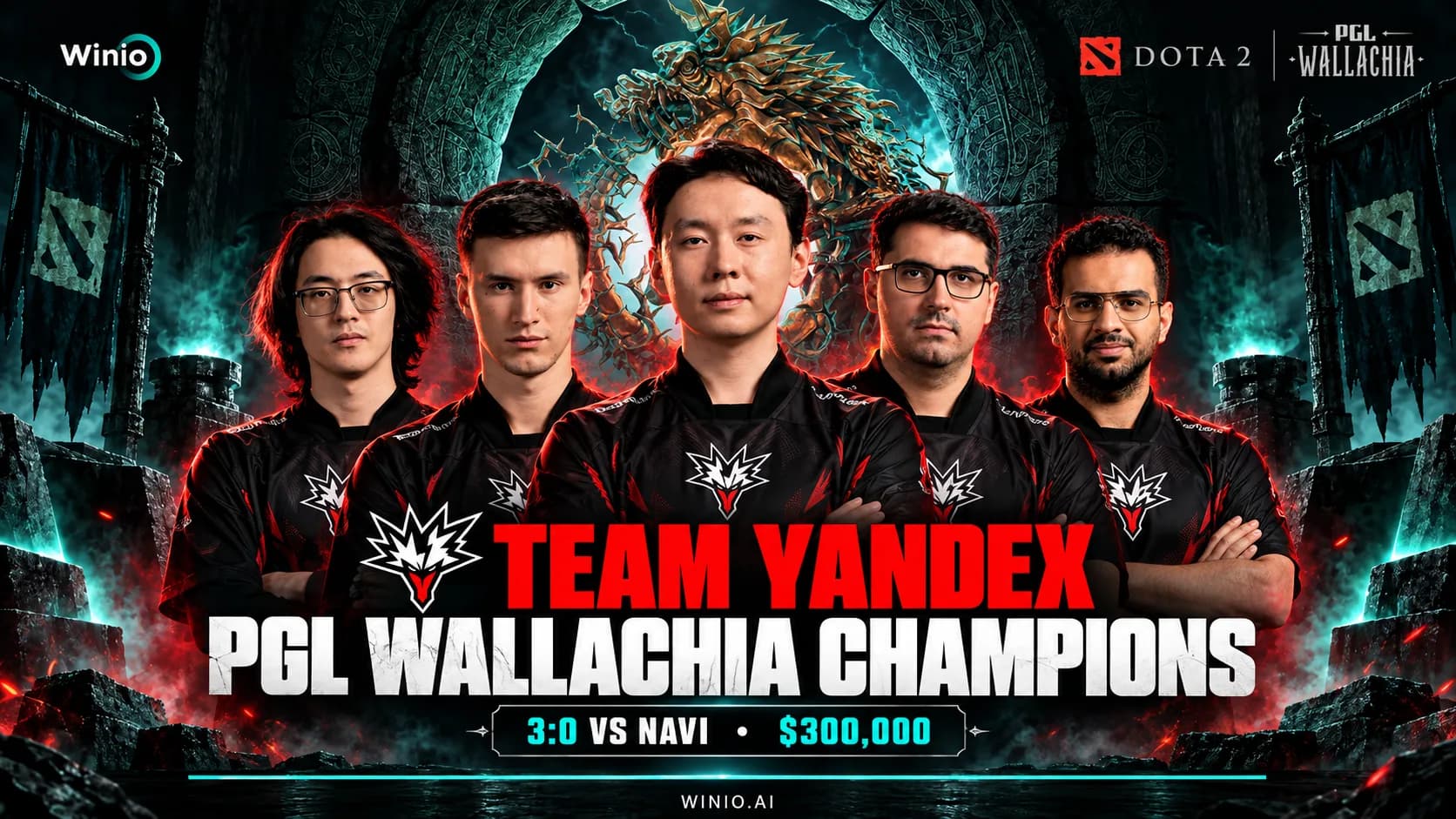
PGL Wallachia Season 9 Results: Team Yandex Win, NAVI Surprise
Team Yandex swept NAVI 3:0 to win PGL Wallachia Season 9. We analyze the champions, NAVI’s final run, surprises and disappointments.
September 28, 202607:28 AM8 min

Odds and predictions often look like they are answering the same question: who is more likely to win? In reality, they come from different systems and serve different purposes.
Those two answers can point in the same direction, but they are not the same thing.
Betting odds can be converted into implied probability. With decimal odds, the formula is simple:
Implied probability = 1 / odds × 100
So odds of 2.00 imply a 50% chance. Odds of 1.50 imply 66.7%. Odds of 3.00 imply 33.3%.
But that does not mean the bookmaker is saying the team has exactly that chance to win. Odds also include the bookmaker’s margin. In a two-team match, if one team is priced at 1.30 and the other at 3.40, the raw implied probabilities are:
| Team | Odds | Raw implied probability |
|---|---|---|
| Team A | 1.30 | 76.9% |
| Team B | 3.40 | 29.4% |
| Total | — | 106.3% |
That extra 6.3% is the overround. It is one reason odds should not be read as clean probabilities.
BLAST SLAM VIII
Tomorrow 12:00
 Team YandexLGD Gaming
BLAST SLAM VIII
Tomorrow 15:30
 Aurora Gaming1w Team
Odds are also affected by market behavior. Bookmakers adjust prices based on information, demand, exposure, liquidity, and how bettors are placing money. A team can become shorter not only because its true chance improved, but because the market is heavily backing it.
A prediction model is not trying to balance a book. It is trying to estimate the chance of an outcome based on available data.
For esports, that can include team form, player performance, head-to-head history, map pool, drafts, side advantage, recent results, patch context, and other match-specific factors. Winio’s prediction view is built around that type of model-based probability: the output is not a betting price, but an estimate of how likely each team is to win.
That difference changes how the number should be read. A model saying 60% does not mean the market must offer odds of 1.67. It means the model sees that team as winning around six times out of ten in comparable conditions.
Good prediction models also need calibration. If a model regularly gives teams a 60% chance, those teams should actually win close to 60% of the time over a large enough sample. Without calibration, a model can look confident without being useful.
Odds and predictions can differ for several reasons.
First, bookmakers include margin. Even if the market is accurate, the displayed odds are not a pure probability.
Second, odds react to money. If many bettors back one side, the price can shorten. That does not always mean the team’s real chance changed by the same amount.
Third, reputation can affect the market. Popular teams, famous players, and recent big wins can attract attention. In esports, brand strength can sometimes move perception faster than actual performance data.
Fourth, models and markets may weigh information differently. A market may heavily favor a known team because of name value or public confidence. A model may see weaker recent form, draft problems, poor map fit, or unstable results and give a more cautious probability.
The difference becomes clear when predictions and odds point to different reads of the same match.
In Team Yandex vs OG Dota 2 group-stage match at the Esports World Cup set to take place on 07.07, the Winio prediction is basically even:
| Team | Prediction |
|---|---|
| Team Yandex | 50% |
| OG | 50% |
But the bookmaker odds tell a different story:
| Team | Odds | Raw implied probability |
|---|---|---|
| Team Yandex | 1.30 | 76.9% |
| OG | 3.40 | 29.4% |
The prediction model sees the match as a coin flip. The odds make Team Yandex a strong favorite.
That is a clean example of why odds and predictions should not be treated as interchangeable. The match is the same, but the numbers are answering different questions. Winio is estimating the probability of the outcome. The bookmaker is offering a market price.
Betting markets should not be dismissed. In many sports and esports markets, odds can be a useful signal because they aggregate information from many participants. A sharp market can react quickly to roster news, injuries, stand-ins, map veto expectations, or public information that changes the match outlook.
In major matches with high liquidity, the market often becomes harder to beat because more people are watching the same information. The closer a match gets to start time, the more data the market may have already absorbed.
But strong does not mean perfect. Markets can still overreact, move because of public demand, or price reputation more aggressively than a model would.
Prediction models are especially useful when the user wants to understand the match rather than just see the price.
Odds can tell you who the market favors. A model can show how strong that favorite actually looks from a data perspective.
That distinction is useful before a match because it can reveal three different situations:
| Situation | What it means |
|---|---|
| Odds and model agree | Market and model see the match similarly |
| Model is more cautious than odds | The favorite may be priced more strongly than the data supports |
| Model disagrees with odds | The match may be more open than the market suggests |
The goal is not to say the model is always right and the market is wrong. The useful part is the comparison. When odds and predictions differ, there is something to examine.
Odds are the market price of an outcome. Predictions are an estimated probability of that outcome.
A bookmaker price includes margin, demand, risk management, and market movement. A prediction model focuses on the chance of the event itself. That is why the same team can be a heavy betting favorite while a model gives the match a much closer probability split.
For esports fans, the practical takeaway is simple: odds can show where the market stands, but predictions can show whether the match looks that one-sided from a data perspective. The best read comes from understanding both — and not confusing one for the other.

Team Yandex
LGD Gaming
Aurora Gaming
1w Team
Team Yandex
LGD Gaming
Aurora Gaming
1w Team
Team Yandex
LGD Gaming
Aurora Gaming
1w Team