CS2 Pets Guide: How to Get and Hatch a Chicken Egg
Learn how to get a Chicken Egg in CS2, how pets hatch and grow, all discovered chicken breeds, Pet Book features and current drop details.
October 1, 202607:54 AM10 min

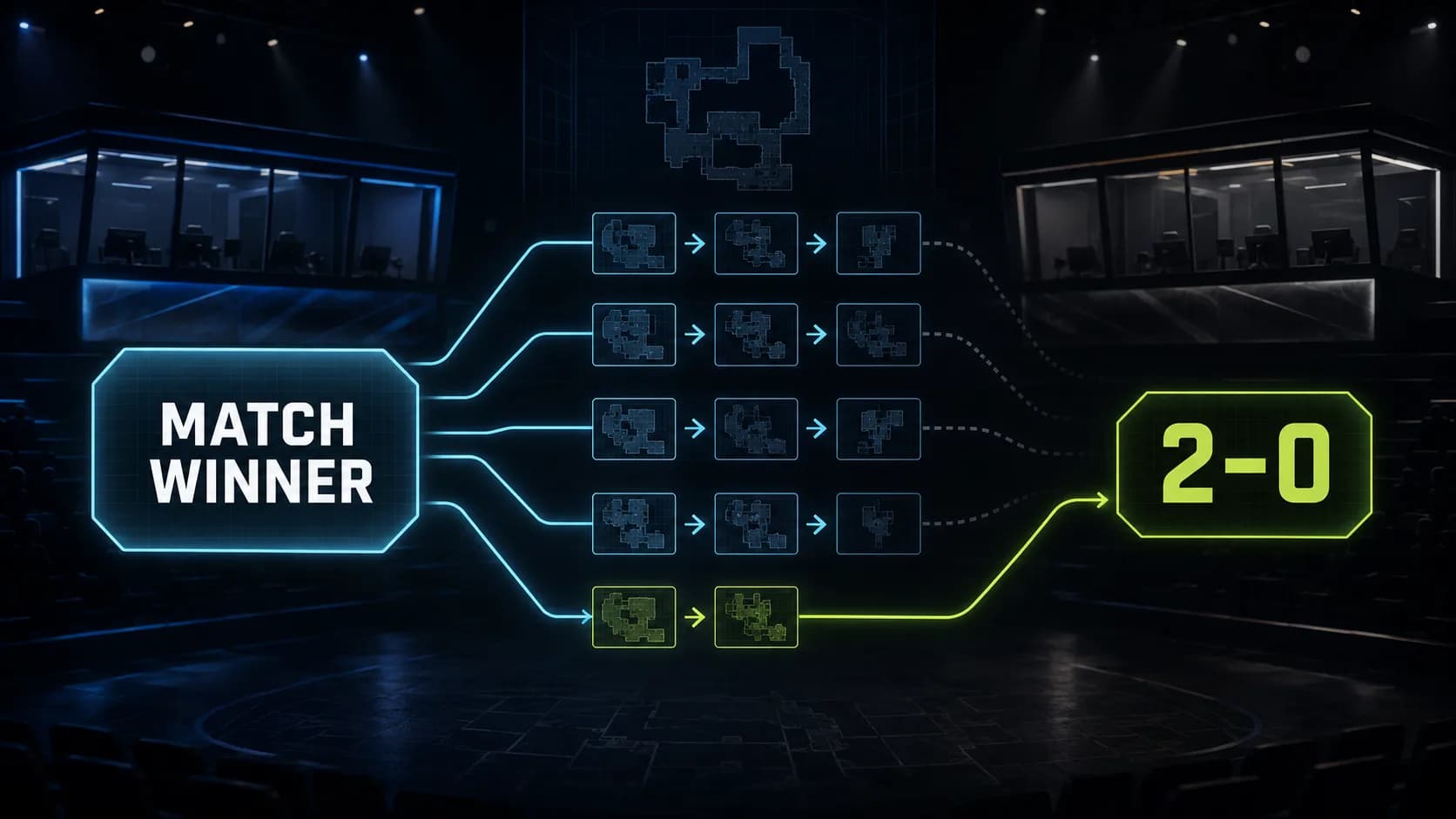
A strong CS2 team can lose a map and still remain in control of a best-of-three. It may start slowly, run into an opponent’s strongest map or need time to adjust before winning the series 2–1.
That flexibility makes predicting the match winner fundamentally different from predicting a 2–0. The first asks which team is more likely to win two maps. The second asks whether it can do so without making a single map-level mistake.
In a best-of-three, Team A has three possible routes to victory:
| Route | Final score |
|---|---|
| Win Map 1, win Map 2 | 2–0 |
| Win Map 1, lose Map 2, win Map 3 | 2–1 |
| Lose Map 1, win Map 2, win Map 3 | 2–1 |
A match-winner prediction succeeds through any of these routes. A 2–0 prediction succeeds through only one.
This distinction matters even when one team is the clear favorite. A prediction model may give Team A a high overall chance of winning because it has an advantage across the full map pool, strong recovery potential and a favorable decider. None of those factors guarantees that the team will win both opening maps.
Pulse Beat III
12.10 13:00
 Ninjas in PyjamasBetclic
Prediction: Ninjas in Pyjamas
United21 Season 56
07.10 11:00
 XIPassion UA
Consider a simplified series in which Team A has a 70% chance of winning Map 1, a 60% chance on Map 2 and a 65% chance on the decider.
Its probability of winning 2–0 is:
70% × 60% = 42%
Its total match-win probability also includes the two routes through a third map:
| Winning route | Probability |
|---|---|
| Win–Win | 42.0% |
| Win–Loss–Win | 18.2% |
| Loss–Win–Win | 11.7% |
| Any series win | 71.9% |
Team A is therefore a clear favorite to win the match, but a 2–0 is still less likely than not. There is no contradiction: the 71.9% match probability combines several possible outcomes, while the sweep probability depends on one exact sequence.
Real prediction models are more complicated because map results are not independent. However, the simplified calculation illustrates the central problem: every additional condition narrows the forecast.
A standard CS2 best-of-three veto usually gives each team one of the first two map picks. The remaining map becomes the decider if the teams split the opening maps.
This means a favorite normally cannot secure a 2–0 by playing only in comfortable conditions. It must win its own selected map and then beat the opponent on a map chosen specifically to give the underdog its best chance.
That second requirement is often where an apparently obvious sweep becomes fragile. An underdog may have little chance across the entire series but still possess one strong map. Winning that map is enough to invalidate the 2–0 prediction, even if the favorite comfortably wins the other two.
The order also matters. A difficult opponent pick played first can put the favorite under immediate pressure, while a comfortable opening map may allow it to settle into the series. The same three-map set can produce different expectations depending on which map is played first and which team chooses the starting side.
Map statistics are essential when evaluating a possible sweep, but raw win rates can be misleading. A 70% win rate does not automatically mean a team has a 70% chance of winning that map in the next series.
The number may have been produced against weaker opposition or over a limited sample. It may also reflect the team’s veto strategy: teams usually play maps when they believe the matchup is favorable and remove them when it is not.
Useful map analysis therefore has to consider:
This creates a larger data requirement for exact-score predictions. Estimating the match winner can rely heavily on overall team strength and the complete BO3 matchup. Calling a sweep requires confidence in both opening maps individually.
Teams can build high series win rates in different ways. One team may dominate early and regularly close matches 2–0. Another may drop maps frequently but excel at adaptation and decider maps.
Both can be equally strong match-winner selections, but they should not receive the same sweep probability. The second team’s ability to recover increases its chance of winning the series without doing anything to protect a 2–0 prediction.
This is why consistency matters more in the correct-score market. The question is not only whether a team’s best level is higher. It is whether its normal and below-average levels are still good enough to beat the opponent twice in succession.
A volatile favorite can produce dominant maps while remaining vulnerable to slow starts, economy collapses or short periods of poor individual form. In MR12, even a relatively brief run of lost rounds can decide an entire map before the stronger team fully stabilizes.
Treating each map as a separate coin flip is useful for explaining the probability, but real series have shared conditions. The same players, form and tactical preparation carry from one map to the next.
If a key player is struggling mechanically, that problem may persist across the series. If a team has misunderstood its opponent’s approach, the weakness can affect multiple maps. These shared factors can make sweeps more likely than a fully independent model would suggest.
The reverse is also possible. Teams gather information during the series, adjust their defensive setups and identify patterns in the opponent’s play. A team that loses the opener may look considerably stronger on Map 2 because it has adapted to what it saw.
The result of Map 1 is therefore information, not just one part of the final score. Pre-match predictions must account for this uncertainty before any of that information becomes available.
A 2–0 forecast becomes especially difficult when made before the map veto. At that point, the analysis must estimate which maps will be removed, what each team will pick and which map is likely to remain as the decider.
Once the veto is known, the uncertainty becomes narrower. Winio’s before- and after-veto probabilities help show how much the selected maps change the overall matchup. A favorite whose probability rises after the veto has gained a better route to the series win, but that still does not mean the increase applies equally to a 2–0.
For example, the final map may heavily favor the stronger team. That makes a 2–1 recovery more likely and raises its match-win probability, but the favorable decider contributes nothing to a sweep because Map 3 is never played in a 2–0.
This is another reason match and correct-score probabilities can move differently. Some veto outcomes provide insurance against an upset map rather than increasing the chance of avoiding one.
A convincing sweep case needs more than a ranking gap or a high match-win percentage. The favorite should have a clear route through both opening maps, including the opponent’s likely pick.
It should also show enough recent stability to make two consecutive strong performances realistic. Lineup continuity, individual form and the ability to close advantages matter more when one poor map invalidates the entire forecast.
The underdog’s map pool is equally important. A weak overall team can still disrupt a sweep if it has one specialized map, a favorable stylistic matchup or enough upset potential to exploit a slow start.
Predicting the match winner asks the broader and more forgiving question. It allows the favorite to lose a map, adjust and use the decider as insurance.
Predicting 2–0 removes that margin for error. It requires the forecast to identify not only the better team, but also the correct map sequence, the impact of the veto and the favorite’s ability to maintain its level across both opening maps.
A high probability of winning the series is therefore not automatically evidence of a likely sweep. The team may be strongly favored because it has several routes to victory. A 2–0 prediction becomes credible only when the analysis shows that it is likely to need just one.

XI
Passion UA

HOTU

STATE

fnatic

Phantom
Prediction: fnatic wins

K27

Metizport

Lavked

Fortress

GamerLegion

BET-M

Enjoy

6666

Nemesis

SINNERS
XI
Passion UA
HOTU
STATE
fnatic
Phantom
Prediction: fnatic wins
K27
Metizport
Lavked
Fortress
GamerLegion
BET-M
Enjoy
6666
Nemesis
SINNERS
XI
Passion UA
HOTU
STATE
fnatic
Phantom
Prediction: fnatic wins
K27
Metizport
Lavked
Fortress
GamerLegion
BET-M
Enjoy
6666
Nemesis
SINNERS