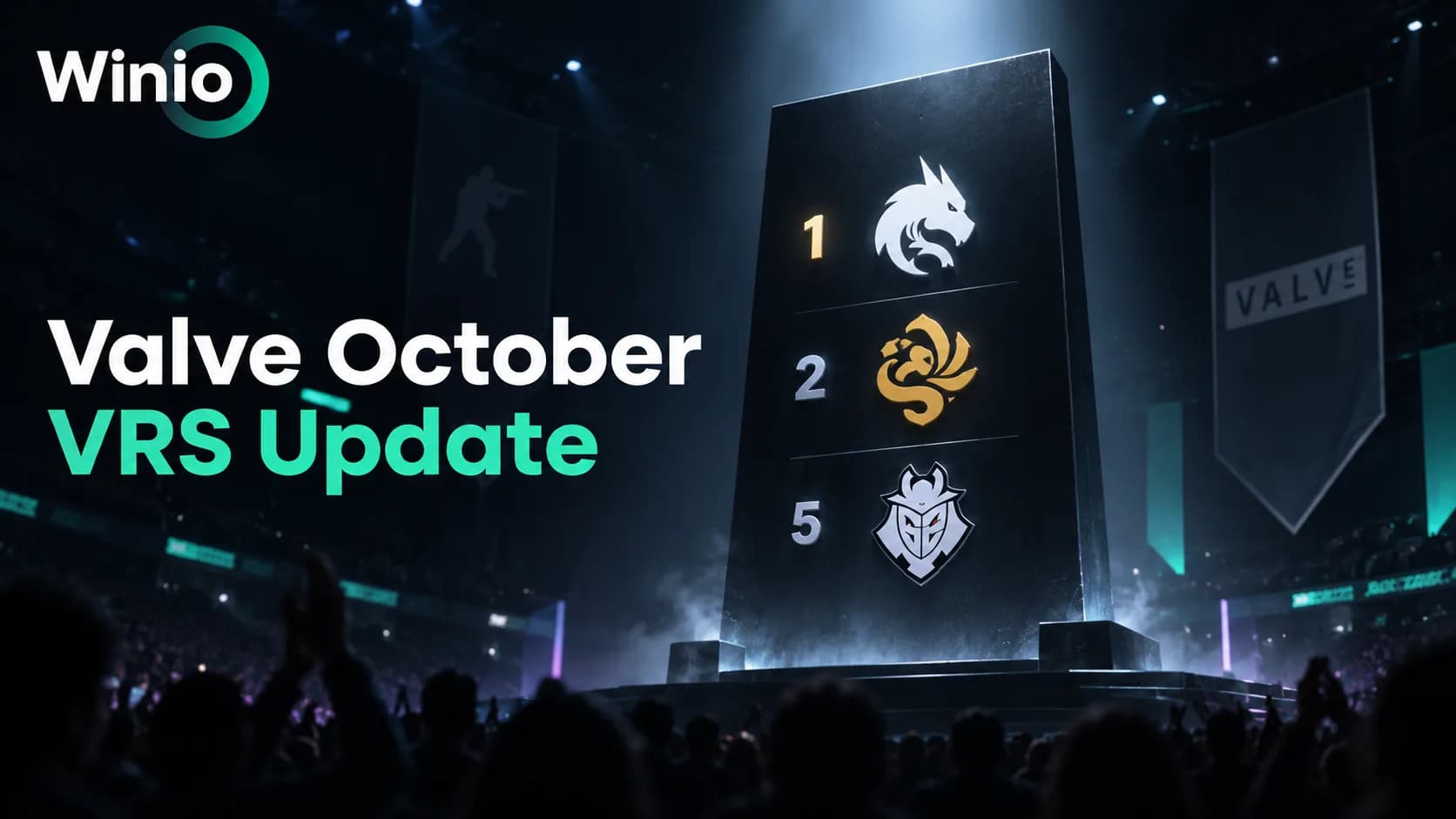
Spirit Stay First as Legacy Surge in Valve's October VRS
Spirit remain No. 1 in Valve's October VRS as Legacy climb to second and G2 return to the global top five.
October 6, 202610:15 AM5 min


Valve has changed the CS Major Supplemental Rulebook to prevent teams from switching VRS regions immediately before a Major invitation deadline. The new rule introduces a three-calendar-month restriction on Regional Assignment.
A roster can now receive a regional assignment only if it has not appeared on another region's VRS list during the preceding three calendar months. The change applies to the PGL Singapore Major qualification process.
It directly affects organizations that recently attempted to move from the European VRS race into Asia, where the same points could place them significantly closer to a Major invitation. BC.Game, Sashi and WW are among the teams affected.
Major invitations are distributed through three regional VRS lists:
A roster's region is determined by the majority of its players. That rule created an opportunity for teams to change regional affiliation through roster moves while preserving enough of their existing core to retain their VRS position. In practice, a European team could add enough Asia-Pacific players to create an Asian majority.
If the roster retained its ranking points, those same points could suddenly place the team much higher in the Asian VRS than in Europe. With the Singapore Major invite cutoff approaching, several organizations began exploring exactly that route.
Private Club #2: CQ
Tomorrow 12:00
 GamerLegionBET-M
Prediction: GamerLegion
ESL Pro League Season 24
LIVE
 FURIA9z
Valve added a new eligibility condition to the Regional Assignment rules. A roster cannot be assigned to a new VRS region if it appeared on another region's VRS list during the previous three calendar months. That creates a delay between leaving one regional ranking and becoming eligible for another region for Major purposes. The key word is Major. The restriction applies to Major invitations. A team can still be eligible for VRS-based invitations to other tournaments even if the new Major regional-assignment rule prevents it from using that region for Singapore qualification.
The timing is particularly important. PGL Major Singapore uses the November 2 VRS cutoff for its invitations. That means teams attempting a late October regional move no longer have enough time to clear the three-month restriction. Valve also clarified that the three-month window is tied to the Major invitation process, not simply to the date on which the Major itself begins. This removes the possibility of a last-minute regional switch immediately before the cutoff.
BC.Game became the most prominent example of the strategy. In September, the organization replaced electroNic with Australian player asap. That move gave BC.Game an Asian-majority core alongside Senzu and mzinho. Before the change, BC.Game's European VRS position left them far from the Singapore Major invitation line. The same points would place them much higher in Asia. After playing the required ranked matches with asap, BC.Game appeared near the top of the Asian VRS and looked to have dramatically improved their Major qualification position. Under the new Major rule, that regional move can no longer be used in the same way for Singapore.
The BC.Game situation attracts additional attention because the roster includes s1mple. A Singapore Major appearance would give one of Counter-Strike's most recognizable players another opportunity to compete on the game's biggest stage. Before Valve's change, BC.Game's Asian VRS position made that route look significantly stronger than their previous European path. Now the situation is much less straightforward.
Valve's clarification indicates that teams that made these late regional moves are out of the current Major race through that route unless they contact Valve and find an acceptable solution. That final condition matters. It means the situation should not be described as an irreversible permanent ban from the Major under every possible circumstance.
Sashi made a similar move shortly before Valve changed the rule. The Danish organization added Australian duo TjP and Hatz on a temporary basis. Together with Anlelele, who Sashi said has Vietnamese citizenship, the roster would have had the regional composition needed to enter the Asian VRS. MistR and Cabbi stepped out of the active lineup during the attempted change. The timing made the purpose clear: Sashi were trying to improve their Singapore Major qualification chances before the November 2 cutoff. The new rule blocks the immediate version of that strategy.
WW were another organization involved in a late regional adjustment. Valve's change is broader than any one team's roster decision. The rule is designed around the roster's VRS history rather than the organization's name. If a roster has appeared in another regional VRS list during the previous three calendar months, it cannot immediately receive a new regional assignment for Major invitations. That approach closes the underlying loophole rather than simply targeting a specific transfer.
The incentive came from the number of Major spots and the strength of each regional race. The Singapore Major has separate VRS invitations for Europe, the Americas and Asia. Europe has the deepest pool of highly ranked teams, which makes the invitation line extremely competitive. A roster that sits far outside the European cutoff can sometimes hold enough points to rank much higher in another region. That difference created the strategic value of changing the roster's regional majority. The team was not earning a completely new ranking from zero. It was trying to use an existing VRS position inside a different regional list.
The PGL Singapore Major invitation date is November 2. That leaves several weeks of ranked competition before the final VRS snapshot. In Europe, many teams are still fighting for positions around the invitation line. Asia is also highly competitive now that the late regional moves have become much harder to use for Major qualification. The new rule therefore changes more than the prospects of BC.Game, Sashi and WW. It can also affect teams that were pushed down the Asian invitation race when those imported rosters appeared near the top of the region. Native Asian teams now have a clearer path through the final month of competition.
This distinction is important. Valve did not remove Regional Assignment changes from the system. Teams can still change their roster composition and eventually become associated with another region. The new rule adds time. A roster needs to avoid appearing in another region's VRS list for the required three-calendar-month period before receiving the new Major regional assignment. So the strategy is no longer impossible. It simply cannot be executed as a last-minute move shortly before Major invitations.
The restriction is part of the Major Supplemental Rulebook. That means it should not automatically be applied to every VRS-based tournament invitation. Teams may still appear in another regional ranking for non-Major event purposes depending on the relevant tournament rules. BC.Game are a useful example. Their recent roster move can still have consequences for ordinary VRS event invitations, even though the new restriction affects their ability to use the Asian route for the Singapore Major. Major eligibility and general VRS event eligibility are not identical.
The timing follows several very visible roster moves built around regional qualification incentives.
BC.Game's transfer had already demonstrated that a roster could move from a difficult European Major position into a very strong Asian ranking position. Sashi then announced an even more explicitly temporary-looking adjustment ahead of the cutoff. That intensified the wider debate around whether the system could be manipulated through late roster moves. Valve's response changes the incentive structure. A team that genuinely wants to change regions can still do so, but planning must begin months earlier rather than during the final weeks of the Major race.
The larger impact may come after Singapore. Organizations now know that regional planning for a Major cannot be treated as a last-minute roster optimization. If a team wants to change regional assignment for a future Major cycle, it will need to consider the VRS publication calendar months in advance.
That affects:
A roster move made purely for a more favorable VRS region now carries a much larger time cost. That should make opportunistic end-of-cycle switches less practical.
Valve's new VRS rule closes one of the clearest late-stage qualification loopholes in the current Major system. Rosters can no longer appear in one regional VRS and immediately switch into another region shortly before Major invitations. The three-calendar-month restriction makes regional changes a longer-term strategic decision rather than a final-week qualification tactic.
The immediate impact falls on BC.Game, Sashi and WW, all of whom made or planned moves toward the Asian VRS during the Singapore Major race. Their recent region changes cannot simply be used for Singapore qualification under the new rule, although Valve has left open the possibility that affected teams could contact the developer and find an acceptable solution.
With the November 2 cutoff approaching, the Major race will now be decided under a significantly different regional landscape. Winio provides predictions for upcoming CS2 matches and analytics for completed series, helping readers follow how the remaining results affect teams competing for the final Major invitation positions.

FURIA
9z

Acend

Sashi

Just Players

Revise

ENCE

MOUZ NXT

G2 Ares

OG

Omega

Noir Verse

Azuolas

megoshort

PARIVISION

Natus Vincere
FURIA
9z
Acend
Sashi
Just Players
Revise
ENCE
MOUZ NXT
G2 Ares
OG
Omega
Noir Verse
Azuolas
megoshort
PARIVISION
Natus Vincere
FURIA
9z
Acend
Sashi
Just Players
Revise
ENCE
MOUZ NXT
G2 Ares
OG
Omega
Noir Verse
Azuolas
megoshort
PARIVISION
Natus Vincere