PGL Wallachia Season 9 Results: Team Yandex Win, NAVI Surprise
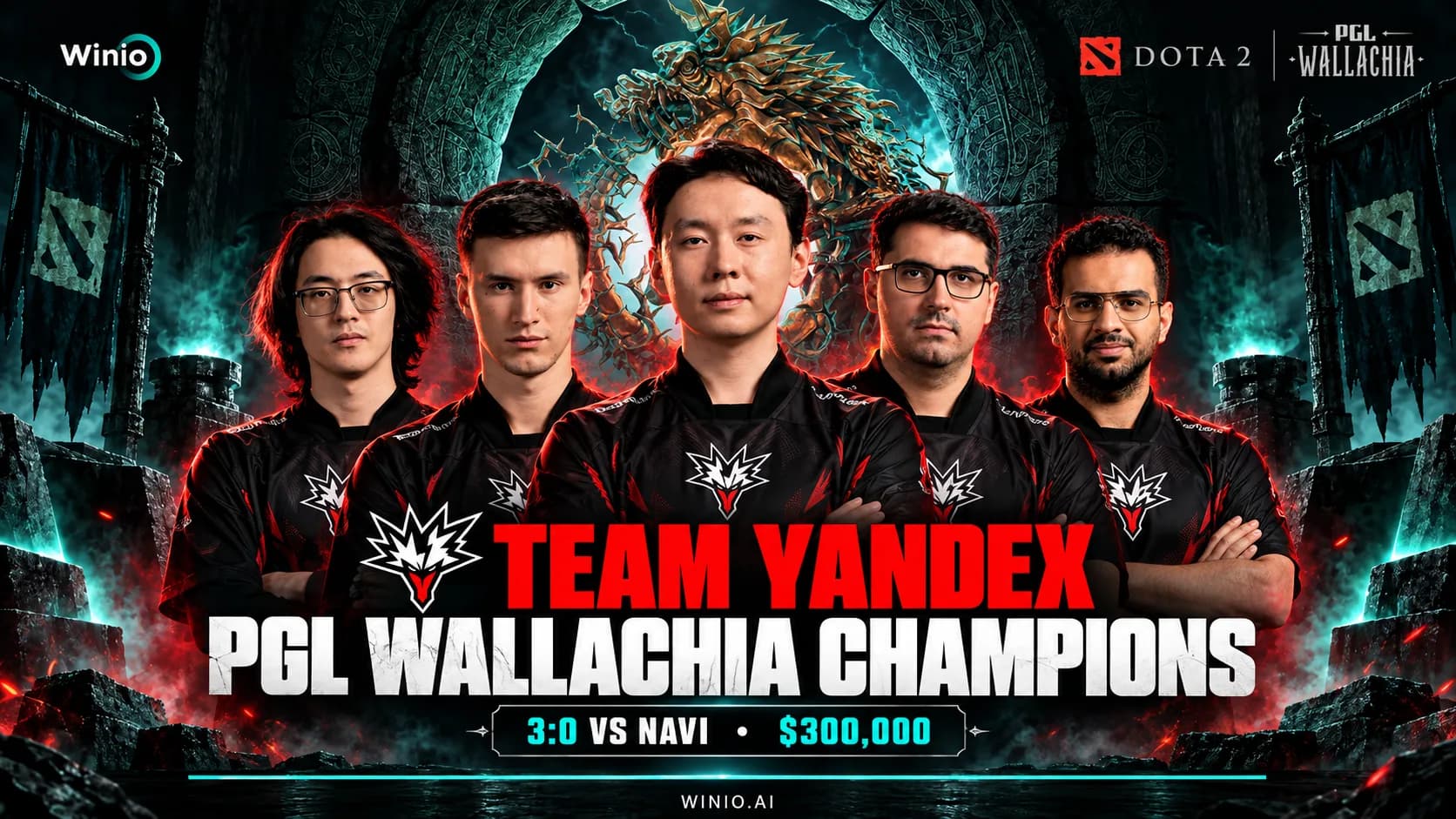
Team Yandex swept NAVI 3:0 to win PGL Wallachia Season 9. We analyze the champions, NAVI’s final run, surprises and disappointments.
September 28, 202607:28 AM8 min


BLAST Slam VII was not a tournament that can be explained by the final alone. Team Yandex lifted the trophy in Copenhagen, but the more important story is how they got there: through a difficult bracket, repeated adaptation, and wins over several of the strongest teams in the field.
The event ran from May 26 to June 7, 2026, with 12 teams competing across the Group Stage, Play-In, and Playoffs. That structure had a noticeable impact on how the tournament unfolded. The group stage created early expectations, but the later rounds showed which teams could actually improve, adjust, and survive longer series under pressure.
The group stage was played in a Bo1 format, which made consistency crucial but also created volatility. A single draft mistake, slow start, or poor read on the meta could immediately affect a team’s position in the standings.
That made the Play-In stage especially important. It gave teams outside the very top of the group stage a second route into the playoffs. In practice, this helped reveal one of the main themes of the tournament: the best team after the first stage was not necessarily the team with the highest ceiling later in the event.
PR Universe
Today 11:00
 1w TeamGamerLegion
PR Universe
Today 14:00
 Team YandexOG
The playoffs then shifted the focus from single-game sharpness to series-level adaptation. Teams had more room to adjust drafts, punish patterns, and respond after losses. That is where Team Yandex separated themselves.

The group stage made LGD Gaming, PARIVISION, and BetBoom Team look like the most stable teams in the field. All three finished at the top of the standings and gave the impression that the tournament might be decided between the early leaders.
Team Yandex were strong, but not yet clearly tournament-winning. Their group-stage record kept them in contention, but it did not fully show what they would become later in the bracket.
Aurora Gaming were another important case. Their group-stage position did not scream title contender, but there were already signs that they could create problems in the right matchups. Their later run proved that their ceiling was higher than the table suggested.
On the other side, teams like Liquid, Falcons, Spirit, and Tundra produced mixed signals. They had enough quality to be dangerous, but not enough stability to fully trust. Xtreme Gaming and GLYPH struggled to build momentum and exited before becoming real playoff factors.
The Play-In stage was the first major turning point.
Team Spirit started well by beating OG 2–0, but then ran into Team Yandex and lost 0–2. That result showed that Yandex were no longer just a solid group-stage team. They were beginning to look sharper in direct elimination conditions.
Aurora also changed the shape of the tournament. They beat Tundra Esports 2–1, then eliminated Team Liquid 2–0. The Liquid result was one of the clearest warning signs that reputation alone was not enough at this event. Aurora were improving, reading opponents well, and finding better execution in series.
By the end of Play-In, the tournament had a different feel. Yandex and Aurora were not just surviving — they were gaining momentum.
Team Yandex’s playoff path was not easy. They beat Aurora 2–0, then defeated LGD Gaming 2–1, BetBoom Team 2–1, and finally LGD again in the grand final, 3–1.
That route means that the title was not built on one upset or a favorable bracket. Yandex beat direct contenders repeatedly. They handled different styles, adjusted across series, and showed that their improvement was sustainable.
The grand final against LGD was the clearest proof. LGD had been one of the most consistent teams throughout the tournament, but Yandex had already beaten them once and looked better prepared for the rematch. The 3–1 final score confirmed that Yandex had the strongest playoff form in the event.
Their win came down to three factors: growth during the tournament, better adaptation in series, and stronger execution under pressure.
LGD Gaming were one of the most impressive teams at BLAST Slam VII even without winning the title.
They topped the group stage and reached the grand final after dropping to the lower bracket. Their lower-bracket wins over Team Liquid, Aurora, and BetBoom showed resilience and consistency. LGD did not collapse after losing to Yandex; they rebuilt their run and earned a second shot at the title.
But the two losses to Yandex define the limit of their tournament. LGD had one of the highest floors in the field. They were stable, disciplined, and difficult to beat. What they lacked was the extra playoff ceiling that Yandex showed in the decisive matches.
That makes LGD a strong signal for future events: reliable against most opponents, but still needing another level against the very best version of a top contender.
BetBoom Team confirmed their strength but left some questions unanswered. Their group stage was strong, and their 2–0 playoff win over Team Falcons showed that they were still a serious contender. But losses to Team Yandex and LGD in close series suggest that BetBoom still need to prove they can consistently close against elite opposition under pressure.
Aurora Gaming were one of the biggest positive stories of the tournament. Their top-four finish was not based on one lucky result. They beat Tundra, eliminated Liquid, and later took down Falcons. That run showed real progression, especially in series where preparation and adaptation mattered more than raw pre-match expectations.
Team Liquid were one of the disappointments. Their loss to Aurora was especially damaging because it exposed a gap between their perceived strength and their actual tournament form. They still had enough quality to be competitive, but not enough control to shape the bracket in their favor.
Team Falcons were also difficult to evaluate. They had strong moments in the group stage and beat Liquid in the playoffs, but the loss to Aurora showed vulnerability against teams that could adapt and challenge their rhythm. Their result was not a collapse, but it was below what their status suggested.
How mathematical models read games should be understood as a probability view, not a promise. Dota 2 is too draft-sensitive, momentum-driven, and format-dependent for any pre-match forecast to be correct every single time.
At BLAST Slam VII, Winio correctly identified many baseline favorites, especially in matches where teams followed stable form patterns. It often aligned well with the strength of teams like PARIVISION, BetBoom Team, Falcons, and Liquid in parts of the group stage. It also recognized Team Yandex as a strong pick in key playoff matches once their bracket form became clearer.
The more valuable part, however, is where the model missed. Those misses help explain the tournament.
Team Yandex were underestimated earlier because their form improved as the event progressed. Aurora were undervalued in some series because they adapted better than their group-stage position suggested. LGD’s lower-bracket resilience was also difficult to capture through baseline indicators alone.
That does not make the model unreliable. It shows why prediction models are most useful when combined with post-match review. Correct calls show where the baseline was strong. Misses show where new inputs deserve more weight: live form, draft flexibility, playoff pressure, and adaptation across a series.
Team Yandex should now be treated as a serious playoff-ceiling team. Their title run was not random; it came through repeated wins over strong opponents and clear improvement through the bracket.
LGD remain one of the most reliable teams to track. They showed consistency across both group and playoff stages, even if Yandex exposed their ceiling in the final matchup.
BetBoom still belong near the top tier, but close series against elite opponents require more caution. They are strong enough to beat almost anyone, but BLAST Slam VII showed that closing power is still a key question.
Aurora deserve more respect in future forecasting. Their tournament showed that form growth and matchup adaptation can matter more than initial seeding.
Liquid, Falcons, Spirit, and Tundra need more careful evaluation before the next event. Their names still carry weight, but BLAST Slam VII showed that current form must be valued over reputation.
BLAST Slam VII showed why tournament analysis needs to go deeper than the final standings. Team Yandex did not simply win the final; they grew into the tournament, survived a demanding path, and beat the strongest available opposition.
That is the main lesson from Copenhagen: results matter, but the reasons behind them matter more. For future tournaments, the teams that deserve the most attention are not always the ones that start strongest — they can be the ones that adapt fastest.

1w Team
GamerLegion
Team Yandex
OG

Team Spirit

BetBoom Team

Team Lynx

rebeldes

Zero Tenacity
rebeldes

Team Liquid
OG
Team Yandex
1w Team

PARIVISION
BetBoom Team
1w Team
GamerLegion
Team Yandex
OG
Team Spirit
BetBoom Team
Team Lynx
rebeldes
Zero Tenacity
rebeldes
Team Liquid
OG
Team Yandex
1w Team
PARIVISION
BetBoom Team
1w Team
GamerLegion
Team Yandex
OG
Team Spirit
BetBoom Team
Team Lynx
rebeldes
Zero Tenacity
rebeldes
Team Liquid
OG
Team Yandex
1w Team
PARIVISION
BetBoom Team