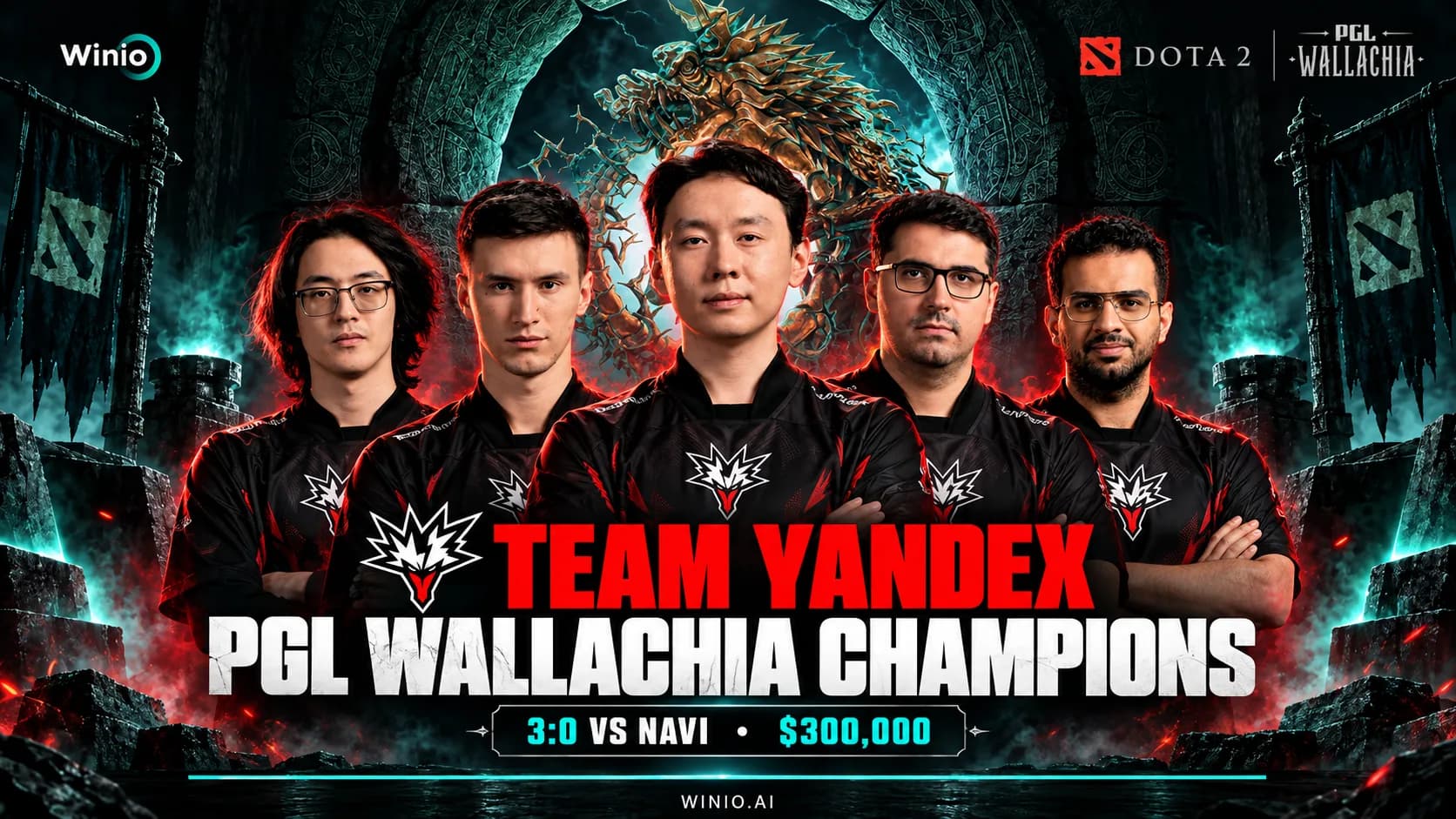
PGL Wallachia Season 9 Results: Team Yandex Win, NAVI Surprise
Team Yandex swept NAVI 3:0 to win PGL Wallachia Season 9. We analyze the champions, NAVI’s final run, surprises and disappointments.
September 28, 202607:28 AM8 min

PARIVISION defeated BetBoom Team 3–1 to win the Dota 2 Esports World Cup 2026, completing one of the most convincing tournament runs of the season. They finished with a 16–3 map record and never lost a series.
The championship also clarified the competitive hierarchy before The International. Team Yandex came closest to matching PARIVISION, BetBoom demonstrated much greater consistency, and Vici Gaming produced the tournament’s biggest surprise. Previous champions Team Spirit and Team Falcons, meanwhile, were both eliminated in the quarterfinals.
PARIVISION started in Group C alongside Team Spirit, Vici Gaming, MOUZ, REKONIX and Team Nemesis. They swept their first four opponents before drawing 1–1 with Spirit, finishing first with a 9–1 record.
Direct qualification allowed PARIVISION to skip the Survival Stage. When they returned for the playoffs, the break had done little to disrupt their form.
EPL Masters III
Today 12:00
 _PowerRangersHULIGANI
EPL Masters III
Today 15:00
 Team Lynx_PowerRangers
Their complete route was:
The quarterfinal demonstrated the gap between a promising underdog and the tournament favorite. PARIVISION recorded 43 kills in both maps, winning the first 43–14 and the second 43–9. Satanic accumulated 41 kills across the series, while No[o]ne recorded 20 assists in each game.
Yandex took one map from them in the semifinal, while BetBoom won the opening game of the final. Those were PARIVISION’s only playoff defeats.
Satanic produced several exceptional carry performances, but PARIVISION did not win EWC by building every game around him. Their biggest advantage was the number of players capable of controlling a match.
According to the event statistics, Noticed finished with a 12.52 KDA across 19 maps—the highest among players with a full tournament sample. No[o]ne ranked second with 9.66, while Satanic was fourth with 7.75. Three PARIVISION cores therefore occupied three of the top four places in the tournament’s KDA ranking.
Noticed’s influence extended beyond statistics. His offlane heroes gave PARIVISION initiation, frontline presence and early pressure without consuming the farm Satanic needed. Against Yandex, his Axe disrupted Watson’s Phantom Lancer and created opportunities for No[o]ne’s Invoker to convert ganks into Sun Strike kills.
No[o]ne was the team’s main connection between the lanes and later fights. PARIVISION used him on Ember Spirit, Puck, Pangolier and Invoker—heroes capable of initiating, controlling space and exploiting any early advantage created by the side lanes.
This structure made the team difficult to target in drafts. Restricting Satanic did not remove PARIVISION’s damage. Focusing on No[o]ne still left Noticed capable of starting fights, while 9Class and Dukalis supplied additional control, saves and ranged initiation.
The grand final demonstrated that adaptability. BetBoom convincingly won game one behind MieRo’s Timbersaw and Kiritych’s Clinkz, limiting PARIVISION to ten kills in 48 minutes. PARIVISION responded by winning three consecutive maps.
For the grand final, Winio’s post-draft prediction gave PARIVISION an 83% probability of winning. The model’s assessment reflected advantages visible throughout the tournament: reliable lanes, multiple sources of initiation and several viable win conditions rather than dependence on one carry matchup.
Team Yandex entered the semifinal with an almost identical tournament record. They drew their opening group series against OG, then swept IC x Insanity, Virtus.pro, LGD Gaming and 1win to finish Group D at 9–1.
Their quarterfinal against defending EWC champion Team Spirit ended in another 2–0 victory. By the semifinal, both Yandex and PARIVISION had won 11 of their 12 maps.
PARIVISION controlled game one through their lanes. Their Tiny, Ember Spirit and Underlord reached the map before Yandex’s physical-damage lineup of Templar Assassin and Slardar could establish its preferred timing. PARIVISION won 28–9 in 31 minutes.
Yandex responded with a composition built around stronger teamfighting. Despite another difficult start, they repeatedly punished PARIVISION around chokepoints and eventually won a decisive fight after Satanic died without buyback. The comeback required 65 minutes, but it forced a third game.
The decider again came down to PARIVISION’s early execution. Noticed pressured Watson’s Phantom Lancer, No[o]ne converted that pressure into kills, and Satanic’s Lone Druid was allowed to farm with limited interference. PARIVISION closed the series in 37 minutes.
Yandex later swept Vici Gaming to finish third with a 14–3 map record. Two of those three losses came against PARIVISION. Third place undersells their overall performance, but the direct series showed that PARIVISION currently possess the more reliable early game.
BetBoom finished Group A with an 8–2 record but missed direct playoff qualification by one map. Their draws against Team Falcons and Rune Eaters left Falcons at the top of the group with a 9–1 score.
The additional Survival Stage series did not become a disadvantage. BetBoom swept LGD Gaming and carried that momentum into the playoffs:
BetBoom then won game one of the grand final, extending their winning streak to seven maps. Their victories over Nigma and Vici were particularly controlled, with neither opponent able to force a third game.
The pivotal moment arrived in the second game of the final. BetBoom secured three early kills on Satanic and had late-game damage through Kiritych’s Drow Ranger, but PARIVISION repeatedly outmaneuvered them after the 30-minute mark.
No[o]ne’s Invoker finished with 12 kills and 16 assists as PARIVISION equalized after 62 minutes. The following two games were much less competitive: PARIVISION won game three 32–16 before taking the final map 29–7 in 36 minutes.
BetBoom finished the event 15–5. They proved that their discipline and consistency have improved, but the final showed a remaining difference in mid-series adaptation.
Vici Gaming entered EWC without a major international result since the organization’s return to Dota 2. They finished third in Group C at 6–4, losing to PARIVISION and Spirit while defeating MOUZ, REKONIX and Nemesis.
After advancing past PlayTime by forfeit during the ongoing integrity investigation, Vici defeated 1win 2–1 to reach the playoffs. They then produced the tournament’s biggest upset by sweeping reigning TI champion Team Falcons.
The run ended with consecutive 0–2 defeats against BetBoom and Yandex, but fourth place still represented a major improvement. Vici also became the only Chinese team to reach the semifinals before TI takes place in Shanghai.
Rune Eaters followed another unexpected route. They finished Group A at 5–5 after drawing with BetBoom, Xtreme Gaming and GamerLegion. In Survival, they defeated Virtus.pro 2–1 and swept Aurora 2–0.
PARIVISION ended their run decisively, but reaching the top eight at the roster’s first Tier 1 event established Rune Eaters as more than an occasional upset threat.
All four group winners finished with identical 9–1 records:
Only PARIVISION and Yandex won a playoff series. Falcons lost 0–2 to Vici, while Nigma lost 0–2 to BetBoom.
The long break between the group stage and playoffs may have helped teams arriving from Survival maintain competitive rhythm. BetBoom and Vici had already played elimination matches immediately before facing their quarterfinal opponents.
That explanation only goes so far. PARIVISION and Yandex had the same break and won their quarterfinals 2–0. The more important distinction was their ability to reproduce their group-stage strengths against prepared playoff opponents.
Falcons and Nigma were consistent across five best-of-two matches, but neither adapted after losing the opening playoff map. Their combined 18–2 group-stage record became 0–4 in the playoffs.
Team Spirit also failed to defend their title. They finished Group C at 8–2 and survived a 2–1 series against Liquid, only to be swept by Yandex in the quarterfinals.
EWC produced 157 maps with an average duration of 42:48. The length of the average game rewarded teams that could apply early pressure without sacrificing scaling or late-game teamfight options.
Hoodwink was the most-picked hero:
| Hero | Picks | Pick rate | Win rate |
|---|---|---|---|
| Hoodwink | 69 | 44.0% | 56.5% |
| Earth Spirit | 67 | 42.7% | 49.3% |
| Clockwerk | 59 | 37.6% | 44.1% |
| Ember Spirit | 47 | 29.9% | 61.7% |
| Bane | 44 | 28.0% | 54.6% |
Hoodwink’s combination of ranged control, damage and flexible positioning made the hero useful in different draft structures. Ember Spirit was less frequently available but considerably more successful, winning almost 62% of his maps.
The ban statistics show which heroes teams were least willing to leave open:
| Hero | Bans | Ban rate | Total contest rate |
|---|---|---|---|
| Treant Protector | 139 | 88.5% | 98.1% |
| Lone Druid | 133 | 84.7% | 97.5% |
| Shadow Fiend | 100 | 63.7% | 87.3% |
| Drow Ranger | 88 | 56.1% | 79.0% |
| Puck | 77 | 49.0% | 71.3% |
Treant Protector and Lone Druid were almost permanently contested. Treant was picked or banned in 154 of 157 maps, while Lone Druid appeared in the draft of 153.
Shadow Fiend was another major priority and justified that attention with a 62.2% win rate across 37 picks. Keeper of the Light won 60% of 35 games, while Nature’s Prophet recorded a 68.8% win rate from 16 picks.
The meta did not revolve around a single dominant strategy. Successful drafts combined lane stability, mobile playmaking and enough scaling to survive longer matches. PARIVISION handled that balance better than anyone.
PARIVISION now enter TI as the clearest favorite. They won 84.2% of their maps, defeated their two closest regional rivals and demonstrated that they could recover after both difficult lanes and complete map losses.
Yandex remain the nearest challenger. Their 14–3 record would have been enough to win many tournaments, while BetBoom’s 15–5 run showed that they can consistently eliminate elite opposition. Both teams are credible TI contenders, but both lost their direct comparison with PARIVISION.
Falcons and Spirit retain championship experience, although their EWC results place them behind the leading Eastern European teams on current form. Vici emerged as a legitimate Chinese contender, while Rune Eaters proved capable of punishing more established rosters.
PARIVISION’s advantage is not that every individual game is flawless. It is that mistakes rarely remove all of their paths to victory. Until another team can consistently disrupt their lanes, contain No[o]ne and Noticed, and still match Satanic in the late game, PARIVISION remain the team everyone else must solve.

_PowerRangers
HULIGANI
Team Lynx
_PowerRangers

Team Yandex

GamerLegion
Prediction: Team Yandex wins
Team Liquid

1w Team
1w Team

OG
Team Liquid
GamerLegion
Prediction: Team Liquid wins
The Bot^$

Dawn Bulls
Dawn Bulls
Zero Tenacity
Prediction: Zero Tenacity wins
_PowerRangers
HULIGANI
Team Lynx
_PowerRangers
Team Yandex
GamerLegion
Prediction: Team Yandex wins
Team Liquid
1w Team
1w Team
OG
Team Liquid
GamerLegion
Prediction: Team Liquid wins
The Bot^$
Dawn Bulls
Dawn Bulls
Zero Tenacity
Prediction: Zero Tenacity wins
_PowerRangers
HULIGANI
Team Lynx
_PowerRangers
Team Yandex
GamerLegion
Prediction: Team Yandex wins
Team Liquid
1w Team
1w Team
OG
Team Liquid
GamerLegion
Prediction: Team Liquid wins
The Bot^$
Dawn Bulls
Dawn Bulls
Zero Tenacity
Prediction: Zero Tenacity wins