PGL Wallachia Season 9 Results: Team Yandex Win, NAVI Surprise
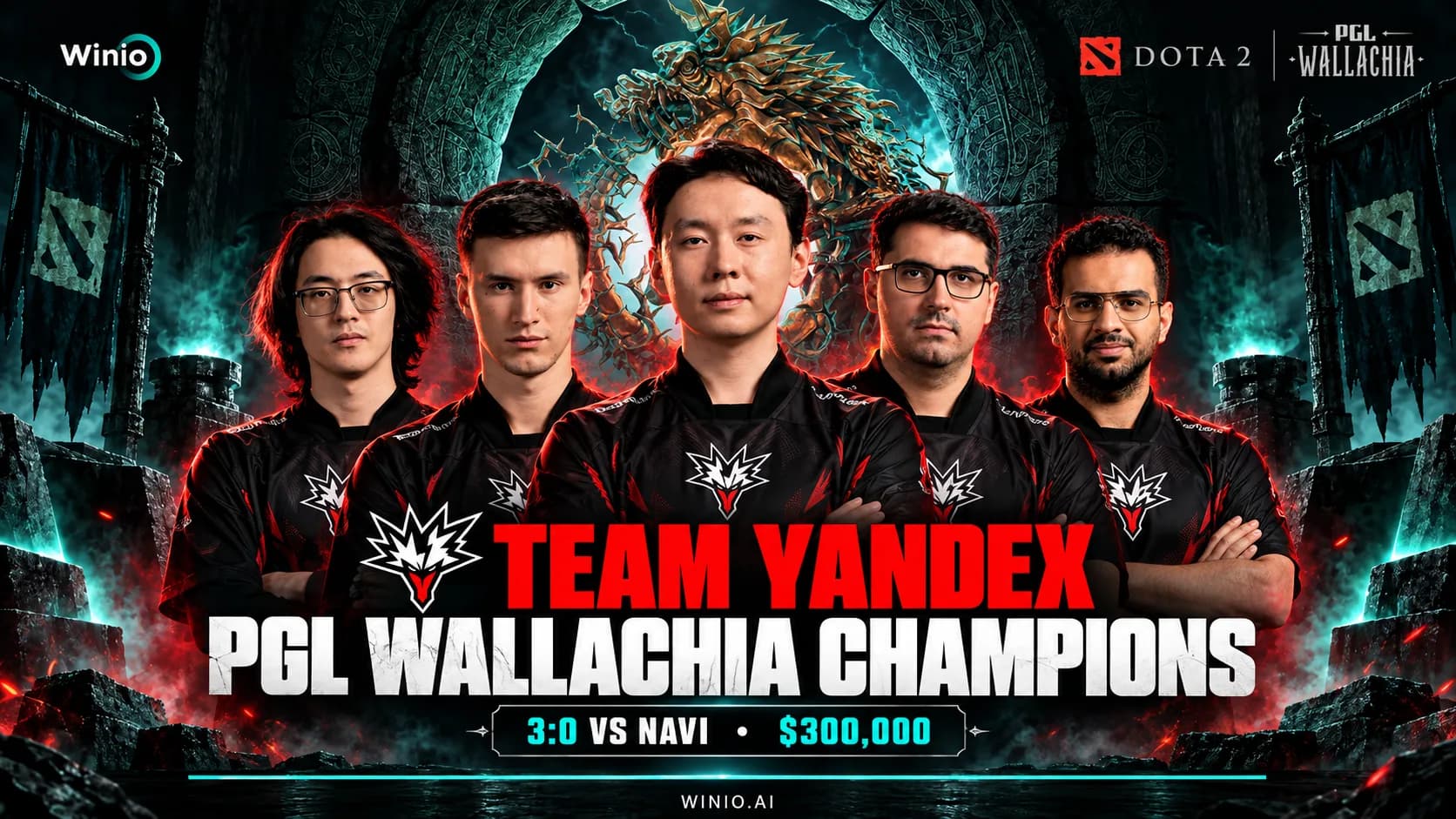
Team Yandex swept NAVI 3:0 to win PGL Wallachia Season 9. We analyze the champions, NAVI’s final run, surprises and disappointments.
September 28, 202607:28 AM8 min


Team Yandex entered professional Dota 2 only in June 2025, but it took the organization less than a year to establish itself among the strongest teams in the world. The roster has already won three Tier 1 tournaments, reached another major grand final, secured a direct invitation to The International 2026 and climbed to the top of several global rankings.
Its rise has not been perfectly consistent. Team Yandex has alternated between championship runs and early eliminations, while the current five-player lineup was finalized only in May 2026. However, its recent results suggest that the team is developing into more than a short-lived contender built around individual form.
Team Yandex enters the second half of 2026 as an established title contender. The team won BLAST Slam VII in June and followed that result with an exceptional start at the Esports World Cup 2026.
EPL Masters III
Tomorrow 18:00
 Team LynxInner Circle
Prediction: Team Lynx
PR Universe
24.10 14:00
 Team YandexOG
Yandex finished first in its EWC group with a 9–1 map record before defeating defending champion Team Spirit 2–0 in the quarterfinals. That gave the roster 11 wins across its first 12 maps and secured at least a top-four finish.
Several ranking systems placed Team Yandex first or second in the world during July. Rankings differ in their methodology, but the broader conclusion is clear: Yandex is currently part of the small group of teams capable of entering any Tier 1 event as a realistic favorite.
Team Yandex entered Dota 2 by signing the Cyber Goose roster in June 2025. The original lineup featured TA2000, CHIRA_JUNIOR, Noticed, prblms and Solo, with Accell joining as coach.
The organization retained CHIRA_JUNIOR and Noticed during its first major rebuild but replaced the remaining three players. Watson and Malady arrived from Gaimin Gladiators, while former Tundra support Saksa initially joined as a stand-in before becoming an essential part of the team.
The final change came in the offlane. DM first replaced Noticed as a stand-in at PGL Wallachia Season 7, where Yandex won the tournament, and officially took over the position in May 2026.
| Player | Position | Primary function |
|---|---|---|
| watson | 1 | Main carry and late-game win condition |
| CHIRA_JUNIOR | 2 | Tempo, initiation and secondary damage |
| DM | 3 | Early communication, space creation and utility |
| Saksa | 4 | Rotations, initiation and draft flexibility |
| Malady | 5 | Lane support, vision and teamfight control |
| Accell | Coach | Drafting, preparation and overall structure |
The rebuild gave Yandex a useful balance between mechanical talent and experience. Watson and CHIRA_JUNIOR provide the individual ceiling, while DM and Saksa add structure, communication and experience from previous Tier 1 teams.
Watson remains the most recognizable player on the roster. He is an efficient carry with a large hero pool, strong farming patterns and the ability to convert relatively limited space into a competitive late game.
However, Yandex does not use him exclusively as a passive farming carry. Watson can join early fights, use Twin Gates to influence the opposite side of the map or continue farming when the draft gives the other four players enough tools to control the game.
CHIRA_JUNIOR is central to this flexibility. His pool includes traditional mobile mids such as Ember Spirit, Pangolier and Puck, but Yandex can also give him unconventional tempo heroes such as Slardar and Earthshaker. These picks allow him to initiate fights while leaving watson as the primary source of sustained damage.
DM has helped connect the two cores. Watson has explained that DM communicates constantly during the early game, plays less greedily and creates additional space for both carry and mid. This is particularly valuable because watson himself tends to become more active in team communication later in the game.
Saksa is the most experienced and tactically flexible player in the lineup. His arrival coincided with the team’s first major improvement, and watson publicly credited him as a major reason for Yandex’s rise. Malady complements him with more stable position-five heroes that protect lanes and provide reliable teamfight utility.
Team Yandex combines structured preparation with considerable freedom inside individual games. The players regularly review replays, prepare new heroes and maintain disciplined practice routines, but their decisions are not limited to one rigid strategic template.
The team can play around an active mid hero, early rotations from Saksa and a low-resource offlaner. In other drafts, it can slow the game down, distribute farm across all three cores and build toward superior late-game scaling.
This makes Yandex difficult to reduce to a simple “four protect one” model. Watson is often the primary win condition, but CHIRA_JUNIOR can become a major damage dealer, while DM is comfortable on offlaners that continue scaling rather than functioning only as initiators.
The team also appears comfortable in long and chaotic games. Its players have enough individual skill to identify alternative win conditions after losing the initial plan, while its drafts frequently retain strong initiation and scaling beyond the first major item timings.
Yandex’s drafts are built around broad individual hero pools, but the team is still willing to repeat a successful idea until opponents prove they can stop it.
Centaur Warrunner became the clearest example at the Esports World Cup. DM played the hero throughout multiple consecutive victories, including both quarterfinal maps against Team Spirit. Centaur gives Yandex a durable initiator, global mobility through Stampede and enough early communication freedom for DM to direct the rest of the team.
CHIRA_JUNIOR’s Slardar has been another important feature. Although normally associated with the offlane, the hero provides a strong mid matchup in the right draft, reliable initiation and Corrosive Haze for watson’s physical-damage carries.
Recent Yandex drafts have used the following heroes particularly effectively:
| Player | Notable recent heroes |
|---|---|
| watson | Nature’s Prophet, Kez, Drow Ranger, Phantom Lancer, Lina, Clinkz |
| CHIRA_JUNIOR | Slardar, Invoker, Ember Spirit, Earthshaker |
| DM | Centaur Warrunner, Underlord |
| Saksa | Mirana, Hoodwink, Keeper of the Light, Techies |
| Malady | Undying, Winter Wyvern |
Watson’s pool is especially difficult to cover during the ban phase. His career heroes include Terrorblade, Morphling, Templar Assassin and Ursa, while recent tournaments have shown that Yandex can introduce less established options without losing its overall structure.
Saksa provides similar flexibility on support. He can initiate, offer ranged damage or play a more defensive role depending on what the three cores need. As a result, early support picks do not always reveal how Yandex intends to approach the game.
Team Yandex won its first Tier 1 title at DreamLeague Season 27 in December 2025. The team defeated Team Spirit 3–1 in the grand final, including two final maps in which Yandex did not lose a single hero.
The months that followed demonstrated both its ceiling and its inconsistency.
| Tournament | Placement |
|---|---|
| DreamLeague Season 27 | 1st |
| BLAST Slam VI | 5th–6th |
| DreamLeague Season 28 | 11th–12th |
| PGL Wallachia Season 7 | 1st |
| ESL One Birmingham 2026 | 2nd |
| PGL Wallachia Season 8 | 15th–16th |
| BLAST Slam VII | 1st |
| Esports World Cup 2026 | At least top four as of July 17 |
At PGL Wallachia Season 7, Yandex defeated Team Liquid 3–2 in the grand final despite playing with DM as a stand-in. It then reached the final of ESL One Birmingham, where Tundra Esports won the rematch 3–1.
The immediate collapse at PGL Wallachia Season 8 raised questions about the team’s consistency. Yandex lost all three series and finished 15th–16th, only to recover and win BLAST Slam VII less than two months later.
The BLAST title was particularly significant because it came with the current permanent roster. Yandex defeated Aurora, LGD, BoomBoys and BetBoom during the playoffs before beating LGD 3–1 in the grand final.
The clearest strength is the individual level of the three cores. Watson, CHIRA_JUNIOR and DM can all take over games, but their farm requirements are sufficiently different to prevent the map from becoming overcrowded.
The roster also has an unusually broad range of drafting options. Watson can play both traditional late-game carries and more active heroes, CHIRA_JUNIOR is comfortable on mobile mids and physical initiators, and Saksa can fill almost any function required from position four.
Experience is another major advantage. Saksa has played in championship-winning teams and at multiple editions of The International, while DM has spent years competing against elite opposition. Their presence reduces the pressure on Yandex’s younger cores and gives the team more ways to manage difficult games.
Finally, Yandex has already shown that it can adapt during long playoff runs. Its three Tier 1 titles came against three different grand-final opponents—Team Spirit, Team Liquid and LGD—and under two different offlaners.
Yandex’s results remain more volatile than those of a fully established dominant team. Finishing first at PGL Wallachia Season 7 and last at Season 8 within five weeks shows how dramatically its level can change between events.
Some of those failures came under unusual circumstances, including stand-ins and visa problems, but they cannot all be dismissed as external noise. DreamLeague Season 28 produced another early elimination, with Yandex failing to win a single series during its group.
Its current drafts also contain several visible priorities. Repeatedly winning with Centaur, Slardar, Undying and Mirana is evidence of excellent execution, but opponents will eventually force Yandex onto different combinations. The deeper test is whether the team can maintain the same coordination after its most comfortable heroes are removed.
The permanent version of the roster is also relatively new. DM officially joined in May, leaving the team with only a few months of full-roster competition before The International. The early results are excellent, but TI places more pressure on preparation and adaptability than a standard tournament.
Yandex’s record against elite opponents supports its position near the top of the rankings. It has repeatedly defeated Team Spirit and has positive recent records against Team Liquid, BetBoom Team and Xtreme Gaming.
| Opponent | Competitive picture |
|---|---|
| Team Spirit | Strong advantage for Yandex |
| Team Liquid | Yandex won four of the five latest meetings |
| BetBoom Team | Yandex won three of the five latest meetings |
| Xtreme Gaming | Yandex won three of five series |
| Team Falcons | Nearly even |
| PARIVISION | Even overall map record |
| Tundra Esports | Historically difficult matchup |
The results are not limited to group-stage best-of-ones. Yandex has beaten Spirit, Liquid, BetBoom and LGD in playoff series, showing that the roster can prepare for specific opponents and adjust across multiple maps.
Tundra has produced the most difficult matchup, including two victories over Yandex during the ESL One Birmingham playoffs. However, the broader top-team record suggests a specific competitive problem rather than a general inability to defeat elite opposition.
Team Yandex has already secured a direct invitation to The International 2026. Based on its titles, current form and player quality, reaching the event is no longer the achievement—the realistic target is a deep playoff run.
The roster has most of the qualities associated with successful TI teams: flexible drafting, several independent win conditions, experienced supports and the ability to play both fast and slow games. Its current trajectory also suggests that the transition from Noticed to DM has strengthened the overall structure.
The remaining question is consistency. Yandex has demonstrated championship-level Dota several times, but it has also produced two major group-stage failures in 2026. A strong TI run will depend on whether the team can maintain its best level across an event where every opponent has time to study its most successful drafts.
Team Yandex has developed from a newly signed regional roster into one of the leading teams of the 2025–2026 season. Three Tier 1 titles, a major grand final, a direct TI invitation and repeated victories over elite opponents provide enough evidence to treat its rise as sustainable.
Its greatest advantage is not any single player or draft. It is the combination of watson and CHIRA_JUNIOR’s mechanical ceiling with the structure provided by DM, Saksa, Malady and Accell. If Yandex reduces the gap between its championship runs and its weakest tournaments, it has the tools to challenge for The International 2026.

Team Yandex
OG

1w Team
OG

Team Liquid

GamerLegion
Prediction: Team Liquid wins
Team Lynx
Inner Circle
Prediction: Team Lynx wins
Inner Circle

HULIGANI
1w Team
GamerLegion

Team Spirit

BetBoom Team
Team Yandex
OG
1w Team
OG
Team Liquid
GamerLegion
Prediction: Team Liquid wins
Team Lynx
Inner Circle
Prediction: Team Lynx wins
Inner Circle
HULIGANI
1w Team
GamerLegion
Team Spirit
BetBoom Team
Team Yandex
OG
1w Team
OG
Team Liquid
GamerLegion
Prediction: Team Liquid wins
Team Lynx
Inner Circle
Prediction: Team Lynx wins
Inner Circle
HULIGANI
1w Team
GamerLegion
Team Spirit
BetBoom Team