CS2 Rush Hour Update: Rush Mode and Premier Changes
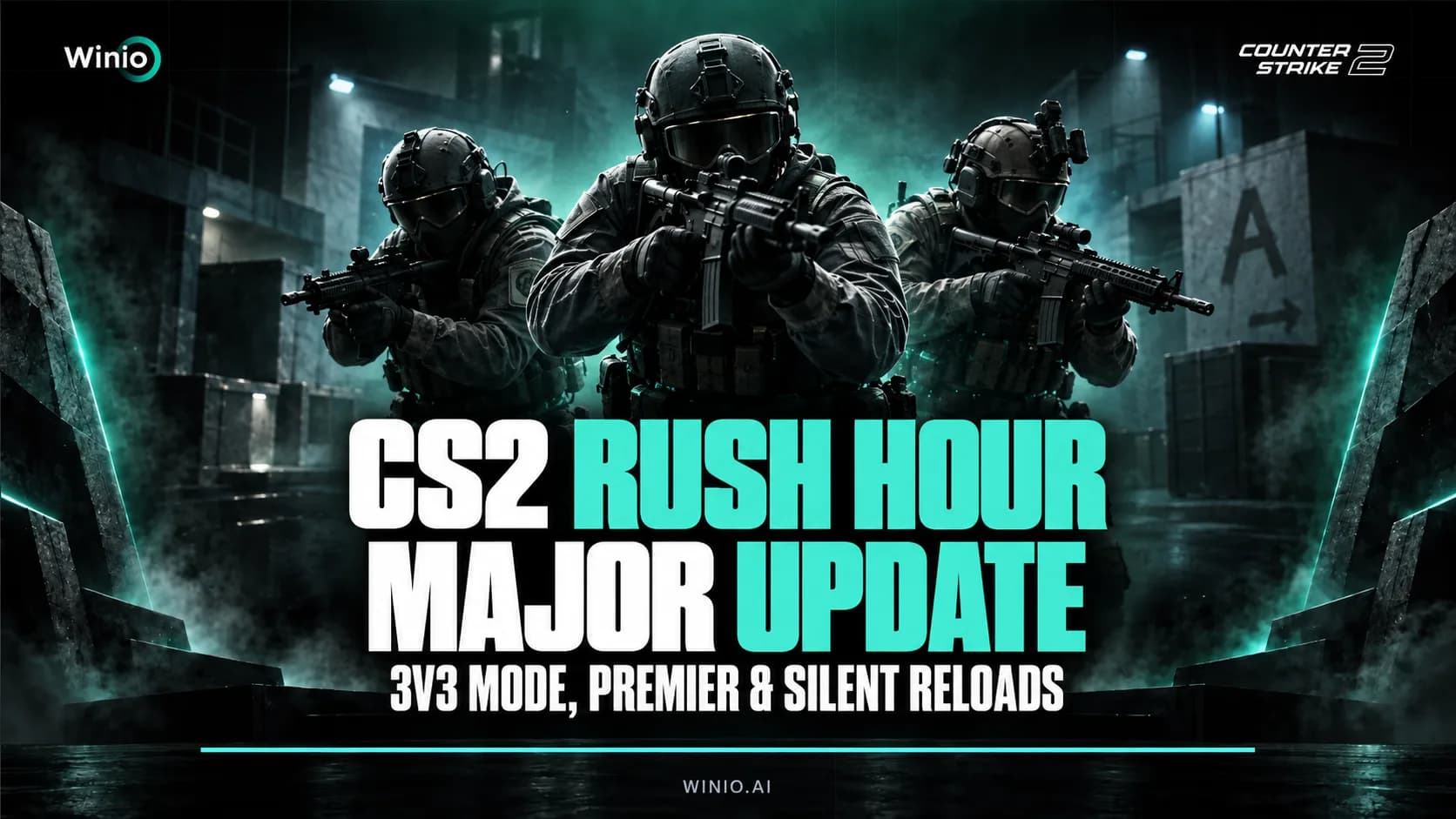
Valve released the major CS2 «Rush Hour» update with a new 3v3 mode, Premier map selection changes, silent reloads and crosshair upgrades.
September 23, 202605:34 AM10 min


IEM Cologne Major 2026 started with a clear hierarchy. Vitality, NAVI and Spirit entered as the safest title picks because they had the recent results, baseline level and pressure-tested identities to justify favorite status. Falcons, FURIA and Legacy were more complicated. They had enough quality to make deep runs, but each still carried questions about consistency, structure or sustainability.
That made Falcons’ title more meaningful. They did not win Cologne as the obvious favorite, they won it as the team whose ceiling was already clear, but whose system still had to prove it could survive a full Major run. The final result was decisive — a 3–0 win over FURIA — but the title was really earned before the final. Falcons beat Vitality in the quarter-final, Spirit in the semi-final and then swept FURIA for the trophy.
That path removes the easiest doubts. Some tournament wins are shaped by favorable brackets or one hot weekend. Falcons’ run was different. They did not avoid the strongest part of the field; they went through it. Cologne turned them from a dangerous project into a proven Major-winning team.
Private Club #1
Tomorrow 15:00
 Ninjas in Pyjamas3DMAX
Prediction: Ninjas in Pyjamas
LB Masters Season 1
Today 18:00
 LP brazilRBLS
The pre-event picture is useful because it shows what the tournament actually changed. Before the first matches, the field could be separated less by stage placement and more by evidence. Some teams had proven title profiles, some had high ceilings with doubts, and others needed early Swiss momentum to change their evaluation.
| Pre-tournament group | Teams | What Cologne tested |
|---|---|---|
| Safest title profiles | Vitality, NAVI, Spirit | Whether proven structure and recent trophies would hold under Major pressure |
| High ceiling with questions | Falcons, FURIA, Legacy | Whether talent and form could become repeatable across the full event |
| Dangerous upward movers | GamerLegion, B8, The MongolZ | Whether recent improvement was real or only short-term momentum |
| Volatile contenders | Aurora, PARIVISION, G2, Astralis, paiN, Monte, 9z | Whether quality could survive Bo3 pressure and stronger opponents |
| Riskier name-value teams | MOUZ, BetBoom, Liquid, BIG, HEROIC, MIBR | Whether reputation, individual talent or past level still matched current form |
Stage 1 quickly showed why that framework mattered. BetBoom, B8, M80 and GamerLegion created early upgrades because they looked prepared and gave themselves cleaner routes forward. HEROIC showed the opposite. Once a team falls into early Swiss pressure, the conversation stops being about potential and becomes about survival.
Still, early momentum was only a first signal. Stage 1 and Stage 2 could reveal sharpness, but not title-level reliability. The real proof had to come later, especially in Stage 3 and the playoffs, where best-of-three series exposed shallow map pools, unstable mid-rounding and weak adaptation. Cologne rewarded teams that could keep solving problems as the pressure increased, and Falcons did that better than anyone.
Before Cologne, Falcons were easy to respect but difficult to fully trust. The firepower was obvious: a lineup with m0NESY and NiKo had enough individual quality to beat anyone. The question was whether Falcons’ new captain could turn that talent into a stable system. Star power wins rounds, but Majors are usually decided in the details — rotations, trading, late-round calls, timeout responses, veto confidence and emotional control after losing streaks.
That was the real doubt around Falcons. Were they a complete team, or just an elite collection of pieces? Cologne answered that question because their run was not perfect. A Stage 3 loss to BetBoom forced them to recover instead of cruise, and that made the title more convincing. Clean runs can hide flaws; recovery runs show whether a team has structure when the event stops going smoothly.
The playoffs made the case even stronger. Beating Vitality was the first major statement because Vitality entered as one of the safest title profiles. Beating Spirit was bigger because Spirit had looked like one of the strongest teams at the event. By the time Falcons reached FURIA, they were no longer proving they had enough talent. They were proving that the rest of the field did not have enough answers.
The final reflected that gap. FURIA had moments, but Falcons had more ways to win. m0NESY gave them round-winning explosiveness, NiKo added pressure and late-stage impact, kyousuke supplied another layer of danger, and karrigan gave the roster direction. That balance changed Falcons’ identity. They were still explosive, but now they were controlled enough for that explosiveness to matter across a full Major run.
NiKo finally winning a Major will be the easiest storyline to remember from Cologne. For years, he was part of the “best players without a Major” conversation, and this result ended that chapter. But the stronger analytical point is not simply that NiKo finally won. It is that he won on a team that did not need him to solve everything alone.
Great players can drag teams deep into tournaments, but Major finals typically punish one-dimensional systems. Falcons had multiple win conditions. m0NESY could take over rounds, NiKo could apply pressure without carrying every map, and the rest of the roster could stabilize enough situations for the stars to decide the right ones.
In that sense, NiKo’s win is also a team-building lesson. The best version of a superstar is not always the version that does the most. Sometimes it is the version that finally has enough structure around him to make his impact sustainable.
FURIA’s tournament should not be judged only by the final. Reaching the Major final was a huge achievement for a team that entered Cologne as dangerous but not fully proven. Their run showed identity, confidence and enough structure to punish opponents that were less complete.
The playoff path still matters, though. Falcons had to beat Vitality and Spirit before the final, while FURIA reached it through 9z and Aurora. That does not make FURIA’s run weak, but it changes how it should be evaluated. There is a difference between a historic run and the strongest run. FURIA’s Major was historic; Falcons’ Major was stronger.
The final made that distinction clear. FURIA could compete in stretches, but they could not consistently disrupt Falcons’ rhythm. The gap was not just individual quality. It was problem-solving. Falcons had more answers when rounds became uncomfortable, while FURIA struggled to force the series into new shapes. FURIA leave Cologne with two truths: they proved they belonged near the top of the event, and they also showed that another level is still required to beat the most complete teams in a Major final.
The biggest failed expectation was not that outsiders went out early. That happens at every Major. The more important story was that some of the safest pre-tournament teams did not turn their status into a final run.
Vitality had one of the clearest title cases before the event. Their baseline was high, their identity was proven and they were easy to trust in pressure matches. But Cologne did not produce the best version of Vitality. Their loss to Falcons was not just a bracket accident; it showed that even reliable teams can look ordinary when structure and individual level do not arrive together.
NAVI were another example. They entered with recent title-winning form, experience and a strong favorite profile, but missed the playoffs. That result separated pre-event logic from tournament reality. NAVI had reasons to be trusted, but they did not create enough current evidence once the event started.
MOUZ and PARIVISION fit the same theme from different angles. MOUZ had talent, but roster instability and role questions made them difficult to read. PARIVISION had a strong starting position, but came in with form concerns. Cologne punished both. At a Major, uncertainty does not need to be dramatic to become fatal. It only needs to appear often enough for better teams to target it.
Spirit should not be grouped with the failed favorites. Their tournament was strong, and for long stretches they looked like one of the teams most capable of winning the whole event. That is what makes their semi-final loss more important. Falcons did not beat a collapsing opponent; they beat a team that looked title-ready.
This is one of Cologne’s key distinctions. Vitality and NAVI failed to fully match expectation. Spirit largely matched it, then ran into the eventual champion. That does not make Spirit’s run a collapse. It makes Falcons’ title stronger, because they beat one of the teams that had shown real championship level before the bracket reached its final stage.
Cologne also clarified the middle of the scene. BetBoom were one of the most important early upgrades because their start was not just random Bo1 noise. They had enough structure and confidence to turn early momentum into a deeper run. B8 also showed that their upward-mover label had substance, even if they did not become a playoff breakthrough.
9z were the better underdog story because they did more than survive early chaos. They reached the playoffs and produced one of the clearest hierarchy-breaking moments by beating Vitality in Stage 3. Aurora also strengthened their case by reaching the semi-finals, even if the FURIA series set a limit on the run.
None of these teams became automatic elite-tier conclusions. But Cologne gave future analysis more evidence. Some teams upgraded their perception, while others showed that reputation alone was no longer enough.
The main tactical lesson was not about one map, weapon or trend. It was broader: the best teams combined structure with flexible star power. The early stages rewarded preparation and sharp starts, but the deeper stages demanded repeatability, adaptation and better answers across series.
Cologne made a few things clear:
Falcons were the best example of the winning balance. They had enough structure to avoid randomness and enough individual quality to win rounds that structure alone cannot create. That matters in CS2, where momentum swings, economy pressure and small timing errors can decide entire halves. Rankings can show who should be strong, but Majors show who can still solve problems when the pressure changes.
Winio’s pre-tournament read held up in structure, even if the final was not obvious. It was right to treat Vitality, NAVI and Spirit as the cleanest favorites, because that was the logical view before the event. It was also right to place Falcons and FURIA in the high-ceiling-with-questions group. In hindsight, that was the most important call. Falcons winning does not mean the doubts were fake; it means they answered them.
The preview was also right to stay cautious about early results. BetBoom, B8, M80 and GamerLegion created useful Stage 1 signals, but not all early momentum translated into deeper strength. The later best-of-three stages gave the real confirmation.
The biggest miss was timing. Falcons’ ceiling was clear, but their ability to make it repeatable under Major pressure arrived faster than expected. The correct adjustment is not simply “Falcons were underrated.” It is more precise: their ceiling was known, but their stability was underestimated.
IEM Cologne Major 2026 will be remembered for Falcons’ title, NiKo’s first Major, m0NESY’s MVP-level impact and FURIA’s historic final. But the deeper meaning is about how teams should be judged. The tournament punished lazy reputation-based thinking. Vitality and NAVI had strong pre-event arguments, but neither reached the final. MOUZ and PARIVISION showed how roster or form uncertainty can become fatal. Early-stage teams proved that momentum matters, but only the strongest can sustain it.
Falcons tied the whole event together. Their star power finally had enough structure, their chaos had direction, and their individual brilliance appeared inside a system that survived pressure. Before Cologne, Falcons were a dangerous project. After Cologne, they are Major champions with a real claim to being one of the defining teams of the current CS2 scene.
The final did not create that conclusion by itself. The whole run did. Falcons beat the teams they needed to beat, answered the questions that followed them into the event and turned the highest ceiling in the field into the biggest result of the year. That is what Cologne revealed: reputation can start the conversation, but only repeatable answers under pressure can finish it.
LP brazil
RBLS
K27

CYBERSHOKE

LP
RBLS

latvjubanda

Seizer
LP brazil
RBLS

Yawara

Juventus

Turma do Pagode

Keyd Stars

INOX Division

Black Phoenix
LP brazil
RBLS
K27
CYBERSHOKE
LP
RBLS
latvjubanda
Seizer
LP brazil
RBLS
Yawara
Juventus
Turma do Pagode
Keyd Stars
INOX Division
Black Phoenix
LP brazil
RBLS
K27
CYBERSHOKE
LP
RBLS
latvjubanda
Seizer
LP brazil
RBLS
Yawara
Juventus
Turma do Pagode
Keyd Stars
INOX Division
Black Phoenix