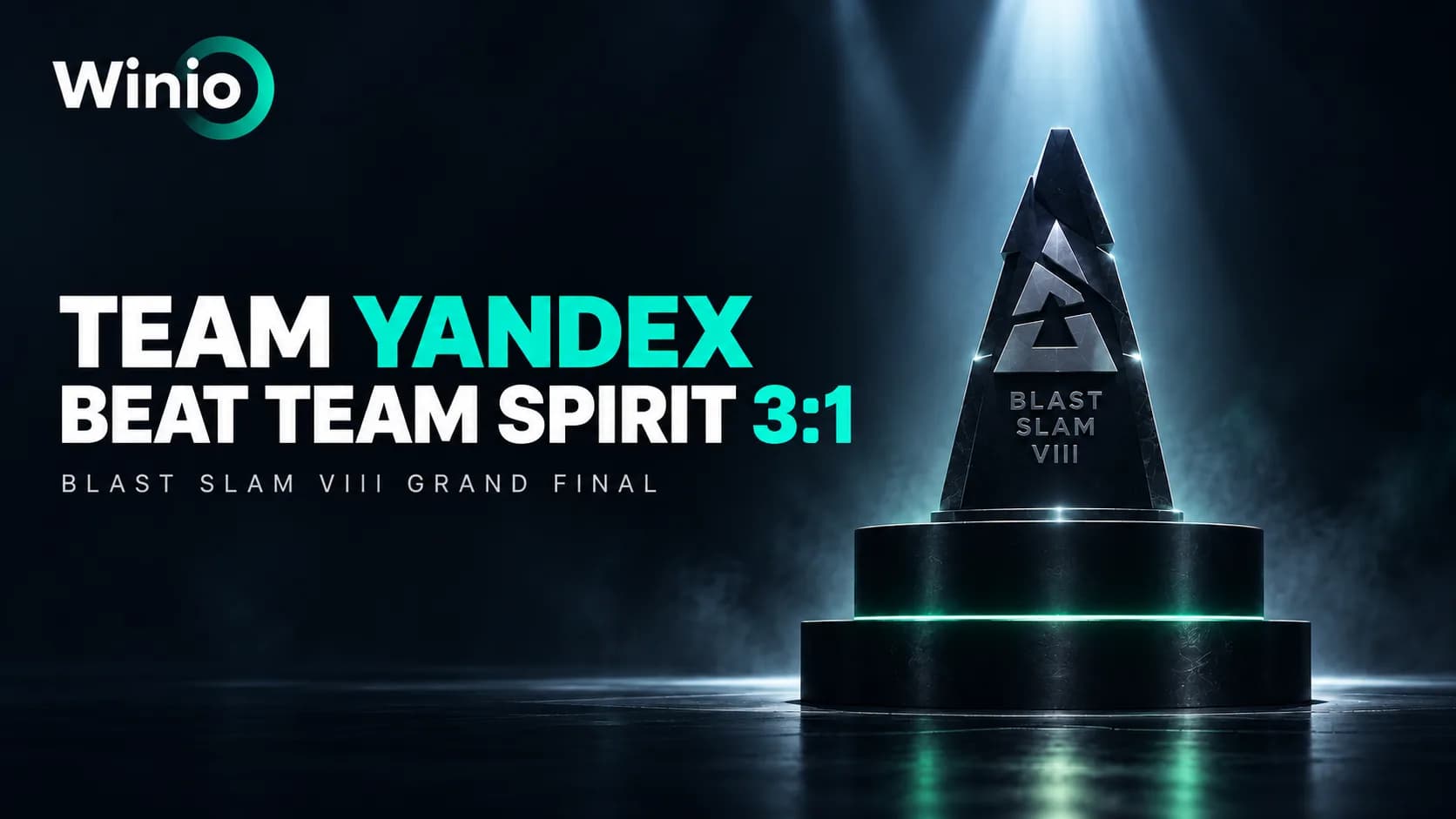
Team Yandex Beat Team Spirit 3-1 to Win BLAST Slam VIII
Team Yandex defeated Team Spirit 3-1 in the BLAST Slam VIII Grand Final, winning the Dota 2 title and $270,000 in Malta. Slug:
October 11, 202608:01 PM5 min

Team Yandex claimed the Dota 2 title at BLAST Slam VII. In the grand final, the team defeated LGD Gaming 3–1 and walked away with the $300,000 grand prize.
BLAST Slam VII took place from May 26 to June 7 at BLAST Studios in Copenhagen. Twelve teams participated in the tournament, and the total prize pool was $1 million. At the end of the tournament, LGD Gaming took second place, BetBoom Team finished third, and Aurora ended the event in fourth place.
For Winio, this victory is interesting not only as a tournament outcome but also as an example of how rematches change match analysis. When teams play each other multiple times in a single tournament, the first result ceases to be the sole benchmark. What becomes more important is which team identifies the opponent’s weaknesses faster and prepares better for the next series.
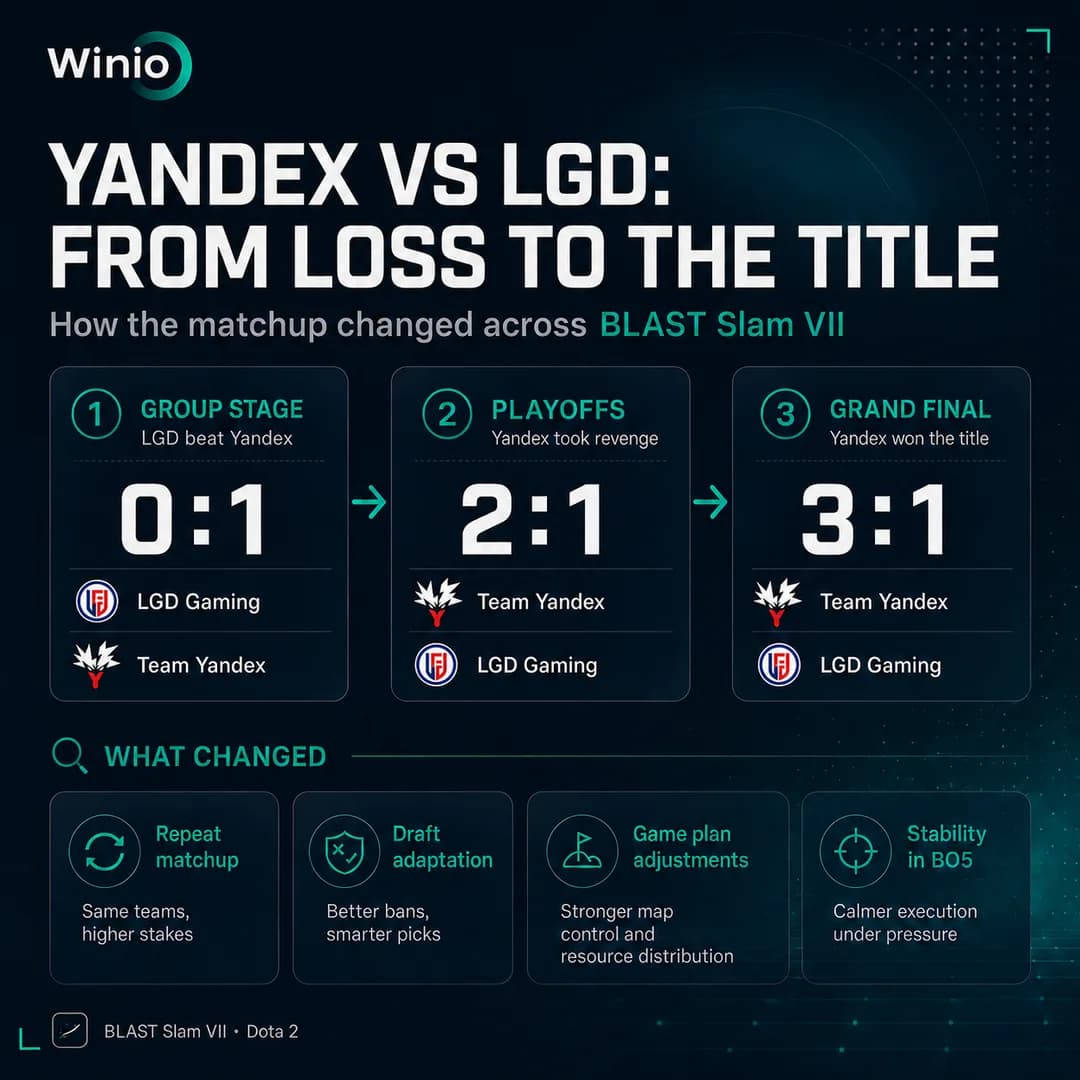
In Dota, this is most often reflected in the draft phase. If a team lost the first match but in the next series began banning the opponent’s key heroes, shifting lane priorities, or picking tempo heroes earlier, this is already a sign of adaptation. Such a signal can be more important than the fact of the early loss itself.
PR Universe
Today 11:00
 Team YandexGamerLegion
Prediction: Team Yandex
EPL Masters III
Today 15:00
 HULIGANITeam Lynx
A rematch also shows how well a team can adjust its game plan. A roster might win thanks to a successful pick or strong early game, but falter when the opponent counters that strategy. One team might start the tournament on shaky ground but gradually find more reliable ways to secure victory: better farm distribution, more careful initiation of fights, and more precise timing when applying pressure across the map.
For fans, this provides a concrete point of reference: before a rematch, you shouldn’t just look at the previous score. It’s more important to understand what the teams changed after the first series. Did the bans change? Did one mid laner start getting more favorable matchups? Did the team start taking Roshan earlier or play more aggressively around the side lanes? It’s precisely these details that often reveal whether the first result was a fluke or if the team truly found a sustainable advantage.
Team Yandex entered the grand final better prepared. The 3-1 victory shows that the team was able not only to win a single map but to maintain an advantage over the course of a best-of-five series. In Dota, long finals test the depth of a team’s strategies, their resilience under pressure, and their ability to adapt between maps.
LGD Gaming also had a strong tournament. Reaching the grand final confirms the team’s caliber, but the decisive series showed that Team Yandex was more consistent in this matchup. Losing in the final doesn’t make LGD weak, but it highlights where Yandex gained the upper hand specifically in the playoffs.
Winio believes this approach helps analyze matches more accurately than simply relying on recent results or the hype surrounding team names. In finals like Team Yandex vs. LGD, it’s often the finer details-form, draft strategy, consistency, matchups, and the pressure of a specific series that tell the story more than the final score.
Team Yandex’s victory at BLAST Slam VII was more than just a final line in the standings. It’s an example of how, in Dota, decisive series are won by teams that not only play well but also adapt better as the tournament progresses.

Team Yandex
GamerLegion
Prediction: Team Yandex wins
HULIGANI
Team Lynx

Team Liquid

1w Team

The Bot^$

Zero Tenacity
1w Team

OG
Team Liquid
GamerLegion
Prediction: Team Liquid wins
Team Yandex
GamerLegion
Prediction: Team Yandex wins
HULIGANI
Team Lynx
Team Liquid
1w Team
The Bot^$
Zero Tenacity
1w Team
OG
Team Liquid
GamerLegion
Prediction: Team Liquid wins
Team Yandex
GamerLegion
Prediction: Team Yandex wins
HULIGANI
Team Lynx
Team Liquid
1w Team
The Bot^$
Zero Tenacity
1w Team
OG
Team Liquid
GamerLegion
Prediction: Team Liquid wins