CS2 Pets Guide: How to Get and Hatch a Chicken Egg
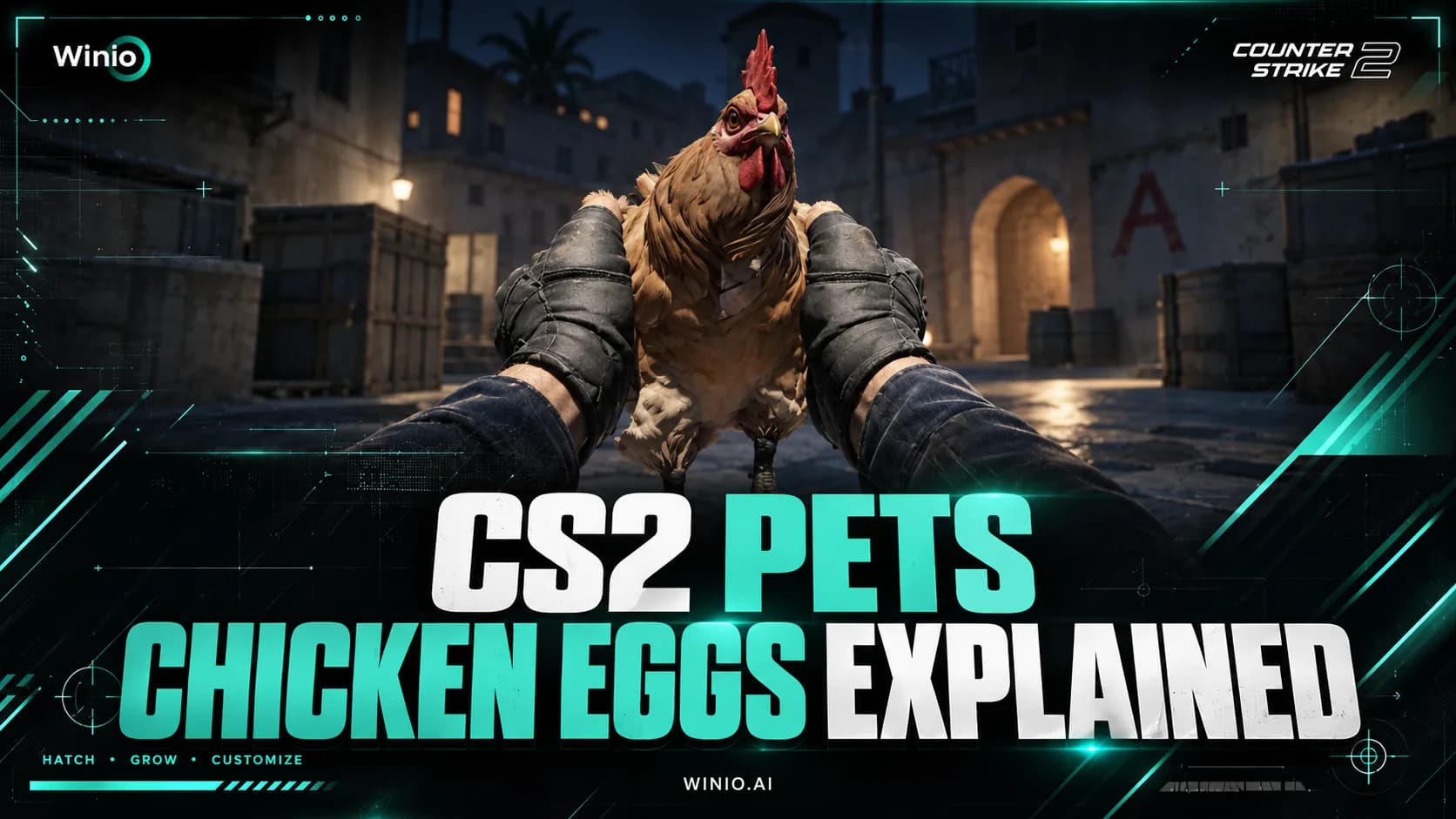
Learn how to get a Chicken Egg in CS2, how pets hatch and grow, all discovered chicken breeds, Pet Book features and current drop details.
October 1, 202607:54 AM10 min


Players moving from CS:GO to CS2 notice one major difference immediately: matches feel shorter. That is because the round system has changed. This article explains the new MR12 format, the exact round count, overtime rules, match duration, and why every round now carries more weight.
The core of CS2's competitive system is called MR12. MR12 stands for Maximum Rounds 12 per half. This directly determines the total round count.
Here is how the match is structured:
However, matches rarely use all 24 rounds. The game stops as soon as one team reaches 13 round wins. This means the actual number of rounds played depends on how one-sided or close the match is.
So the answer to "how many rounds are played in CS2" is not a single number. It is either 13 rounds (if one team dominates) or up to 24 rounds (if both teams are evenly matched). In close games, overtime adds even more rounds.
Private Club #2: CQ
Tomorrow 12:00
 HOTUSTATE
Prediction: HOTU
CCT Eu 2026 Series #10
Today 14:00
 MASONICZero Tenacity
The win condition in CS2 is straightforward: you need 13 round wins. This applies to all competitive modes, including Premier.
Unlike CS:GO, where you needed 16 wins out of 30 possible rounds, CS2 lowers the target. This change has several effects:
If a team reaches 13 rounds before the second half finishes, the match ends immediately. For example, if Team A wins the first half 9:3 and then wins the first 4 rounds of the second half, the match stops at 16 rounds total. The remaining 8 rounds of the second half are not played.
This is why professional players and casual gamers alike had to adjust their strategies when switching from CS:GO to CS2.
Now let us focus specifically on competitive play. How many rounds are played in CS2 competitive matches? The MR12 rule applies exactly the same way for both Competitive and Premier queues with the exception of overtime.
| Mode | Maximum rounds | Rounds needed to win |
|---|---|---|
| Competitive | 24 (MR12) | 13 |
| Premier | 24 (MR12) | 13 |
| Wingman | 16 (MR8) | 9 |
| Casual | 15 total | 8 |
In Competitive and Premier, the first half always consists of 12 rounds. Teams switch sides after round 12. Then they play another 12 rounds or fewer if someone reaches 13 wins earlier.
If the score reaches 12:12 at the end of regular time, the match ends as a draw in standard Competitive. However, Premier includes one overtime block which can also end in a draw, while many tournaments feature unlimited overtime blocks until a winner is decided.
When both teams have 12 rounds at the end of regular time, the match is tied. In CS2 Premier and many professional tournaments, a tied match does not end in a draw. The game proceeds to overtime.
How overtime works in CS2:
There is no limit on the number of overtimes in pro play. In theory, a match could continue forever. In practice, most matches end after one or two overtimes.
So the answer to "how many rounds are played in CS2" can grow beyond 24 when overtime is involved. A match with two overtimes would have 24 regular rounds + 6 + 6 = 36 rounds total.
Knowing the round count helps estimate how long a CS2 match will take. Each competitive round lasts up to 1 minute and 55 seconds of in-game time. However, many rounds end earlier due to bomb explosions, team wipes, or failed defuses.
Average round duration (including freeze time, buy time, and post-round delays) is approximately 1 minute and 40 seconds.
Using this number, we can calculate typical match lengths:
| Match type | Rounds played | Estimated time |
|---|---|---|
| One-sided match (early finish) | 13 rounds | 20–25 minutes |
| Balanced match (full 24 rounds) | 24 rounds | 35–45 minutes |
| Match with 1 overtime | 30 rounds | 50–60 minutes |
| Match with 2 overtimes | 36 rounds | 65–80 minutes |
In CS:GO, a full MR15 match (30 rounds) often took 45–60 minutes. CS2's MR12 format reduced that by roughly 10–15 minutes on average. This makes the game more accessible for players who cannot spend an hour on a single match.
If you want to predict whether a CS2 match will end quickly in 13 rounds or stretch into overtime, Winio provides statistical forecasts based on team performance.
The switch from MR15 to MR12 is not just about match length. It changes how players approach each round.
In CS:GO (MR15), losing the first four rounds was not a disaster. You still had 26 rounds left to recover. Teams could afford to lose several rounds in a row while saving money for a later comeback.
In CS2 (MR12), losing four rounds in a row puts you in a deep hole. Only 20 rounds remain, and you are already behind. This means:
Professional analysts now describe CS2 as a "snowball" game. The team that gains an early lead often keeps it because the opponent has limited time and rounds to respond.
Beyond the basic MR12 rules, several other factors influence how many rounds are actually played in a CS2 match.
1. Surrender option
If a team is losing badly and has no chance to come back, players can vote to surrender. Surrender is possible after the first half (12 rounds) or if the score difference is large enough. When a team surrenders, the match stops immediately, and the winning team gets the win without playing all potential rounds.
2. Disqualifications and technical issues
In rare cases, a player disconnects or a server issue occurs. If the match cannot continue, the round count stops at that point. Tournament rules usually determine the final result based on the current score.
3. Tournament-specific round limits
Some third-party tournaments modify the round rules. For example, certain online qualifiers use MR9 (9 rounds per half, win at 10) to save time. Always check the tournament rules if you are watching professional CS2.
4. Wingman mode
Wingman is a 2v2 mode played on smaller maps. It uses MR8: 8 rounds per half, 16 rounds max, win at 9. This mode is much faster, with matches typically lasting 10–15 minutes.
Let us walk through three realistic examples to make the round system clear.
Example 1 – Dominant win (13 rounds total)
Team A starts as Terrorists and wins 10 out of the first 12 rounds (10:2). After switching sides, Team A wins the first 3 rounds as Counter-Terrorists. The score becomes 13:2. The match ends immediately. Total rounds played: 10 + 3 = 13.
Example 2 – Close win without overtime (24 rounds)
Team A wins the first half 7:5. Team B wins the second half 7:5. The final score is 13:12 in favor of Team A. Both halves went the full 12 rounds. Total rounds played: 12 + 12 = 24.
Example 3 – Overtime required (30+ rounds)
The first half ends 6:6. The second half also ends 6:6. Regular time ends 12:12. Overtime starts. Team A wins the first overtime 4:2. Total rounds played: 12 + 12 + 6 = 30.
These examples show that the answer to "how many rounds are in a CS2 match" depends entirely on how competitive the game is.
Some players still confuse CS2 rules with CS:GO. Here are frequent mistakes:
Misconception 1: "You need 16 rounds to win like in CS:GO"
No. CS2 uses MR12. You need 13 rounds. This is a permanent change.
Misconception 2: "All matches go to 24 rounds"
No. Most matches end earlier when one team reaches 13 wins. Only close matches use all 24 regular rounds.
Misconception 3: "Overtime is MR3 in all modes"
No. Standard CS2 Competitive uses MR6 overtime (6 rounds total, need 4 wins). Some tournaments use MR3, but that is not the default.
Misconception 4: "Casual mode uses the same round rules"
No. Casual mode has 15 rounds total. You need 8 wins to win a Casual match.
Here is everything you need to remember about rounds in CS2:
The MR12 system makes CS2 faster and more intense than CS:GO. Every round matters more. Pistol rounds, economy management, and momentum are now critical to success.
Now you know exactly how the round system works in CS2. Focus on winning your 13 rounds, manage your economy wisely, and adapt to the faster pace.
MASONIC
Zero Tenacity

Noir Verse

MayBe

PARIVISION
G2

Spirit

1win

Butterfly
ex-RUSTEC

LPH

MOUZ NXT

FURIA

Aurora

Falcons

Natus Vincere
MASONIC
Zero Tenacity
Noir Verse
MayBe
PARIVISION
G2
Spirit
1win
Butterfly
ex-RUSTEC
LPH
MOUZ NXT
FURIA
Aurora
Falcons
Natus Vincere
MASONIC
Zero Tenacity
Noir Verse
MayBe
PARIVISION
G2
Spirit
1win
Butterfly
ex-RUSTEC
LPH
MOUZ NXT
FURIA
Aurora
Falcons
Natus Vincere